Slack and Email Delivery for Agent-Generated Digests
Building Slack and email pipelines requires channel-specific architecture, not generic formatting.
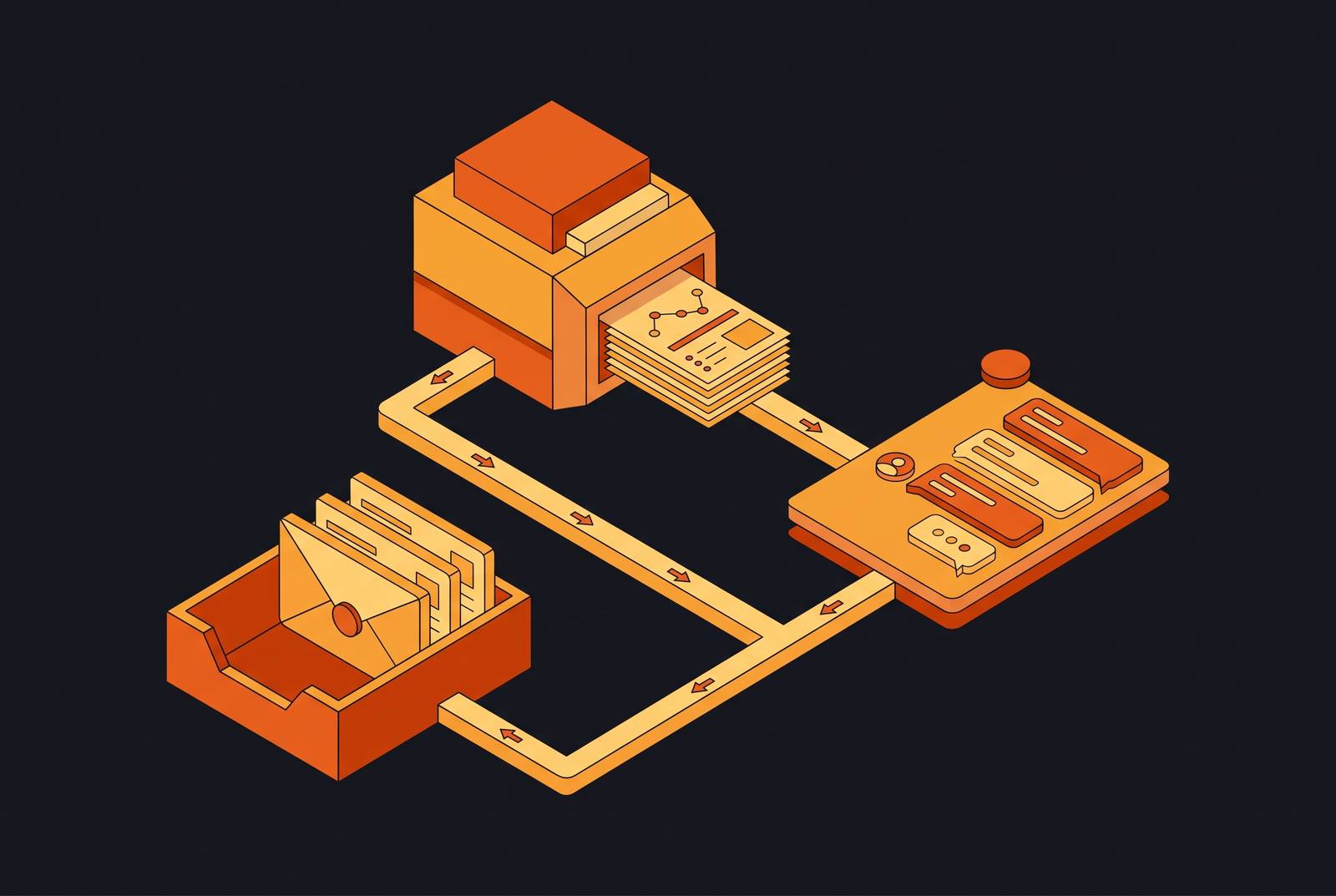
An agent can retrieve the right sources, reason over them correctly, and write a clear, well-structured summary, and still fail when nobody reads it, nobody can act on it, or it never reaches the channel. A message with broken formatting, a send time nobody is awake for, context stripped out during rendering, or a silent failure at the API level produces the same result as a digest that was never generated: a user who learned, correctly, that this particular feed isn't worth checking.
Slack and email as delivery surfaces for machine-generated content
Slack and email are not the same channel wearing different skins. They impose different constraints on message length, they use different threading models, they render content through different engines, they offer different delivery guarantees, and they tie output to different models of recipient identity. These differences are architectural, and they shape what an agent pipeline has to build, not just how the final message looks.
On Slack, a message renders inside a channel or a direct message, and native Markdown support is limited. Threading is a first-class concept on the platform, which cuts both ways: post a digest directly into a channel without threading it, and it can flood the feed and bury the conversation already happening there; post it as a thread reply instead, and it may stay invisible to anyone not already following that thread. Slack's own AI features, channel recaps and thread summaries among them, work on a pull model: you ask for a summary and you get one on demand. An agent-pushed digest works on a push model instead, and because of that, you trust it less and attend to it less before you've even read the content.
Email runs on different rules. HTML rendering varies significantly across Gmail, Outlook, and mobile clients, so a pipeline that emits raw Markdown or unvalidated HTML will produce broken layouts in a meaningful share of inboxes. A digest that lands in a spam folder has failed just as thoroughly as one that was never sent, and the agent has no way of knowing it happened. Email is also asynchronous and persistent in a way Slack isn't: people expect to come back to it, search it, and forward it later, which changes what the right length, structure, and citation density look like compared to a Slack message meant to be read once and scrolled past.
Red Hat's work on multi-channel agent architecture, built for a self-service agent that spans Slack, email, and ServiceNow, states that these channels "have different identity models, delivery semantics, and interaction patterns. You cannot treat them as interchangeable, and you cannot treat them as entirely separate systems with no shared foundation either. Both channels need to feed into one shared layer for normalization and routing, but each one still needs real, non-trivial engineering built on top of it.
Formatting agent output for each channel without degrading the content
The same raw LLM output cannot go straight to both Slack and email.
For Slack, you should post-process LLM output into Block Kit JSON, Slack's structured message format, so it doesn't go out as plain text. Block Kit controls layout directly, removes the ambiguity of how Markdown might render on a given client, and supports interactive elements, buttons and overflow menus, that make human-in-the-loop approval possible. Length matters here too: a digest that reads well as a 1,200-word document is not a Slack message, and the pipeline needs its own length budget tuned to how a channel feed actually gets read, not to how a document gets read. Sections like "Top signals," "Action items," and "Sources" should map onto Block Kit section blocks directly, rather than relying on LLM-generated headers that may or may not render the way the model intended.
For email, output needs to come out as validated HTML, tested against the major clients, because you can't just convert raw Markdown to HTML on the fly. The better pattern uses a template layer, MJML is one example, that the LLM populates with content rather than one where the LLM generates raw HTML itself. Citation handling diverges between the two channels as well. In Slack, citation footnotes that link to internal threads or messages are often more useful to an enterprise reader than an external URL would be.
None of this is cosmetic.
Timing and scheduling digests to match how each channel is used
A digest sent at the wrong time has the same effect as a digest that was never sent.
Slack feels synchronous even though it technically isn't: messages compete directly with live conversation happening in real time, so a digest posted during peak hours is likely to scroll out of view before anyone sees it. Posting during a low-activity window, early morning or a post-lunch lull, gives the digest dwell time near the top of the feed; the scheduler needs to know something about the timezone distribution of the team, not just run on a fixed UTC cron. Slack's API supports scheduled message delivery directly, so the pipeline can queue a message for a future send time without keeping the agent process alive to trigger it, and that's a much more reliable pattern in production than sleep-based scheduling baked into the agent itself.
Email softens this constraint without eliminating it. Event-triggered digests, generated when some data threshold is crossed rather than on a clock, need their own decision layer to judge whether a given digest should go out right away or wait for the next scheduled window, so users don't learn to ignore frequent alerts.
Preserving context across the agent-to-channel boundary
A digest earns its value from the context an agent assembled while retrieving and reasoning over source material, and that context can get stripped out, flattened, or disconnected from the claims it supports by the time a message reaches a channel.
Three failure modes occur repeatedly, starting when multi-step reasoning chains collapse into a flat conclusion: the digest states something correct, but gives the reader no way to see why it's correct, and no way to judge whether to act on it.
In Slack, context preservation is a Block Kit design problem: context blocks, accessory fields, and overflow menus can carry source links, confidence labels, and "view more" affordances without cluttering the primary message. Red Hat's multi-channel architecture routes requests through a shared session and context layer before anything reaches channel-specific rendering, so context stays intact at the system level and each channel adapter doesn't have to reconstruct it on its own.
Freshness itself is part of the context that has to survive. The retrieval timestamp and the data window it covers belong in the output, not just in an internal log.
Building failure handling that makes delivery failures visible and recoverable
Production digest pipelines fail in ways that are specific to each channel, mostly silent, and disproportionately damaging to trust whenever they go undetected, because a pipeline that looks broken gets fixed, while one that looks fine while quietly failing erodes confidence without anyone noticing until much later.
On Slack, rate limits apply per workspace, per API method, and per app, so a pipeline posting to many channels at once can exhaust its rate budget and drop messages with no indication visible to the user on the other end. Even a successful API response only confirms that Slack accepted the message, not that any user saw it, so the pipeline should log that response and page on anything other than a 200 instead of retrying silently and hoping it resolves itself.
Without those signals, a digest pipeline that has quietly stopped working is indistinguishable from the outside from one that's working fine.
Gating delivery on human approval
If you send agent-generated digests to a broad audience before the system has proven it produces reliable output, you put organizational trust at risk in a way that's hard to recover from, but good architecture can manage that risk while you still keep the value of automation. The practical starting point is narrow: route the digest to a single human reviewer for an initial validation window, long enough to calibrate false positives and tone problems, before broadcast delivery gets switched on. You make that architectural decision at design time, not as a cautious habit added later.
Approval gates look different on each channel. Slack's Block Kit supports interactive approval buttons natively, so a digest can post to a private review channel with "Send" and "Edit" actions that trigger delivery or kick off a revision loop without the reviewer ever leaving the platform. Email has no equivalent built in: an unsent draft doesn't support interactive approval on its own, so the pipeline needs a separate mechanism, a review interface, a confirmation link, or a Slack-based approval step that gates the email send from outside.
The approval gate does more than check quality. Every reviewer action, approve, reject, edit before sending, generates a signal the pipeline can use to improve retrieval relevance and formatting over time, which makes it a learning surface as much as a safeguard. Enterprise governance requirements may also demand a durable audit trail independent of whether the reviewer actually read the content closely: who approved it, when, and which version got approved all need to be logged.
That gate is only as useful as what it shows the reviewer. If a reviewer sees nothing but the formatted output, they have no way to judge whether the claim behind it holds up, but if they see the sources and retrieval metadata preserved through the context layer described above, they can make a real judgment call. Red Hat's multi-channel design keeps this in mind by holding agent logic, intent, policy, workflow orchestration, separate from channel transport, which puts the approval gate in the orchestration layer where it belongs, rather than bolted onto an individual channel adapter as an afterthought.
A unified channel architecture that keeps agent logic separate from delivery mechanics
Teams that build digest delivery ad hoc tend to hit the same failure pattern: agent logic gets duplicated per channel, the Slack pipeline and the email pipeline drift apart over time, context handling starts to diverge between them, and failure modes multiply independently.
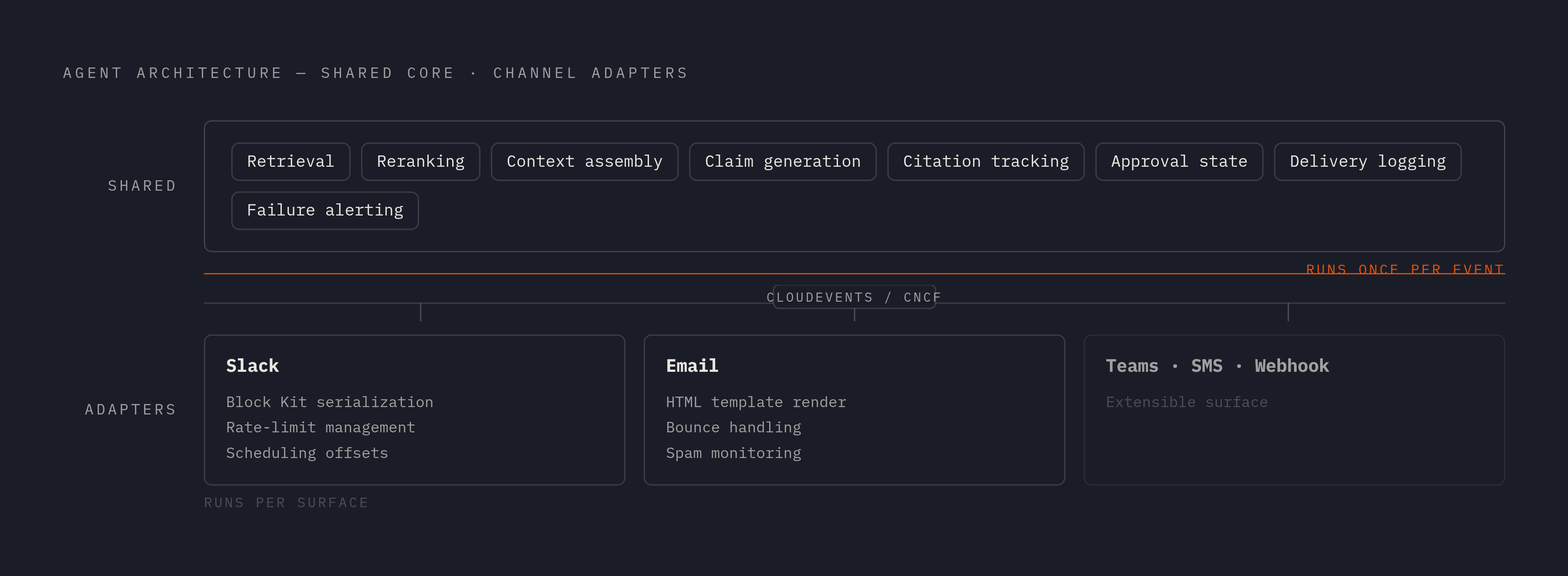
The fix is a clear architectural boundary. A shared normalization and session layer handles request routing, context management, and agent orchestration in one place, while channel adapters are responsible only for transport-specific formatting and delivery mechanics. Red Hat's self-service agent architecture makes this split explicit: once a request is normalized and tied to a user session, "the rest of the system treats it the same way regardless of where it came from." The agent logic runs once. The channel adapter runs per surface.
Retrieval, reranking, context assembly, claim generation, citation tracking, approval state, delivery status logging, and failure alerting all belong in the shared layer. Block Kit serialization for Slack, HTML template rendering for email, API authentication, rate-limit management, bounce handling, and channel-specific scheduling offsets belong in the adapter. Adding a new channel, Teams, SMS, a webhook, under this design means writing a new adapter, and that extensibility is a direct result of keeping the boundary clean.
Connecting the shared core to each adapter through an event-driven layer, using a vendor-neutral event specification such as CloudEvents, a CNCF standard, or an equivalent, gives the system the durability and decoupling that real production volume demands. Freshness logic belongs in the shared layer too: the retrieval and grounding work that keeps a digest reflecting current information runs once, and its outputs, including retrieval timestamps and source metadata, pass to every channel adapter as structured fields rather than getting regenerated separately for each channel.
Requirements for a production-ready digest pipeline's web knowledge layer
A pipeline can get every delivery decision right, formatting, timing, context preservation, failure handling, approval gates, and still reliably deliver content that's stale or wrong, because none of those decisions touch what the agent retrieved. Get the delivery layer right while the retrieval layer stays weak, and the failure just moves upstream: delivery works perfectly, and the content arriving through it is the problem.
Whether a digest is worth delivering at all comes down to three retrieval requirements. Freshness comes first: digest agents need live web retrieval, not static indexed data, because a model's training knowledge can't substitute for current information in anything time-sensitive, and the gap between a model's training cutoff and the moment a digest gets sent is a systematic hallucination risk. Context-readiness comes second: raw HTML, heavily scripted pages, and documents full of boilerplate degrade an agent's reasoning quality even when the right information is sitting somewhere inside them, so the retrieval layer needs to hand the agent clean, structured, machine-readable content rather than raw web output the agent has to pre-process itself. Reliability under load comes third: a pipeline running on a schedule or triggered by events needs a retrieval layer with predictable latency and real availability, because a retrieval timeout an agent can shrug off gracefully in a demo becomes a systematic gap in a digest running in production.
The grounding quality of retrieved content sets the ceiling for how faithful the digest can be. If an agent works from clean, relevance-ranked, well-retrieved content, it can produce something grounded and citable. An agent working from shallow or noisy retrieval will hallucinate with just as much confidence, and the delivery architecture described throughout this piece will carry that hallucination reliably to every channel it's built to reach. Delivery architecture decides whether a good digest reaches its audience. Retrieval architecture decides whether the digest was good to begin with. Neither one substitutes for the other, and a production pipeline needs both built as first-class engineering concerns from the start.