Freshness Guarantees and Index Lag in Web Retrieval APIs
Stale search indexes make AI systems confidently wrong instead of cautiously uncertain.

Freshness in a web retrieval system is a structural property of how the underlying index gets built and kept current, and the quality of that property shapes whether an AI system reasons reliably about anything time-sensitive or hallucinates with more confidence than it would otherwise. Consider a model asked about a current interest rate. If it retrieves an outdated figure from a stale index, it does not pause to flag the discrepancy between what it found and what might have changed since. It reasons forward from that number as though it were current, and the output arrives polished, specific, and wrong. A model operating with no retrieval at all, by contrast, can at least signal uncertainty or decline to answer past its training cutoff. Stale retrieval removes that safety valve entirely, because the model believes it has done its job.
Retrieval-augmented generation exists to reduce hallucination, and it does so substantially when the retrieved content is actually current. But a RAG pipeline pulling from a stale index does not fail safely. It inherits the exact failure mode it was built to eliminate, now dressed in the credibility of citations, source URLs, and retrieved passages that look like evidence. The infrastructure around the model has grown more elaborate while the underlying reliability problem has stayed exactly where it started. In finance, healthcare, and legal contexts, that gap stops being a matter of user experience. A confidently wrong citation backed by a stale source in a FINRA-regulated advisory workflow or a clinical documentation tool carries regulatory exposure, not just an annoyed user. Freshness, in other words, belongs on the same list of engineering priorities as uptime and latency, not somewhere below them.
How a Web Retrieval Index Works
Index lag is an inherent consequence of how crawl-based indexes operate, because a crawler has to discover a page, fetch it, and store it on some schedule before any downstream system can do anything with it. Only after that storage step does a ranking and extraction layer process the content into a form usable by a model, and only after that does a query actually return it. Every one of those stages sits between the moment a page is published and the moment an AI system can retrieve it, and every one of them adds time.
The pipeline breaks down into distinct stages, each contributing its own share of delay: crawl scheduling determines how often a crawler revisits a given URL, crawl prioritization determines which URLs get revisited first when crawling resources are finite, content extraction and cleaning turns raw HTML into usable text, embedding or indexing makes that text searchable, and query-time retrieval finally serves it. Traditional search APIs return titles, links, and snippets. An agent needing the full page still has to issue a separate fetch request. AI-native search APIs attempt to collapse that gap by maintaining their own indexes or retrieval pipelines, delivering extracted Markdown or relevance-scored chunks, sometimes in a single request that handles both search and extraction. But the freshness of whatever content comes back is set by the crawl infrastructure underneath the API, not by how convenient the API's interface happens to be.
That creates a structural tension with no easy resolution. Search systems built for speed give an agent access to live results, but not necessarily to the full pages those results point to. Indexes built to surface page content quickly carry the opposite risk: the corpus behind them can be stale or incomplete even as the retrieval call itself feels instantaneous. No architectural position maximizes both simultaneously without a pipeline purpose-built to do so. Freshness, too, only solves half the problem, because raw HTML is not content an LLM can reason over efficiently. Web pages run 60 to 80 percent boilerplate, navigation bars, ads, cookie banners, none of which answers a query. A page that was crawled an hour ago but extracted poorly fails the model just as surely as a page that was crawled a year ago. Index-based APIs that own the entire chain, crawling through ranking through extraction, can tune every stage for AI consumption specifically. Systems built by wrapping a third party's existing service inherit that provider's freshness ceiling and extraction choices, whatever they happen to be.
Why AI agents amplify index lag
A single-query system asks one question and returns one answer, so whatever lag sits in the index gets experienced exactly once. Agents do not work that way. They retrieve repeatedly, reason over whatever evidence accumulates across those retrievals, adapt their queries as new information comes in, and do all of it inside a latency budget the user can feel. Every property of the retrieval layer, freshness included, gets experienced as many times as the agent chooses to call it, and an agent in the middle of a multi-step task can call it quite a few times.
Latency compounds the way interest compounds, which is to say it does not stay linear for long. An agent running six sequential lookups does not experience a two-second delay once. It experiences two seconds, six times, in sequence, while whoever is waiting on the output watches the clock. Stale results make this worse directly, because a result that conflicts with what the agent already believes often triggers a follow-up lookup to resolve the discrepancy, adding a seventh hop where six would have sufficed. Token cost compounds alongside latency: agentic workflows already consume far more tokens than a single LLM call, and when stale results force the agent to re-query or reconcile conflicting evidence, that cost rises further without the answer getting any better for it.
A production system built at LinkedIn, described in a 2026 paper, addresses this by treating retrieval not as a fixed step that happens before reasoning but as a tool the agent can invoke from inside its own reasoning loop, deciding for itself when to retrieve and how to phrase the query. That design choice shifts the cost of stale results away from whoever built the pipeline and onto the model's own reasoning budget, where the agent at least has a chance to notice a conflict and compensate for it. But it is a mitigation, not a cure. The index underneath an agentic system has to be built differently from an index serving one-shot queries, because an agent will find every weak seam in a corpus that a single query would have simply missed.
Batch re-indexing versus streaming re-indexing
The dominant shift underway in retrieval infrastructure is a move away from batch re-indexing, where a system re-embeds its entire document corpus on a nightly or hourly schedule, toward streaming re-indexing, where only documents that actually changed get re-embedded as soon as they change. The distinction sounds like an implementation detail. It determines the freshness ceiling of the entire system.
Batch re-indexing builds a predictable gap directly into the architecture. A nightly run means a page published at 12:01 AM may not become retrievable until the following night's cycle completes, and no amount of speeding up the embedding model itself closes that gap, because the gap comes from the schedule, not the computation. Streaming approaches close it by design. ComRAG illustrates the pattern with its dynamic vector store architecture, which manages historical question-and-answer pairs across high- and low-quality vector stores through a centroid-based memory mechanism during an update phase, keeping retrieval quality current over time-sensitive community content without waiting on a full re-index cycle. LinkedIn's ETL pipeline enforces a related discipline through a snapshot pointer: each refresh scopes retrieval to the latest snapshot and supersedes whatever came before it without deleting the prior content outright, which keeps stale documents from lingering in the index while preserving continuity for anything still relying on the older snapshot.
Streaming re-indexing is the more efficient option: re-embedding only what changed costs a fraction of re-embedding an entire corpus every night on a fixed schedule. That makes freshness cheaper to maintain at scale rather than more expensive, which inverts the usual assumption that tighter freshness has to mean higher cost. A RAG system left on a batch schedule without continuous maintenance drifts back toward the same stale-knowledge problem it was built to solve in the first place, just with a more elaborate pipeline sitting on top of it.
Setting freshness windows to match a domain's risk profile
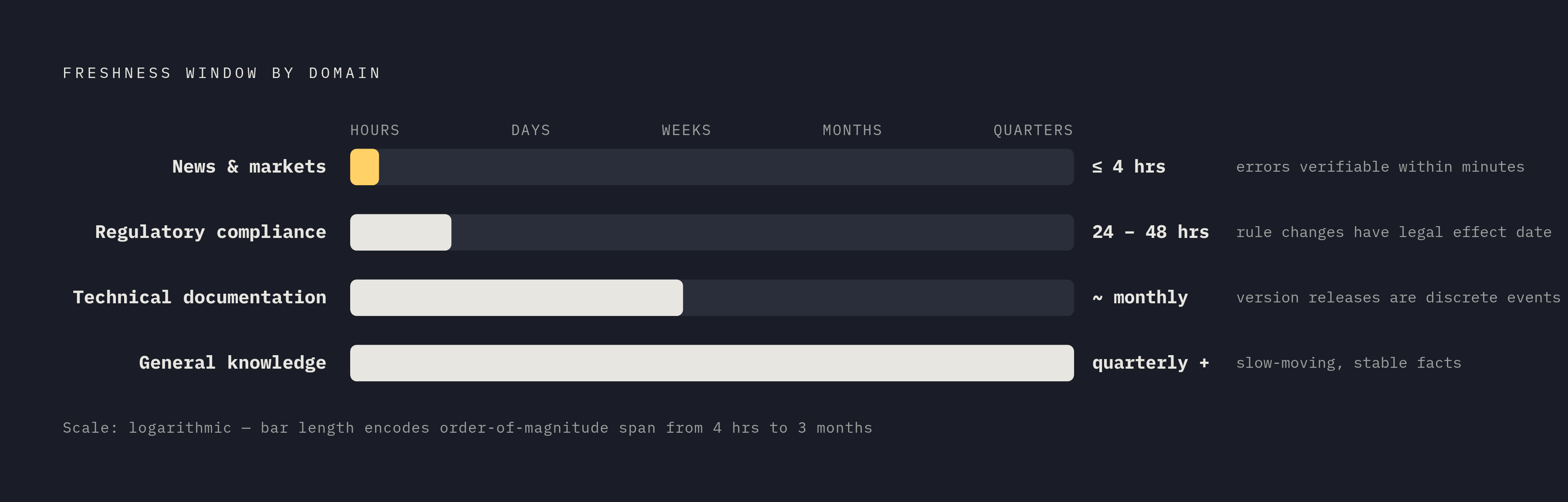
Freshness windows do more than control infrastructure cost. Stale results conflict with what a model already learned during training, and that conflict produces confident, synthesized answers that are wrong in ways neither the model nor the user can easily detect, so tightening a freshness window reduces hallucination risk directly rather than simply making retrieval feel more current. The quality effect and the cost effect of a freshness window setting pull against each other, and any configuration decision has to weigh both. News and market monitoring applications need windows of four hours or less, because content in that domain changes within the publication cycle itself and anything stale produces errors a reader can verify within minutes. Regulatory compliance work can tolerate 24 to 48 hours, since rules and filings tend to update on business-day cycles, though even a two-day lag can matter inside an audit. Technical documentation can run on a roughly monthly window, because version releases happen as discrete events and a daily re-crawl adds cost without adding proportional freshness. General knowledge content, where the training data and the live web mostly agree, can sit on a quarterly window or longer without meaningful risk.
Wider windows draw from a larger cached index and cost less per call, while narrow windows demand either live crawling or high-frequency re-indexing, both of which raise per-query cost. The sensible default reserves tight windows for the use cases where recency is a functional requirement of the task, not a blanket setting applied everywhere out of caution. Citation integrity follows directly from how freshness gets configured at the metadata level: source URLs and publication dates should travel as structured metadata fields alongside the retrieved text, never folded into the prose itself, because that structure forces the model to treat them as verifiable external references instead of generating citations from pattern memory the way it might fabricate a plausible-looking source. In regulated sectors, this stops being a stylistic preference. An unverifiable citation in a finance workflow governed by the SEC or FINRA, or a healthcare workflow touching FDA or HIPAA-adjacent processes, constitutes a compliance violation on its own terms. Freshness window configuration, in those domains, functions as compliance engineering, not as a tuning knob left to engineering taste.
What context engineering adds on top of freshness
A fresh index solves one problem and leaves another standing. Content retrieved the moment it was published still fails the model if it arrives in raw or poorly structured form, because web pages run 60 to 80 percent boilerplate, and an LLM spending its context budget on navigation menus and cookie banners has that much less capacity left to reason over the signal buried inside the noise. Freshness governs whether the right page gets retrieved, and context engineering governs whether the model can actually use it once it arrives.
Ranking built for human browsers optimizes for a different target than ranking built for a model. PageRank and keyword frequency were designed to predict what a person would click. LLM search APIs instead need semantic relevance scoring tuned to what answers a given query. The ranking model itself has to be built around AI consumption rather than retrofitted from a system designed for search engine results pages. The output format carries equal weight as a design decision. A traditional pipeline strings together search, scrape, parse, and chunk before an LLM ever sees the content, and each of those steps is its own point of failure and its own source of added latency. An API built for AI consumption collapses that chain into a single call that delivers pre-extracted text in Markdown chunks, removing intermediate steps.
Microsoft's Web IQ launch in June 2026 shows what this kind of re-architecture looks like at the scale of a hyperscaler. Microsoft stated that the system required re-architecting "from the ground up from indexing and retrieval to ranking, passage selection, and orchestration so every layer is aligned around the needs of inference-time grounding," and the company claims sub-second end-to-end grounding with 164ms P95 latency tuned specifically for multi-step agent chains. That a company with Microsoft's existing search infrastructure treated this as a ground-up rebuild rather than a filter bolted onto an existing index says something about how seriously context engineering needs to be taken as its own discipline. Better context shaping also pays for itself in token efficiency: prioritizing the passages that actually answer the query and trimming what doesn't cuts the tokens spent per call, and that saving compounds across the volume of calls a production agentic workload generates.
The strongest objection to investing in any of this holds that a sufficiently capable model will simply extract what it needs from noisy input on its own. That argument breaks down inside a multi-hop agent loop, where noise introduced at the first hop propagates into the second hop as false signal. The model's reasoning capacity gets spent disambiguating what it was given instead of advancing the task, and whatever error that process introduces compounds at every hop that follows.
Why owning the full data pipeline makes freshness guarantees credible
A freshness guarantee is only as reliable as the weakest stage in the pipeline that produces it. A retrieval API built on top of a third-party index can promise whatever freshness figure it wants in its contract, but the actual freshness experienced by a user is set by that upstream provider's crawl schedule and extraction quality, not by the promise layered on top of it. A contractual guarantee cannot outrun the infrastructure underneath it.
End-to-end ownership of the pipeline, crawl scheduling, crawl prioritization, content extraction, embedding, ranking, and delivery, gives a provider the ability to observe, audit, and tune each of those stages independently rather than accepting whatever tradeoffs an upstream vendor already made. A system stitched together from third-party services inherits every one of those tradeoffs without visibility into how they were made or whether they can be changed. That is the structural reason freshness, examined closely, turns out to be less a feature than an architecture, and why the credibility of any freshness guarantee rests on how much of the pipeline behind it a provider actually controls.