Tool-Call Retry Logic and Backoff Strategies for Agents
How agents fail silently and what retry logic must account for.
Traditional software fails loudly. An unhandled exception throws a stack trace, a server returns a 500, a process crashes and gets logged. Those are signals built to be caught. AI agents fail differently, and the failure mode that matters most doesn't announce itself: it arrives dressed as success. This piece is about what a retry stack has to account for once "the call returned 200" stops meaning "the call worked."
An LLM API call fails outright somewhere around 1 to 5 percent of the time, mostly rate limits, timeouts, and server errors. Those are the easy ones. A valid HTTP 200 and a confident-sounding response can still be wrong, incomplete, or have already caused a side effect the agent doesn't know about, which is what makes these failures dangerous. A CRM record gets created three times because a retry fired on a write that had actually succeeded, just slowly. No exception. No error in the log. Just three records where there should be one, and nobody notices until billing or sales ops does.
Deterministic code never had to worry about a response that's partially there. Agents do, constantly. A model can truncate mid-reasoning and hand back half a plan. A context window can silently drop tool output because the conversation got too long, and nothing errors, the agent just proceeds with less information than it thinks it has. A model can go unavailable and return something structurally valid, like an empty JSON object that parses fine and means nothing. And tool calls routinely produce side effects, an email sent, a charge made, before the agent ever gets confirmation back. The action already happened in the world. The agent just doesn't know it yet.
Scale is what turns this from an annoyance into an operating risk. A production agent can make hundreds of tool calls across one task. At that volume, the question is no longer whether something fails but what the agent does the moment it does. A NeurIPS study (MAST), built on annotated execution traces and validated against a larger corpus totaling over 1,600, found multi-agent systems fail on real tasks somewhere between 41 and 86 percent of the time. That's not an edge case. That's closer to the median outcome.
None of this gets fixed by a better model. The gap between an agent that's fragile and one that holds up in production is the recovery layer wrapped around every action it takes, not the intelligence of the action itself.
Failure Compounding Across a Long Agent Chain and Its Implications for Recovery
Every tool call in a chain carries its own probability of failure, and those probabilities multiply across steps. That compounding matters more than people think, because a 99 percent success rate sounds close enough to certain that nobody bothers to do the arithmetic.
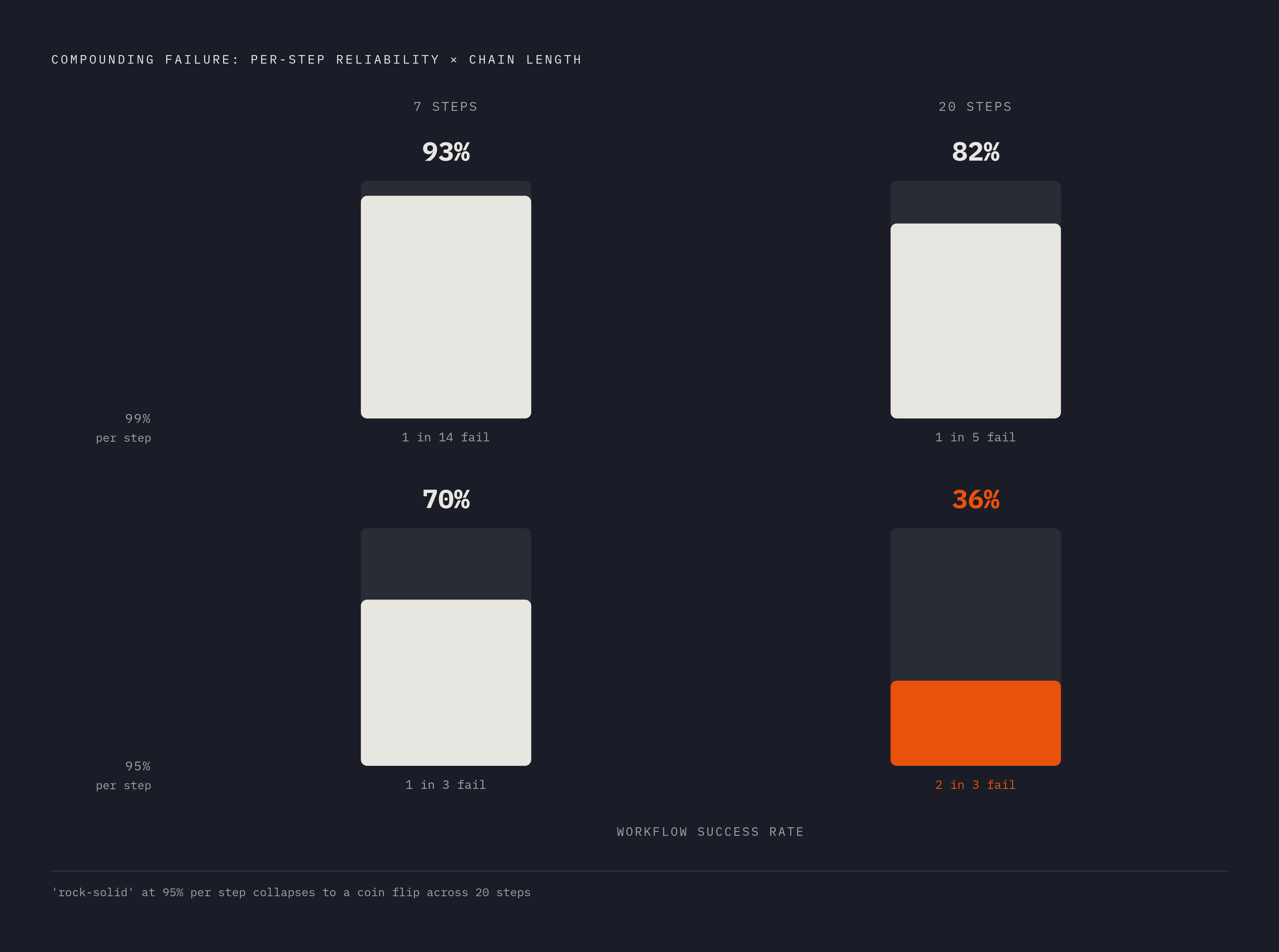
Do it anyway. At 99 percent reliability per step, seven steps in a row still succeed about 93 percent of the time, so roughly 1 in 14 tasks fails. Stretch that same 99 percent reliability to 20 steps and success drops to around 82 percent, or 1 in 5 tasks failing. Drop reliability to 95 percent per step, a number plenty of real tool integrations don't even hit, and seven steps get you to roughly 70 percent success, about 1 in 3 tasks failing. Pushing that to 20 steps collapses success to around 36 percent: two out of three tasks fail before they finish.
A tool that looks rock-solid in a five-step demo becomes a coin flip once it's embedded in a twenty-step production workflow. Recovery logic is the thing holding the system up. It's the thing holding the system up.
The MAST taxonomy also makes a claim: these failures aren't random noise. They cluster into 14 distinct modes across three root categories. Specification issues, where the agent misunderstood or was given an ambiguous task, account for about 42 percent. Inter-agent coordination breakdowns, where agents miscommunicate or duplicate or contradict each other's work, account for about 37 percent. Weak verification of outputs, where nothing checks whether a result was actually correct before moving on, accounts for the remaining 21 percent.
That's the useful part. Agents don't fail in an infinite number of unique, unpredictable ways. Failure is systematic. And if failure is systematic, recovery can be built systematically too, tuned to the failure type rather than applied as one blanket retry rule slapped over everything.
The failure classification decision that every other retry choice depends on
Before an agent decides how to recover, it has to answer one question correctly: what kind of error is this? Get that wrong and one of two bad things happens. Either the agent keeps retrying something that will never succeed no matter how many attempts it gets, or it gives up on something that would have cleared itself in 200 milliseconds.
Two axes matter here. The first is transient versus permanent. Network timeouts, a 503 from an overloaded server, a 504 gateway timeout, and a 429 rate limit are transient failures, and those are the ones worth retrying. A 400 for bad input, a 401 for failed authentication, and a 403 for an authorization problem the agent doesn't have permission to fix by trying again are permanent failures, and retrying only makes those worse. Retrying those wastes cycles at best and triggers account lockouts at worst.
The second axis, and the one that matters more for agents specifically, is idempotent versus non-idempotent. Reads, lookups, and queries are idempotent: running the same call twice produces the same result, so retrying is free. Writes are not. Payments, emails, CRM record creation, booking confirmations, anything that changes state outside the agent's own head, carries risk on every repeat. This is one of the most consequential distinctions in agentic system design, and it's also the one most retry logic borrowed wholesale from traditional web services simply ignores, because traditional web services didn't usually let a language model decide when to fire the retry.
There's a third category that sits outside retry logic entirely: critical failures. Budget overruns, destructive or irreversible actions, anything where a wrong guess can't be undone. Those don't get retried. They get escalated, immediately, to a human or a higher-authority process.
For anything ambiguous, the safe default is to treat it as non-idempotent until proven otherwise. If the action changes something outside the agent's internal reasoning, sends a message, raises an invoice, moves money, assume repetition creates a side effect and gate the retry accordingly. Classifying failures this way up front isn't just about correctness. It also cuts wasted retries, which is a resource and cost question as much as a reliability one.
Exponential backoff with jitter: the baseline pattern for transient, idempotent failures
Once a failure is confirmed transient and the call is confirmed idempotent, exponential backoff with jitter is the correct default. Not a nice-to-have, the baseline.
Mechanically, it's simple. Pick a base delay, something like 1 to 2 seconds. Double it with each subsequent attempt. Add a random jitter value on top of every interval, so the wait time looks like base delay times two to the power of the attempt number, plus some random amount up to a jitter ceiling. The delay is capped at a maximum, and retries stop after a maximum number of attempts.
The jitter part is not decoration. Without it, every client hitting the same outage backs off on the identical schedule and then retries at the identical moment, a thundering herd slamming back into a service that was just starting to recover. AWS research on distributed systems has found that adding jitter to exponential backoff cuts retry storms by 60 to 80 percent. That's the difference between a service recovering in seconds and a service getting re-flattened by its own clients every time it comes back up.
In Python, the Tenacity library provides exponential backoff utilities that can be combined with jitter to handle this pattern, and a workable schedule for something like an LLM provider call might look like 2 seconds, then 5, then 12, shaped to whatever rate limits the provider enforces and how urgent the workflow actually is.
Two things get conflated constantly here, and they shouldn't be. Maximum attempt count, say 5 retries, tells you nothing about time. Five attempts spaced a second apart is a different animal than five attempts spread across ten minutes. What actually matters is the retry budget, the total time the workflow can afford to spend retrying. A customer-facing agent with a 30-second deadline and a background reconciliation job with several minutes to spare might both be configured for 5 retries, and that number would mean something completely different in each case.
Backoff with jitter also doesn't solve the multi-agent version of the thundering herd, where several agents independently react to the same outage by launching their own parallel retry streams. Worse, an agent doesn't just retry, it might also fire off a follow-up search, try an alternative tool, or kick off a fresh planning loop when a result doesn't come back the way it expected. Every one of those costs tokens and time on top of the retry itself. Backoff alone can't stop that. Circuit breaking can, and that's further down this list.
Idempotency keys and durable state: what separates a safe retry from a duplicate charge
Here's the sharper version of the problem: for a non-idempotent call, a well-timed, well-jittered retry can still be dangerous, because the agent has no way of knowing whether the first attempt already succeeded before its response got lost in transit.
The pattern that's held up across teams running agents in production is to attach an idempotency key to every tool call that produces a side effect, derived from durable workflow state rather than generated fresh on each attempt. That key lets the receiving service recognize a duplicate and return the original result instead of executing the action a second time. On the agent's side, it means persisting step results somewhere durable, so that if the process restarts, the agent can reconstruct what already ran and what's still outstanding, instead of guessing.
Skipping this has a real cost attached to it. One overnight image generation agent hit a flaky image API, and the workflow replayed entirely from scratch rather than resuming where it left off, because there was no checkpoint to resume from. The bill came to $700. The infrastructure's own self-healing behavior, meant to help, made the failure worse by repeating the whole job instead of picking up from the last good state.
The fix is idempotent checkpointing: persist state after every completed step, so a restart resumes instead of replaying. One failed branch shouldn't be able to drag the entire workflow back to zero. Where a step has downstream dependencies, the saga pattern applies: a compensating transaction should exist for that step, so that if something later in the chain fails, the system knows how to undo what came before rather than leaving half-finished state hanging around.
The classification work from earlier becomes infrastructure here, not just theory. Knowing a call is non-idempotent only matters if there's a durable mechanism that acts on that knowledge at runtime. A call which reads live content, a search, a document fetch, a retrieval step, is generally idempotent since it doesn't write anything. But checkpointing the result still pays off, because a mid-workflow failure shouldn't force the agent to redo retrieval work it already completed successfully.
Circuit breakers: stopping the retry loop before it becomes a platform-wide problem
Backoff protects one caller against one failing request. It doesn't protect the system from a dependency that's genuinely down and getting hammered by every agent that depends on it. A circuit breaker makes a collective judgment about whether a dependency is healthy, applied across all requests, not just the one currently in flight.
The pattern has three states, borrowed directly from microservices architecture and now standard in agent systems too. CLOSED is normal operation, requests go through and the system tracks the failure rate quietly in the background. OPEN means the breaker has decided the dependency is unhealthy, so it fails every request immediately without sending it, which gives the downstream service room to recover and gives the agent an instant, clean signal instead of a slow timeout. HALF-OPEN is the recovery test, after a cooldown one probe request goes through, and if it succeeds the circuit closes again, if it fails it reopens and the cooldown restarts.
The math on why this matters at scale is not subtle. At 500 jobs per minute, three extra retry attempts per job adds up to 15,000 avoidable calls in just ten minutes. Without a breaker in place, a single 500 error from one dependency can send an agent into what is functionally an infinite retry loop, burning tokens the entire time. An agent that says "couldn't access that tool" is a far better outcome than one that fails silently or quietly runs up an unbounded bill.
This has moved beyond a reliability nicety into something regulators and analysts are naming directly. Gartner, in May 2026, stated that when agents operate autonomously at a scale and speed that outpaces human oversight, governance requires circuit breakers that halt agent operation on threshold violations. That's a governance requirement, stated as such, not a suggestion for cleaner engineering.
The circuit breaker described here is an operational resilience mechanism, a system-level control managing agent behavior when a component fails or degrades. That's reliability engineering. There's a separate, unrelated body of work using the same term, model-level circuit breakers, as described in Zou et al.'s 2024 paper on improving alignment and robustness, which operate during inference to interrupt harmful model outputs by manipulating internal representations. That's safety alignment, a different discipline solving a different problem, and the shared name is coincidence more than kinship.
The absence of an operational circuit breaker has a dollar figure attached to it. On April 29, 2026, a developer's nightly pipeline entered a retry loop around 11 PM and kept running until 7 AM, generating thousands of identical tool calls, every one of them failing, every one of them billed. The total came to $437. No alert fired. No threshold tripped. Nothing stopped it until a human found it in the morning, and fixing it took twenty minutes.
A circuit breaker only works if there's something meaningful for the agent to do once the breaker trips. Declaring a dependency unavailable and then having the agent hang or crash anyway defeats the purpose. The fallback path has to be designed in, not assumed.
Timeout architecture: the three layers most implementations leave incomplete
Most guides on this subject stop at one timeout, the per-request kind, how long a single call is allowed to run before it's abandoned. That's necessary but nowhere near sufficient for an agent. There are three layers, and they need to work together rather than in isolation.
The first is the per-tool timeout: how long any single tool call gets before it's cut off and classified as a failure. The second is the per-step timeout: how long the agent can spend on one reasoning step overall, tool calls included, before the orchestration layer steps in and forces a decision. The third, and the one most often missing entirely, is the hard workflow-level deadline: a ceiling on the entire task, one that no individual step or retry is allowed to breach. Once that ceiling is hit, the workflow stops, whatever state exists gets saved, and the result comes back either partial or gets escalated to a human.
That third layer matters most precisely because it's the only one that catches a failure mode the other two structurally cannot see: a loop that never breaks any individual step's limit. One production case makes this concrete. Agent A requested data from Agent B, which called Agent C, which called back to Agent A, and the loop kept going. No single agent ever exceeded its own step timeout, because each individual hop was fast and reasonable on its own. The loop existed in the space between agents, invisible to any per-agent limit. The runaway loop ran up a substantial bill before anyone caught it. The fix wasn't a smarter per-agent timeout, it was a session-level budget tracking total spend across every agent in the workflow combined, not agent by agent.
This connects directly back to the MAST finding that inter-agent coordination breakdowns account for 37 percent of failures. Workflow-level timeout architecture is the structural answer to that entire category, not a patch on top of it.
None of these numbers are universal, either. A customer-facing agent working against a 30-second deadline needs aggressive per-tool timeouts measured in low single-digit seconds. A background reconciliation job might reasonably get several minutes per tool call. Both the maximum attempt count and the retry budget need to reflect what the workflow actually promises to the person or system waiting on it, not a default copied from a tutorial.
A timeout that fires without saving state first is worse than no timeout at all, because it throws away completed work along with the failed portion, forcing a full restart on the next attempt instead of a resumption from the last known good checkpoint.