Knowledge Cutoff Gaps and Live Web Grounding for Time-Sensitive Queries
Models confidently hallucinate answers about facts beyond their training window.

A model's published knowledge cutoff tells you when its training data stopped. It does not tell you what the model actually remembers about any given product, policy, or event inside that window, and the distance between those two facts is where time-sensitive AI deployments fail. The model was not ignorant. It was confidently, articulately wrong, and that distinction matters more to anyone deploying these systems than the cutoff date printed on any model card.
Why the knowledge cutoff date printed on a model card does not tell you what the model knows
A knowledge cutoff marks the date after which no new information entered training, but a fact's presence somewhere in a training corpus and a model's ability to reliably retrieve that fact are two separate properties. The gap between the two is now documented, not theoretical. That is not a small margin of error: it is the gap between a model believing it knows a product cold and a model actually holding reliable information about where that product stood eight months later.
The failure pattern compounds once you look past a single data point. Across Dev Proxy tasks spanning many versions, there was no clean degradation curve where correct answers tapered off as the questions moved closer to the cutoff. Correct answers and outright failures appeared scattered throughout the product's version history, with no identifiable transition point separating "known" from "unknown". The same held true for SPFx: across a large set of tasks spanning many versions, passes and failures distributed without any consistent boundary. If cutoff dates mapped cleanly onto recall, you would expect accuracy to decay as questions approached the boundary, but it doesn't. Instead, the model answered some tasks involving Dev Proxy 2.3.4, 3.0.0, and 3.1.0, released April 23, May 28, and July 1 of 2026 respectively, all well past the official cutoff, apparently by inferring plausible answers from adjacent patterns in training rather than from any direct exposure to those versions. The model wasn't recalling. It was pattern-matching convincingly enough to pass, which is a different capability with a different failure mode, and a far less predictable one.
How cutoff dates vary across the model landscape
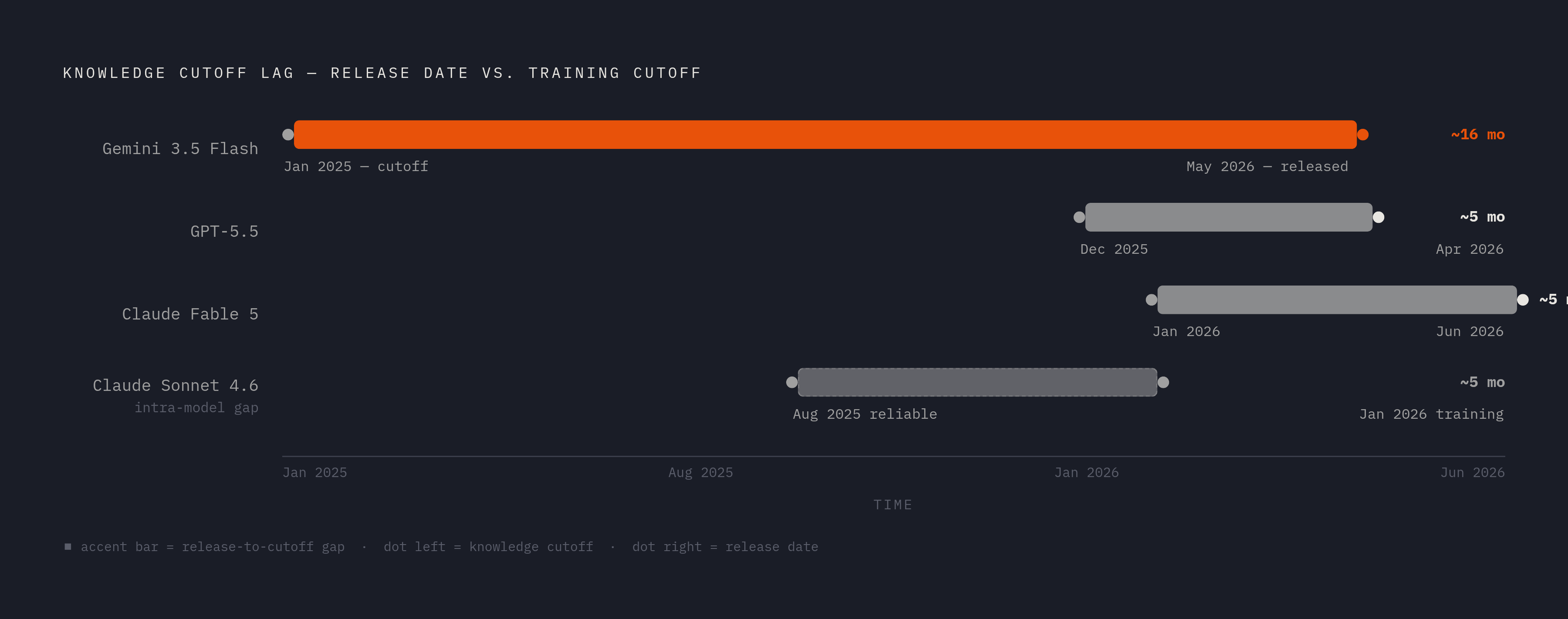
This divergence between stated cutoff and actual recall is not confined to one model or one lab; it is systemic, and it compounds with a second, separate problem: release date tells you almost nothing about how fresh a model's training data actually is. Gemini 3.5 Flash released on May 19, 2026, yet carries a knowledge cutoff of January 2025 according to official Google documentation, a gap of well over a year between shipping date and the last day the model learned anything new. Compare that to GPT-5.5, released April 23, 2026 with a cutoff of December 1, 2025, or Claude Fable 5, released June 9, 2026 with a reliable cutoff of January 2026. The gap between release and cutoff swings from a few months to well over a year depending entirely on which provider and which model line you're looking at, with no consistent industry convention a developer can rely on as a shortcut.
Self-reporting makes the problem worse. Qwen's maintainers have stated that a model's own claims about its cutoff date are unreliable, because models are not trained to accurately identify themselves or their own training boundaries. Third-party aggregation adds a further layer of distortion: the same fact-check that confirmed Gemini 3.5 Flash's January 2025 cutoff also found third-party blogs reporting January 2026 instead, a full year off from what Google's own documentation states. A developer who trusts a blog post instead of primary documentation inherits an error before writing a single line of code.
Anthropic is the one provider that has built transparency around this gap directly into its documentation, distinguishing a "reliable knowledge cutoff" from a broader "training data cutoff." Claude Sonnet 4.6, for instance, carries a training data cutoff of January 2026 but a reliable cutoff of August 2025 under Anthropic's platform documentation, though the Anthropic Transparency Hub separately lists a single May 2025 cutoff for the same model, which shows that even the most transparent provider has not fully reconciled its own public figures. The practical consequence for anyone building on these models is straightforward: reading a release date and assuming freshness is a mistake, and trusting a model's self-reported cutoff is a second, compounding mistake. Both signals are unreliable, and both are the signals most developers reach for first.
Query categories most damaged by the cutoff-to-recall gap
The cutoff-to-recall gap does not harm all queries equally. It concentrates in a handful of categories where facts shift on a timescale shorter than a model's retraining cycle, and where a confident wrong answer carries real cost.
Product and API knowledge sits at the center of the problem, and the Dev Proxy experiment is the clearest illustration available: a model can know a product's general architecture and common usage patterns well enough to construct a plausible, well-formed answer while still missing the one specific fact, a renamed executable, a removed feature, that the task actually depends on. Pricing and commercial terms carry the same risk in a commercial setting. A model trained before a price change or a policy update will state the old figure with full confidence, because nothing in its internal representation marks that figure as stale. Air Canada's chatbot told a customer about a refund policy that did not exist, an ungrounded generation delivered with no check against the airline's actual current terms.
Legal and regulatory work raises the stakes further. A New York attorney was fined after filing a legal brief containing case citations fabricated by an AI system. The mechanism behind that failure is the same one that defines the knowledge cutoff itself: anything that happened after the boundary is either honestly absent from the model or hallucinated into something that sounds plausible, and from the outside, those two failure modes are indistinguishable. Fast-moving technical domains carry a quieter version of the same risk. A model trained before a major library release, a framework deprecation, or a security advisory will deliver outdated guidance with exactly the same fluency it would use for current, accurate guidance.
Agentic workflows turn this from an accuracy problem into an operational one. A chatbot that hallucinates produces a wrong sentence a person can fact-check. An agent that hallucinates takes a wrong action, modifying a database, triggering a payment, routing a decision, before anyone has a chance to review it. The risk does not fade as models improve. Reasoning models generate a greater volume of claims per response, agentic workflows compound small errors across multiple sequential steps, and retrieval alone does not guarantee that a model's output is actually grounded in what was retrieved.
Inference-time retrieval as the structural answer
The obvious fix, retrain models more often, does not solve the underlying problem, because the lag between a world event and that event's appearance in a training corpus cannot be closed by scheduling alone. Every major frontier model family has already converged on a different answer: live-data retrieval at inference time rather than a race toward fresher weights. OpenAI supplements its models with web browsing on paid plans. Google directs users toward Search Grounding for anything after January 2025 rather than promising a fresher base model. Anthropic supports tool use and web access through its tool-calling framework. None of these labs are betting that retraining cadence alone will close the gap.
The Dev Proxy experiment explains why. Even with a cutoff as recent as February 2026, GPT-5.6 Luna's recall was spotty wherever training coverage of the product was thin, and no increase in retraining frequency fixes a coverage problem that is topical rather than temporal. Training data is dense where the internet itself is dense: high-traffic consumer topics are well represented, while specialized products, regional regulatory detail, and fast-moving APIs are not, regardless of how recent the training run was. Retraining faster narrows the time gap without narrowing the coverage gap.
Inference-time retrieval addresses both problems at once, because it does not depend on how densely a topic happened to be represented in a prior training run, and it can be triggered at the exact moment of the query against the current state of the web. Retrieval is not a solved problem on its own. Standard retrieval-augmented generation assumes a relatively static document corpus, but agent contexts evolve dynamically over the course of a session, and agentic RAG architectures have gained traction specifically because static corpora cannot support multi-hop reasoning over information that keeps changing underneath the query.
What live retrieval must deliver to close the gap
Retrieval alone is not the finish line.
Freshness is necessary but not sufficient. A page that merely mentions a product does not guarantee the model receives the one specific fact, a renamed executable, a removed feature, a changed price, that the query actually depends on. Position inside the retrieved context matters just as much as presence within it. Large language models show measurable position-dependent bias when processing long input, often failing to make use of information placed in the middle of a long context window. The order and ranking of retrieved chunks carries as much weight as the retrieval step itself. Context that is present but poorly ordered, or present but irrelevant, does not ground a model's answer. It pollutes the window the model is reasoning over, producing the same confident, wrong tone that a stale training corpus produces, just by a different mechanism.
Speaking at AI Engineer Europe 2026, Elastic's Leonie Monigatti said that context engineering, the discipline of deciding what enters an agent's context window, accounts for most of what makes agentic search work at all. Retrieval and shaping are not two separate steps that happen to run in sequence. They are one problem. Two concrete strategies follow from that framing. Intelligent filtering surfaces only the most relevant material for a given query using semantic search and relevance scoring, instead of dumping everything a retrieval pass turned up into the window. Compression, summarizing, extracting key facts, building condensed representations of longer documents, reduces the token load on the model while preserving the substance it needs to answer correctly. Elastic's own internal benchmarking found that a hybrid retrieval approach, combining ELSER sparse retrieval with dense vector search, outperformed either method running alone at surfacing the most relevant documents near the top of the result set.
Retrieval from the open web also introduces a genuine security exposure that any serious grounding architecture has to account for. Retrieved pages can be treated by a downstream system as authoritative sources, and indirect prompt injection remains a dominant attack vector against LLM-mediated workflows, as demonstrated by EchoLeak (CVE-2025-32711), a zero-click vulnerability found in Microsoft 365 Copilot.
The limits of conventional search APIs for live grounding
The tools most developers reach for first when building retrieval into an agent were not built for this job, and the mismatch gets more expensive as systems scale into production. Traditional SERP APIs and scraping tools were not designed to deliver the ranked, filtered, machine-ready content that genuine LLM grounding requires, and the mismatch creates compounding costs at production scale. It hands an agent a pointer toward content, not the content itself, which means the agent still has to retrieve the underlying page, parse raw HTML, and filter out what's irrelevant before it can reason about any of it. Every one of those extra steps costs tokens and adds latency, and in a high-throughput agentic system making many calls per task, that cost compounds call over call.
Scraping breaks down further once the target pages involve dynamic content, multi-step forms, or interactive elements, none of which were built with machine consumption in mind. Research on web agents identifies four distinct points where these pipelines fail: observation, reasoning, action, and execution, each one a place where an agent built to operate on human-facing pages runs into a wall. Neither a SERP snippet nor a block of raw scraped HTML arrives ranked or filtered for the specific query an agent is trying to answer, which leaves the lost-in-the-middle and relevance problems described above completely unaddressed by the retrieval step itself.
A newer category of search infrastructure, built specifically for AI consumption rather than for human eyes, closes that gap by returning direct Markdown or JSON output, bundling the scraping step into a single call, applying context-aware filtering before the content ever reaches the model, and supporting native tool calling. The underlying design requirement runs end to end: selecting, filtering, ranking, and shaping content for a model's reasoning process, a purpose general-purpose search APIs were never built to serve.
A purpose-built web knowledge infrastructure for AI agents in practice
Closing the cutoff gap at production scale, reliably and repeatedly, requires owning the entire pipeline: selection, filtering, ranking, and shaping, rather than wrapping a third-party service built for a different kind of consumer. That pipeline breaks into four stages that all need to sit under the same system's control: the query an agent sends out, the index or live crawler that resolves it, the structured response that comes back, and the integration point where that content finally enters the model's reasoning context. Wrapping a third-party API at any one of those stages imports a quality ceiling the builder has no control over. Latency, coverage, freshness, and output format are all inherited wholesale from a system that was never designed with LLM reasoning in mind.
Owning the crawler and the index directly means freshness can be guaranteed against the specific query being asked, rather than inherited from a general-purpose index tuned for human search ranking rather than machine grounding. Context engineering, filtering, ranking, shaping, has to be designed into the pipeline from the start as a first-class requirement, not bolted onto the end of a SERP response as an afterthought, which is the same point Monigatti's framing makes about agentic search more broadly. Production systems also demand predictable performance under real load. Embedding caching, which avoids regenerating embeddings for content that gets requested repeatedly, cuts p95 response time substantially, and warm-start techniques that preload frequently accessed vectors are the kind of infrastructure engineering that separates a working demo from a system that holds up in production.
Security is inseparable from retrieval quality at this scale. Validating, hashing, and access-controlling every document that enters a retrieval corpus is a security requirement, not an optional hardening step, because poisoning attacks target precisely that validation chain, and a pipeline that doesn't own its own data provenance cannot make that guarantee to anyone downstream. Harvey AI's use of retrieval-augmented generation to ground legal research across a large share of leading law firms shows what production-grade RAG looks like in a domain where a wrong answer carries direct legal liability, the exact conditions under which infrastructure quality stops being optional. Web knowledge, to actually close the gap a printed cutoff date leaves open, has to be continuously fresh, shaped for machine reasoning, and secured from the point it enters the pipeline, not patched in afterward with a snippet bolted onto the end of a search call.