Structured Summaries With Source Attribution From Multi-Document Retrieval
A systems approach to tracing claims back to their source documents in multi-document summaries.

Structured Summaries With Source Attribution From Multi-Document Retrieval.
Why multi-document retrieval creates a provenance problem
Generating structured summaries that carry reliable source attribution across multiple retrieved documents is an engineering problem, not a prompting trick, and it breaks into distinct stages (retrieval, content shaping, and provenance binding), each of which has to be solved on its own terms before an LLM can reason over the result and a person or downstream system can verify it. Single-document summarization never really confronts this, because one input maps to one output and one source; nobody has to ask where a claim came from when there's only one place it could have come from. Multi-document retrieval erases that convenience.
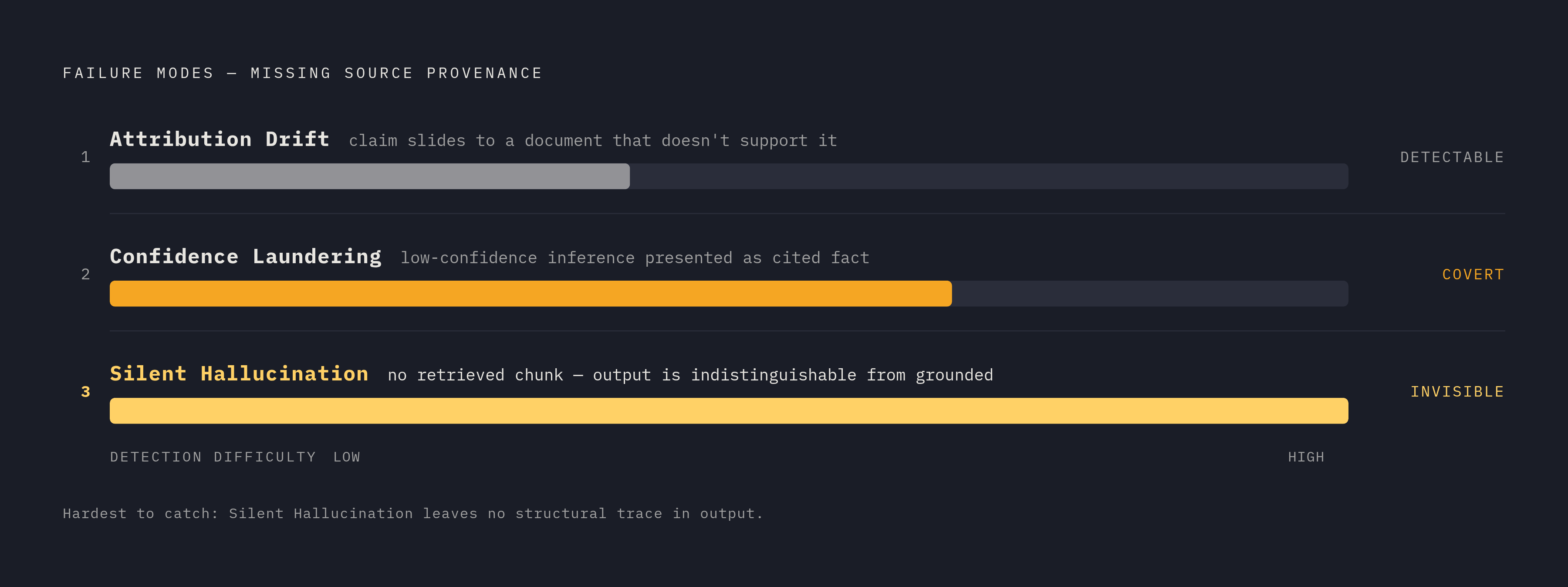
Three failure modes occur when that pointing isn't handled deliberately. Attribution drift happens when a claim quietly slides from the document that actually supports it onto a document that doesn't. Silent hallucination is worse: the model produces a plausible-sounding claim that no retrieved chunk actually supports, and nothing in the output distinguishes it from a claim that's fully grounded. Confidence laundering rounds out the trio, where a low-confidence inference gets presented with the same flat authority as a directly cited fact, leaving the reader no way to tell a guess from a citation.
None of these failures announce themselves. Retrieval returns documents that look plausible but are wrong, the model synthesizes a confident answer anyway, and without evaluation running somewhere in the pipeline, that error just ships. That's the concrete cost of treating provenance as an afterthought rather than a design requirement. Verification pipelines, user-facing citation displays, and audit logs all need structured provenance, something they can parse programmatically. This is a systems design problem, not a summarization quality problem in the way a wordy or repetitive summary is a quality problem. It's a systems design problem, and it has to be engineered into retrieval, shaping, and generation as three separate stages rather than patched on after the text comes out.
Retrieval stage outputs required before summarization
Retrieval has to hand off a structured object. Every chunk needs a document ID, a source URL or citation handle, its position within the source document, and a relevance score attached to it before it ever reaches a prompt. Stripping any of that at this stage means there's no way to recover it later; the summarization step downstream can only cite what retrieval preserved.
The production baseline for getting there is hybrid retrieval. Dense semantic search, using vector embeddings, finds material by meaning, matching on concepts even when the wording differs. Sparse keyword-based retrieval, the BM25 family, works differently: it scores documents by weighted term overlap, folding in term frequency, inverse document frequency, and document-length normalization, so it's a genuinely statistical ranking method rather than simple exact matching.
Before any of that ranking happens, though, the query itself needs work. A single ambiguous question retrieves inconsistently, pulling back a different slice of the corpus depending on how it's phrased. Strong pipelines generate several paraphrases of the same question and retrieve for each one, then pool the results, because most weak answers out of a RAG system trace back to a retrieval problem, not a generation problem. Teams spend enormous effort tuning prompts and models when the actual defect sits upstream, in what got retrieved in the first place.
Chunk boundaries deserve the same scrutiny. A chunk that depends on the paragraph before or after it for context risks being misread the moment it's pulled out on its own. Structured data and clearly bounded contextual units improve extraction accuracy in practice. Chunks should be sized so that each discrete claim inside them can be traced to a single source without ambiguity. And permissions have to travel with the content, not get bolted on at the interface layer afterward; if a chunk carries permission metadata from the moment it's retrieved, downstream summarization can't accidentally blend data across authorization levels that were never meant to mix. What retrieval owes the next stage, in full, is a ranked list of chunks, each carrying a stable source identifier, a relevance score, permission metadata, and its position inside the document it came from. The research brief identifies merging and re-ranking results using Reciprocal Rank Fusion and cross-encoder re-ranking as the pattern modern production RAG systems use to improve precision. Metadata preserved at retrieval time is the raw material for provenance binding later, and if a chunk loses its source ID at this stage, no downstream step can recover it.
Shaping retrieved content for attribution-intact summarization
The context window isn't a holding pen where retrieved text gets dumped and hoped over. Production systems that work treat context engineering as its own discipline: filtering, ranking, pruning, summarizing, and isolating information on purpose before it ever reaches the model. Ordering matters more than it looks like it should, too. Research on long-context behavior shows models fail to use information sitting in the middle of a long prompt. Where a chunk lands in the sequence directly affects whether its content shapes the output at all, and whether its attribution survives the trip.
A handful of concrete operations belong in this shaping layer before a prompt gets assembled. Conflict flagging catches the opposite case, where two sources disagree outright; rather than pass both into the prompt and hope the model resolves the contradiction sensibly, the shaping layer should mark the conflict explicitly and let the generation step handle it as a labeled disagreement. Relevance pruning drops chunks that fell below the re-ranking threshold, since including them doesn't add support, it just adds noise that dilutes everything the model has to reason over. And every chunk that survives all of that needs a consistent, machine-parseable source tag, a structured identifier the generation prompt can point to directly.
That points to a specific prompt structure. Each chunk gets wrapped in a labeled block, something like [SOURCE_ID: doc_42] followed by the chunk text, and the instruction to the model has to explicitly require it to cite those SOURCE_ID tags rather than paraphrasing freely without pointing back to anything. The instruction should also separate three categories cleanly: claims directly supported by a chunk, which get cited; claims the model is inferring across chunks, which get flagged as inference; and claims with no support at all, which the model should be told outright not to generate.
The output itself shouldn't be free prose either. It should be a schema-defined object, JSON or something close to it, where every claim or summary unit carries a source-ID array and a confidence indicator alongside it. None of this exists to fill the context window as fully as possible. The point is to hand the model the minimum context it needs to get the answer right and properly attributed on the first pass, because every regeneration loop needed to fix a bad citation costs time and money that a well-shaped prompt would have avoided.
Binding provenance to generated output so attribution survives post-processing
Provenance has to get bound at generation time, not stitched back on after the fact. Trying to reconstruct sources once a summary is already written is unreliable work; the binding needs to be structural, built into the schema the model is required to fill out, not an editorial pass applied afterward.
A workable schema gives each claim unit in the output fields including a list of source IDs. And unsupported claims shouldn't appear in the output with an empty or null source field. A null field is ambiguous, it could mean "no source" or it could mean the field just didn't get filled in correctly. Absence is unambiguous. If a claim has no support, it simply doesn't appear.
There's a longer-term risk that makes this discipline matter beyond any single pipeline. As AI-generated content increasingly gets consumed by other AI agents to produce further content, output drifts progressively further from human ground truth, generation after generation. Provenance binding is one of the few structural defenses against that drift, because it forces every claim in the output to trace back to a retrieved, human-authored source rather than to whatever a prior model happened to generate. Cryptographic provenance chaining would let a downstream system verify not just that a source got cited, but that the specific chunk cited was actually retrieved and actually passed to the model, a distinction that matters a great deal in enterprise settings where auditability is a compliance obligation rather than a nice-to-have.
A lightweight validation pass belongs at the end of this stage regardless: check that every source_id appearing in the output corresponds to a chunk that was genuinely present in the retrieval set. That single check catches hallucinated citations before they leave the pipeline. And the payoff of doing all this structurally, rather than in prose, is concrete. Downstream systems can distinguish a claim resting on a single source from one corroborated by several. User interfaces can render inline citations without parsing natural language guesses. Audit logs can record the full chain from retrieval to claim, for any output, on demand.
Where multi-document pipelines fail in production
Silent failure is the defining failure mode of RAG pipelines generally. Retrieval returns documents that look right but aren't, the model answers confidently anyway, and absent an evaluation layer, nobody notices. Multi-document structured summary pipelines inherit that risk and add their own variations on top of it.
Retrieval failures sit at the base: wrong documents pulled in, or the right documents ranked too low to ever reach the model. Attribution drift can also creep in during shaping, when deduplication or pruning strips out the one chunk that actually supports a claim while leaving behind a related chunk from an entirely different source, so the final summary ends up citing the wrong document with total confidence. Synthesis hallucination occurs when the model produces something that reads like a reasonable synthesis of the retrieved material but isn't actually backed by any single chunk, a risk that spikes when chunks from different sources sit next to each other in the prompt and the model interpolates between them. The model simply invents an identifier that was never in the retrieval set at all, which is what the post-generation validation check described above exists to catch.
RAGAS has become the standard framework for catching these failures in production, and it gives teams a handful of dimensions to track deliberately. Faithfulness asks whether claims in the output are actually backed by the chunks they cite. Answer relevance asks whether the summary addresses what was actually asked, rather than just reflecting whatever happened to be easiest to retrieve. Context precision measures what fraction of retrieved chunks actually contributed to the final output; high retrieval volume paired with low contribution is a signal of over-retrieval and attribution noise piling up. Attribution accuracy, specific to this use case, checks for each source_id in the output whether the chunk it points to actually contains the content that supports the claim.
None of this works as a one-time check during development. It has to run continuously, in production, because the gap between developer trust and distrust of AI output accuracy is real and current: 46% of developers distrust AI output accuracy against 33% who trust it. That gap doesn't close by picking a better model. It closes by running evaluation continuously and making the results visible. And there are three specific gaps basic RAG cannot close on its own: real-time data access without ingestion delay, knowledge graph traversal across interconnected sources, and granular access controls. Each of those is also, quietly, a provenance gap. If any one of them is left unaddressed, a whole class of output claims exists that simply cannot be reliably attributed to anything.
Retrieval infrastructure requirements for attribution at production scale
Provenance binding at generation time is only as trustworthy as the retrieval infrastructure feeding it. Everything upstream, freshness, formatting, metadata consistency, decides whether the source information reaching the model can be trusted at all.
Freshness matters first. Model training data alone can't substitute for live, time-sensitive information, and a structured summary can cite a retrieved document with perfectly correct attribution while stating a fact that's simply out of date. Real-time retrieval is the only way to close that particular gap, since no amount of careful schema design fixes a summary built on stale source material. Structural consistency matters just as much: when different retrieval sources return chunks in different formats with different metadata schemas, the shaping layer has to normalize all of it, and every normalization pass is another chance for source metadata to get corrupted or dropped entirely.
Depth matters too, and this is where a lot of general-purpose infrastructure quietly falls short. SERP-style search APIs return short teaser snippets built for a human's clicking behavior, not for machine reasoning, which forces engineering teams to build their own search-scrape-parse-chunk-rerank chains, with every added step introducing latency and one more place for the pipeline to break. Infrastructure built to return machine-ready content, with stable source identifiers already attached, removes that whole chain.
This matters more given where production architecture has actually landed. Agentic RAG, the dominant pattern now, treats retrieval as a multi-step decision process: the agent plans, orchestrates retrieval across several sources, inspects what came back, and decides whether it needs to go retrieve again. That loop only holds together if every single retrieval call returns reliable provenance metadata along with the content, because a broken link anywhere in a multi-step loop breaks the whole chain of attribution behind the final answer.
Enterprise deployments raise the stakes further still. Something like 80% of enterprise data sits unstructured, in contracts, meeting notes, support tickets, and when an agent reads that material literally and different sources contradict each other, the contradictions don't quietly average out on their own. Governed retrieval infrastructure with a real semantic metadata layer is the architectural answer to that, and access control belongs at the retrieval layer itself, not deferred to whatever interface a user happens to be looking at, so that permission context travels with the provenance metadata and a summary can never cite a document its requester isn't cleared to see.
Enterprise teams shouldn't be stuck picking between speed and owning their own data pipeline. Infrastructure that owns the pipeline end-to-end, instead of wrapping a stack of third-party services together, is what makes both achievable at once. A purpose-built web search API designed specifically for AI agents, one that returns content already shaped and context-engineered for LLM reasoning rather than for a human scanning a results page, strips out that intermediate parse-and-normalize burden and delivers chunks with stable, consistent source identifiers that provenance binding can actually depend on. That's the gap general-purpose search tools and scrapers were never built to fill. And under real load, latency isn't a minor performance detail to optimize later. Asynchronous, event-driven retrieval handles the multi-step loops agentic RAG demands without timing out, where synchronous request-response retrieval simply breaks down under the same conditions.
A practical build sequence for teams implementing structured summaries with source attribution
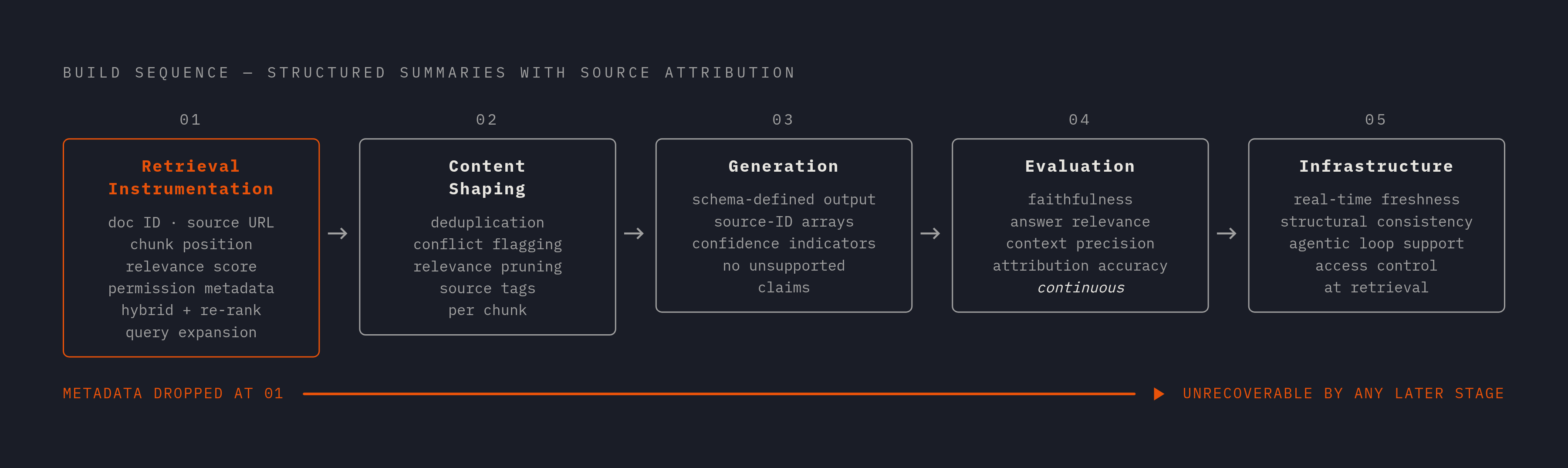
Building this out follows the same order the stages appeared in above: retrieval, shaping, generation, evaluation, infrastructure, which makes for a build checklist rather than a new set of ideas.
Stage one is retrieval instrumentation. Every retrieval call needs to confirm it's returning a document ID, a source URL or citation handle, chunk position, a relevance score, and permission metadata, with none of those fields optional. Hybrid retrieval, dense plus sparse plus re-ranking, should be the baseline from day one, since single-modality retrieval is a known and well-documented precision gap. Query expansion belongs in front of the very first retrieval call, addressing ambiguity before it has a chance to compound downstream.
Stage two is the content shaping pipeline. Near-identical chunks pulled from different sources get deduplicated before anything reaches a prompt, conflicting claims across sources get flagged rather than silently passed through, and anything below the re-ranking relevance threshold gets pruned rather than included on the theory that more context can only help. Each surviving chunk carries a machine-parseable source tag into the prompt, wrapped in a labeled block the model is explicitly instructed to cite rather than paraphrase around.
The retrieval infrastructure produces freshness, structural consistency, and machine-ready depth, and generation binds provenance structurally into a schema while evaluation runs continuously rather than as a one-time gate before launch; those requirements have to stand from the start, not get bolted on once something in production breaks. The summary that comes out the other end after skipping any one of these stages might read cleanly. It just won't be one anybody can actually trust.
Sources
- Retrieval-Augmented Generation for Natural Language Processing: A Survey
- RAGentA: Multi-Agent Retrieval-Augmented Generation for Attributed Question Answering
- Overview of the TREC 2025 Retrieval Augmented Generation (RAG) Track
- [2608.29753] PAGE-RAG: Provenance-Aware Graph Evidence Promotion for Fixed-Budget Multi-hop Retrieval-Augmented Generation
- RAG and Hallucinations: Definition & FutureAGI Guide (2026)
- Towards a Robust Retrieval-Based Summarization System
- GenerationPrograms: Fine-grained Attribution with Executable Programs
- SoK: Agentic Retrieval-Augmented Generation (RAG): Taxonomy, Architectures, Evaluation, and Research Directions