JSON Schema Enforcement for Reliable LLM Structured Outputs
Schema enforcement layers catch what prompts alone cannot, preventing parser crashes at scale.

Getting reliable JSON out of a large language model isn't a prompting problem. Any one of these crashes a downstream parser, and none of them appear in a demo where a human is reading the output and nodding along.
Structured output, in the LLM sense, means the model's response conforms to a predefined, machine-readable format instead of free-form prose. That distinction matters because function calling, data extraction pipelines, and multi-step agent workflows all depend on getting back something parseable and schema-conformant, not something merely readable.
"Reliable" deserves a harder definition than most teams give it. Valid JSON syntax is table stakes. Reliable means correct field names, correct types, and correct semantics, which is a much higher bar and one that syntax checking alone will never clear. That's exactly why prompt engineering by itself doesn't hold up under load. During the phase when "output valid JSON only" instructions and a handful of few-shot examples were the entire strategy, failure rates ran anywhere from 5% to 20% depending on how complex the schema got How Structured Outputs and Constrained Decoding Work SLOT: Structuring the Output of Large Language Models. That range isn't a rounding error. At the low end it's a nuisance; at the high end it's a system that can't be trusted with a customer-facing feature. The common production failure pattern involves trailing commas, markdown fences, invented keys, and "Here is your JSON:" preamble (any of these crashes a downstream parser).
How the industry got here: four phases of structured output enforcement
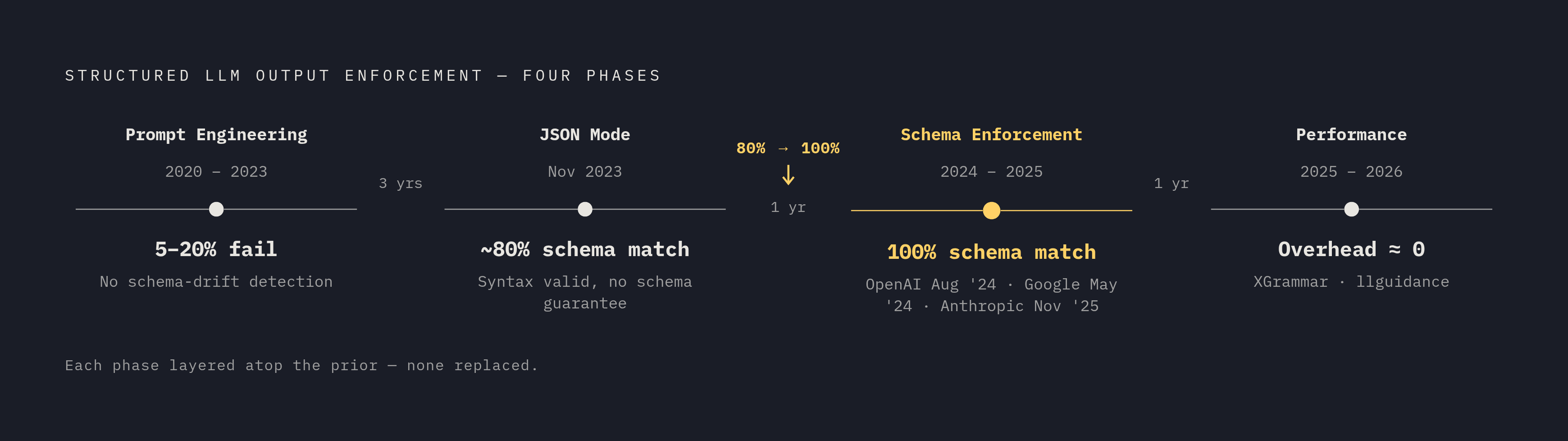
The industry didn't arrive at multi-layer enforcement by design. It backed into it, one failure mode at a time, across four distinct phases DisasterBench: Benchmarking LLM Planning under Typed Tool Interface Constraints SLOT: Structuring the Output of Large Language Models.
Phase one, running roughly from 2020 through 2023, was prompt engineering alone: careful instructions, few-shot demonstrations, and hope How Structured Outputs and Constrained Decoding Work SLOT: Structuring the Output of Large Language Models. Failure rates sat in that 5 to 20 percent band, and there was no mechanism built into the system to catch schema drift when it happened How Structured Outputs and Constrained Decoding Work SLOT: Structuring the Output of Large Language Models. Phase two arrived when OpenAI shipped JSON mode in November 2023, via a response_format parameter set to json_object SLOT: Structuring the Output of Large Language Models. This guaranteed syntactically valid JSON, a real improvement, but it enforced nothing about structure. The model could return a perfectly valid JSON object that had none of the fields anyone asked for SLOT: Structuring the Output of Large Language Models. That gap turned out to be the whole story: syntax conformance is not schema conformance, and JSON mode matched the intended schema only around 80% of the time, compared with 100% once strict, schema-aware structured outputs arrived How Structured Outputs and Constrained Decoding Work JSONSchemaBench: A Rigorous Benchmark of Structured Outputs for Language Models.
Phase three is when actual schema enforcement appeared across the major providers, in quick succession. OpenAI released Structured Outputs in August 2024, using response_format with type json_schema SLOT: Structuring the Output of Large Language Models. Google added response_schema for Gemini at Google I/O in May 2024 SLOT: Structuring the Output of Large Language Models. Anthropic followed later, bringing constrained decoding to Claude in November 2025 SLOT: Structuring the Output of Large Language Models. Phase four, running from 2025 into 2026, is about performance: engines like XGrammar and llguidance pushed the overhead of constrained decoding down close to zero, to the point where OpenAI publicly credited llguidance's foundational work as underpinning its own implementation in May 2025 DisasterBench: Benchmarking LLM Planning under Typed Tool Interface Constraints SLOT: Structuring the Output of Large Language Models.
The important editorial point about these four phases is that none of them replaced the one before it DisasterBench: Benchmarking LLM Planning under Typed Tool Interface Constraints SLOT: Structuring the Output of Large Language Models. Each phase added a layer on top of what already existed. Prompt engineering didn't stop mattering once JSON mode arrived, and JSON mode didn't stop mattering once schema enforcement arrived. The stack is additive, with each phase adding a layer on top of what already existed.
Layer one: the prompt contract
JSON Schema is the contract language most teams reach for, and for good reason: it's declarative, it defines structure and constraints for JSON data in a form both humans and machines can read, and it keeps output patterns consistent enough to validate and exchange between systems without ambiguity. The prompt contract is where that schema gets translated into instructions the model can actually follow: explicit field names and types, a clear line between required and optional fields, and few-shot examples that show the target structure in context rather than describing it abstractly. Negative examples, showing what a malformed response looks like, earn their keep here too, because models learn from contrast as readily as they learn from a single correct pattern.
There's a real temptation to over-engineer this layer, and it backfires. Schemas that grow too complex exceed what prompt-layer enforcement can hold on its own, and complexity is exactly where that 5 to 20 percent failure range clusters most heavily How Structured Outputs and Constrained Decoding Work SLOT: Structuring the Output of Large Language Models.
Intermediate tool outputs get validated per-tool and consumed by the agent itself, while the final agent output gets validated against a separate top-level schema and consumed by the application. Conflating these two levels, writing one prompt contract meant to cover both, is a common and avoidable mistake SLOT: Structuring the Output of Large Language Models. And even a well-scoped, well-specified prompt contract cannot close the loop alone. Non-determinism in generation, schema complexity past a certain threshold, and a more subtle failure documented in recent research, where verbose chain-of-thought reasoning clashes with structured output instructions, all sit outside what a prompt can control DisasterBench: Benchmarking LLM Planning under Typed Tool Interface Constraints SLOT: Structuring the Output of Large Language Models. In the MCP context, the MCP specification (November 2025) now requires that tool servers return structured results conforming to an output schema, meaning prompt-layer schema definition is no longer optional for MCP tool builders SLOT: Structuring the Output of Large Language Models.
Layer two: output validation (catching what the prompt missed)
Validation is the layer that checks the model's work after the fact, programmatically: type mismatches, missing required fields, extra keys that shouldn't be there, malformed values that slipped past whatever the prompt asked for. It's cheap, it's fast, and it catches a meaningful share of what the prompt contract misses.
It has two blind spots, though, and they matter SLOT: Structuring the Output of Large Language Models. Validation can't catch a transport failure, and it can't catch a value that's structurally valid but semantically wrong. A confidence score of 0.97 passes every schema check in the world even when the model fabricated that number out of nothing. This is the validity-correctness split, and it's not academic. Research on small language models from 2026 introduces the idea of a "constraint tax": forcing hard schema decoding can push schema validity all the way to 100% while answer accuracy actually drops, an effect that sharpens at the sub-3-billion-parameter scale How Structured Outputs and Constrained Decoding Work DisasterBench: Benchmarking LLM Planning under Typed Tool Interface Constraints SLOT: Structuring the Output of Large Language Models JSONSchemaBench: A Rigorous Benchmark of Structured Outputs for Language Models.
SLOT, a project out of Amazon Web Services published on arXiv in May 2025, takes a different approach entirely, using a fine-tuned lightweight model as a post-processing layer that transforms messy, unstructured LLM output into precise structured formats SLOT: Structuring the Output of Large Language Models. Its fine-tuned Mistral-7B variant, paired with constrained decoding, reports 99.5% schema accuracy and 94.0% content similarity against reference outputs SLOT: Structuring the Output of Large Language Models. For teams running compliance-grade systems, validation gets pushed further still. Auditable RAG deployments increasingly require explicit fields beyond the basic answer, things like a sources array, a confidence score, a decision_path_hash, and a recommended_action, plus automatic sanitization whenever a response is at risk of crossing a tenant or clearance boundary. Validation, done properly, is also where schema drift gets discovered in the first place: the moment the model has quietly picked up a new output habit that no longer matches what the contract specifies.
Layer three: retry logic (designing the recovery path when validation fails)
Even a well-built prompt contract and a solid validation layer will not eliminate every failure. Transport errors happen, models refuse requests, edge cases slip past validation rules nobody thought to write. The retry loop is what separates a system that works in a demo from one that runs in production under real traffic.
JSON mode matched schemas roughly 80% of the time, leaving a gap that historically required a retry loop How Structured Outputs and Constrained Decoding Work JSONSchemaBench: A Rigorous Benchmark of Structured Outputs for Language Models. Strict, schema-enforced structured outputs close that gap to 100% for providers that support it, which is precisely why the retry loop becomes less load-bearing, though not irrelevant, once an engine guarantees compliance at generation time How Structured Outputs and Constrained Decoding Work JSONSchemaBench: A Rigorous Benchmark of Structured Outputs for Language Models. Designing the retry path well means deciding whether to resend the original prompt cold or to feed the failed output plus the validation error back into context so the model can see what went wrong. It means choosing exponential backoff over fixed intervals when latency actually matters to the user waiting on the other end. It means setting a hard ceiling on retry count and having an honest answer for what the failure path looks like once that ceiling is hit. And it means logging every failed attempt, because that log is the raw material for catching schema drift before it becomes a production incident.
Provider behavior isn't uniform here, and Anthropic is the clearest example SLOT: Structuring the Output of Large Language Models. Documentation updated in April 2026 states that the strict parameter is currently ignored for tool definitions: Claude makes a best-effort attempt at schema compliance for tool calls but doesn't guarantee it DisasterBench: Benchmarking LLM Planning under Typed Tool Interface Constraints SLOT: Structuring the Output of Large Language Models. That single fact makes parameter validation and failure retry mandatory, not optional, for any team using Claude for tool calling DisasterBench: Benchmarking LLM Planning under Typed Tool Interface Constraints SLOT: Structuring the Output of Large Language Models. Put together, parameter validation, failure retry, and constrained decoding form a three-layer pattern that covers the distance between a system that merely works and one that runs stably under load, with retry sitting in the middle, bridging validation failures to whatever guarantee constrained decoding can offer. In multi-agent pipelines, this gets harder still. DisasterBench, a May 2026 evaluation spanning 14 models and five planning paradigms, found performance degrading sharply once a workflow ran past two steps, with parameter-binding errors and tool mismatch dominating the first failures DisasterBench: Benchmarking LLM Planning under Typed Tool Interface Constraints SLOT: Structuring the Output of Large Language Models. The design implication is specific: retry logic in a multi-agent pipeline needs to be scoped to the step that actually failed, not to the whole chain from the beginning, or every retry becomes an expensive re-run of work that was already correct DisasterBench: Benchmarking LLM Planning under Typed Tool Interface Constraints SLOT: Structuring the Output of Large Language Models.
Layer four: constrained decoding (how the token-masking guarantee works)
Constrained decoding turns the guarantee from probabilistic to structural. The mechanism is a finite state machine that masks invalid tokens at every single sampling step, setting their logits to negative infinity so the model is mathematically incapable of emitting a token that breaks the schema. That's a categorically different kind of promise than anything the earlier three layers can make. Validation checks the output after generation; constrained decoding makes schema compliance a property of the generation process itself, not something inspected afterward.
The technical wrinkle is that a pure finite state machine handles flat schemas fine but can't express recursion, and JSON, with its capacity for nested objects and arrays, is inherently recursive. Context-free grammars solve recursion using a pushdown automaton, but that expressiveness comes at a cost: full precomputation of valid transitions gets much harder to pull off.
Even this layer has a ceiling, and constrained decoding is not a cure-all. It guarantees structural validity, full stop, but it says nothing about whether a field's value is true. A hallucinated number in a perfectly-shaped JSON object still passes every check this layer runs. And the constraint tax from small-model research applies here directly: forcing schema validity to 100% through hard decoding can suppress answer accuracy, especially at the smaller end of the parameter scale How Structured Outputs and Constrained Decoding Work DisasterBench: Benchmarking LLM Planning under Typed Tool Interface Constraints SLOT: Structuring the Output of Large Language Models JSONSchemaBench: A Rigorous Benchmark of Structured Outputs for Language Models. Teams choosing a small model for cost reasons need to track "wrong-but-valid" as its own metric, separate from schema pass rate, or they'll ship a system that looks perfectly reliable on a dashboard while quietly returning fabricated values How Structured Outputs and Constrained Decoding Work DisasterBench: Benchmarking LLM Planning under Typed Tool Interface Constraints SLOT: Structuring the Output of Large Language Models JSONSchemaBench: A Rigorous Benchmark of Structured Outputs for Language Models. The FSM vs. CFG distinction. XGrammar (MLSys 2025) splits vocabulary tokens into context-independent (~99% of vocabulary, fully precomputed into bitmask tables) and context-dependent (~1%, requiring runtime stack inspection), achieving CFG expressiveness at FSM performance SLOT: Structuring the Output of Large Language Models.
Choosing a constrained decoding engine: XGrammar, llguidance, and Outlines compared
JSONSchemaBench gives the clearest apples-to-apples read on how these engines actually perform, since it draws on 10,000 real-world JSON schemas across a wide spread of complexity and evaluates six frameworks, including Guidance, Outlines, Llamacpp, XGrammar, OpenAI, and Gemini, in the first systematic comparison of its kind arxiv.org JSONSchemaBench: A Rigorous Benchmark of Structured Outputs for Language Models.
XGrammar has become the default structured generation backend across vLLM, SGLang, and TensorRT-LLM, running under 40 microseconds per token DisasterBench: Benchmarking LLM Planning under Typed Tool Interface Constraints SLOT: Structuring the Output of Large Language Models How Structured Outputs and Constrained Decoding Work. A benchmark found it edging out llguidance specifically in repeated-schema scenarios, where its caching pays off SLOT: Structuring the Output of Large Language Models. It's the natural fit for high-throughput serving where the same schema, or a small rotating set of them, gets reused across a large volume of requests.
llguidance, built on a Rust-based Earley parser, runs at roughly 50 microseconds per token, with startup costs negligible enough not to matter in practice How Structured Outputs and Constrained Decoding Work. It was influential enough that OpenAI credited its foundational work when describing what underpins its own Structured Outputs implementation, released in May 2025 SLOT: Structuring the Output of Large Language Models. Where llguidance pulls ahead is time-to-first-token in dynamic schema scenarios, situations where the schema itself changes from request to request rather than staying fixed, which makes it the better fit for workloads that can't rely on caching a stable schema.
Outlines deserves real credit as the origin point for this entire approach: the FSM method traces back to the foundational 2023 paper by Willard and Louf SLOT: Structuring the Output of Large Language Models. Its limitation appears at the complexity end of the spectrum, where schema compilation times have been measured running anywhere from 40 seconds up past 10 minutes for genuinely complex schemas How Structured Outputs and Constrained Decoding Work JSONSchemaBench: A Rigorous Benchmark of Structured Outputs for Language Models. That compilation cost is why JSONSchemaBench recorded Outlines with the lowest compliance rate of the engines tested, driven largely by those timeouts rather than by any weakness in the underlying method. It remains a solid choice for simple, stable schemas in research settings or lower-throughput environments, though it's not the right call for complex production schemas running at scale.
For teams that don't want to own engine selection at all, OpenAI's Strict Mode and Gemini's response_schema hand that decision to the provider entirely. That's a reasonable trade when data residency and self-hosting aren't hard requirements, and it removes an entire category of infrastructure decisions from the table. As a rough heuristic: stable schemas at high request volume point toward XGrammar, schemas that shift per request point toward llguidance, and simple self-hosted schemas can run on Outlines as long as compilation caching is part of the design from the start. llguidance (Microsoft).
Where the stack breaks in agent pipelines: parameter binding, tool mismatch, and reasoning interference
Agent architectures in 2026 typically stack four layers: a reasoning layer, an orchestration layer, a memory and data layer, and a tool integration layer, and structured output is the glue holding communication between all four together DisasterBench: Benchmarking LLM Planning under Typed Tool Interface Constraints SLOT: Structuring the Output of Large Language Models. When that glue fails, it doesn't fail gracefully. It fails at the seam between layers, which is exactly where debugging gets hardest.
DisasterBench offers the clearest empirical picture of what actually breaks. The study, run by researchers at Texas A&M and the University of Toronto in May 2026, evaluated 14 models across five distinct planning paradigms on 233 planning tasks built from 26 real disaster-response tools. Three findings stand out. Performance degrades sharply once a workflow runs past two steps, and this holds across every model and every method tested, so more parameters alone do not buy a way out of the problem. Tool mismatch turned out to be the dominant grounding failure: models struggle to distinguish between tools that sound similar but behave differently, and picking an operationally incompatible tool poisons every downstream step even when the model's high-level plan looked sound going in. And verbose intermediate reasoning, the kind of chain-of-thought output that's supposed to make a model's decisions more transparent, can actively clash with structured output requirements, disrupting the very plan generation it was meant to support DisasterBench: Benchmarking LLM Planning under Typed Tool Interface Constraints SLOT: Structuring the Output of Large Language Models.
The intermediate-versus-final output distinction from the prompt contract layer earns its keep again here, this time as an architectural warning. Per-tool output needs validation scoped to that tool's own schema; the final assembled result needs validation against the application's top-level schema. Treating these as one and the same is a mistake that occurs constantly in practice, and it compounds exactly the tool-mismatch and workflow-depth problems DisasterBench documented DisasterBench: Benchmarking LLM Planning under Typed Tool Interface Constraints SLOT: Structuring the Output of Large Language Models.
A broader signal deserves the same scrutiny. A study out of École de technologie supérieure and Université du Québec à Montréal found that "LLM code smells," poor coding practices in LLM-integrating systems, affect 73.5% of 692 analyzed open-source projects DisasterBench: Benchmarking LLM Planning under Typed Tool Interface Constraints LLM Code Smells: A Taxonomy and Detection Approach SLOT: Structuring the Output of Large Language Models. Their SpecDetect4LLM tool achieved 91.3% detection precision and 71.8% recall across 171,194 source files, and missing output validation and absent retry logic are identifiable code-smell categories DisasterBench: Benchmarking LLM Planning under Typed Tool Interface Constraints LLM Code Smells: A Taxonomy and Detection Approach SLOT: Structuring the Output of Large Language Models. That's not a niche finding. It suggests a large share of teams building on LLMs today are shipping systems missing at least one layer of the stack this piece has been describing, often without realizing which layer is the gap DisasterBench: Benchmarking LLM Planning under Typed Tool Interface Constraints SLOT: Structuring the Output of Large Language Models.
RAG pipelines as a special case: schema enforcement from ingestion through retrieval
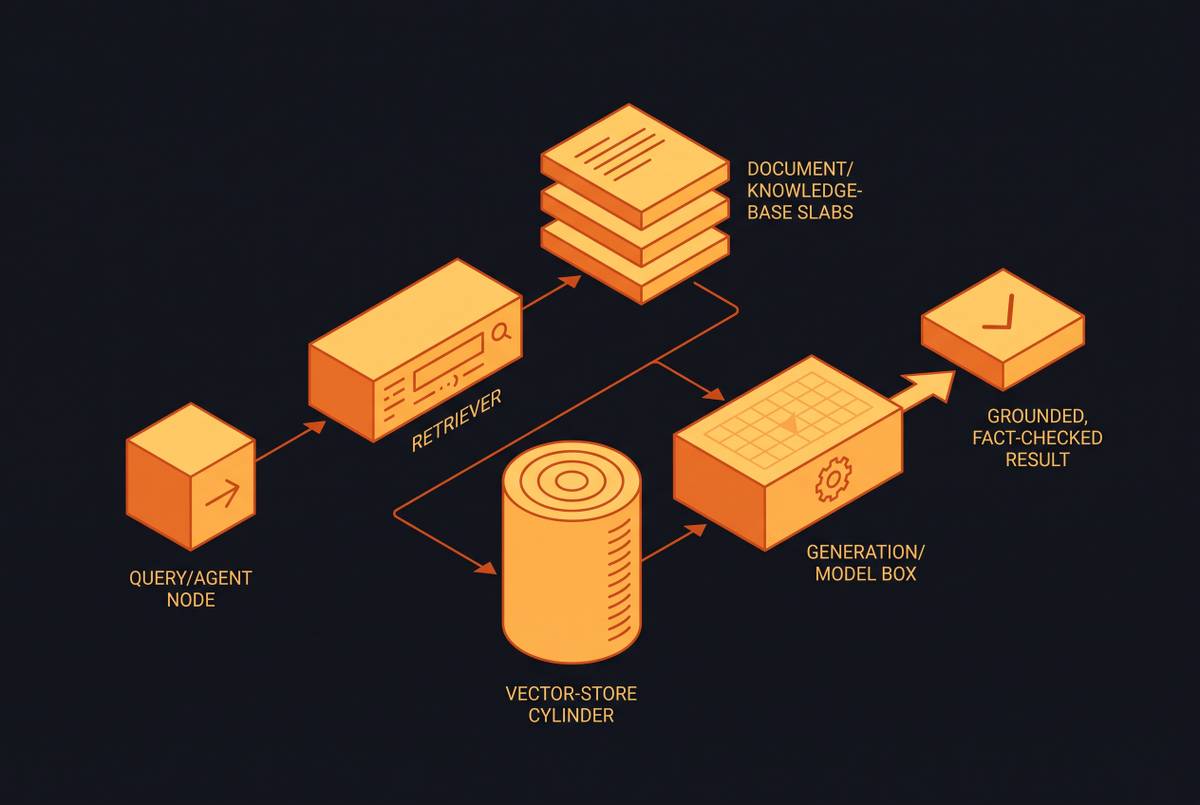
Retrieval-augmented generation systems complicate the schema story because structured output isn't just a concern at the final answer stage. It touches every step from ingestion onward. Documents get chunked and embedded before a model ever sees a query, and any schema drift at that ingestion stage, a metadata field silently dropped, a source identifier malformed, propagates forward into every retrieval and every generated answer built on top of it, invisibly, until something downstream breaks in a way nobody can trace back to its origin.
The compliance-grade fields described earlier for auditable systems, an explicit sources array, a confidence score, a decision_path_hash, a recommended_action, matter more in RAG contexts than almost anywhere else, precisely because a RAG answer's credibility depends entirely on being able to trace it back to the documents it came from. A generated answer without a verifiable sources array is unauditable. It's unauditable, which in regulated domains is functionally the same as being wrong, whether or not the underlying content happens to be accurate.
This is where the constraint tax discussion from the decoding layer becomes a genuinely practical concern rather than a research footnote. RAG systems built for cost efficiency often lean on smaller models to keep latency and inference spend down, and that's exactly the regime where hard schema decoding has been shown to push schema validity toward 100% while quietly eroding answer accuracy How Structured Outputs and Constrained Decoding Work DisasterBench: Benchmarking LLM Planning under Typed Tool Interface Constraints SLOT: Structuring the Output of Large Language Models JSONSchemaBench: A Rigorous Benchmark of Structured Outputs for Language Models. A RAG pipeline that reports perfect schema compliance while its "wrong-but-valid" rate climbs unnoticed is a blind spot wearing the shape of a reliability win. It's a blind spot wearing the shape of one, and it's one every one of the four layers, prompt contract, validation, retry, and constrained decoding, has to be built to catch rather than paper over DisasterBench: Benchmarking LLM Planning under Typed Tool Interface Constraints SLOT: Structuring the Output of Large Language Models. SOURCE PAGES (what the pages behind the outline's links say).