Detecting Stale Knowledge Boundaries in Production LLMs to Trigger Live Web Retrieval
Systems must detect when LLM knowledge grows stale to trigger timely web retrieval.

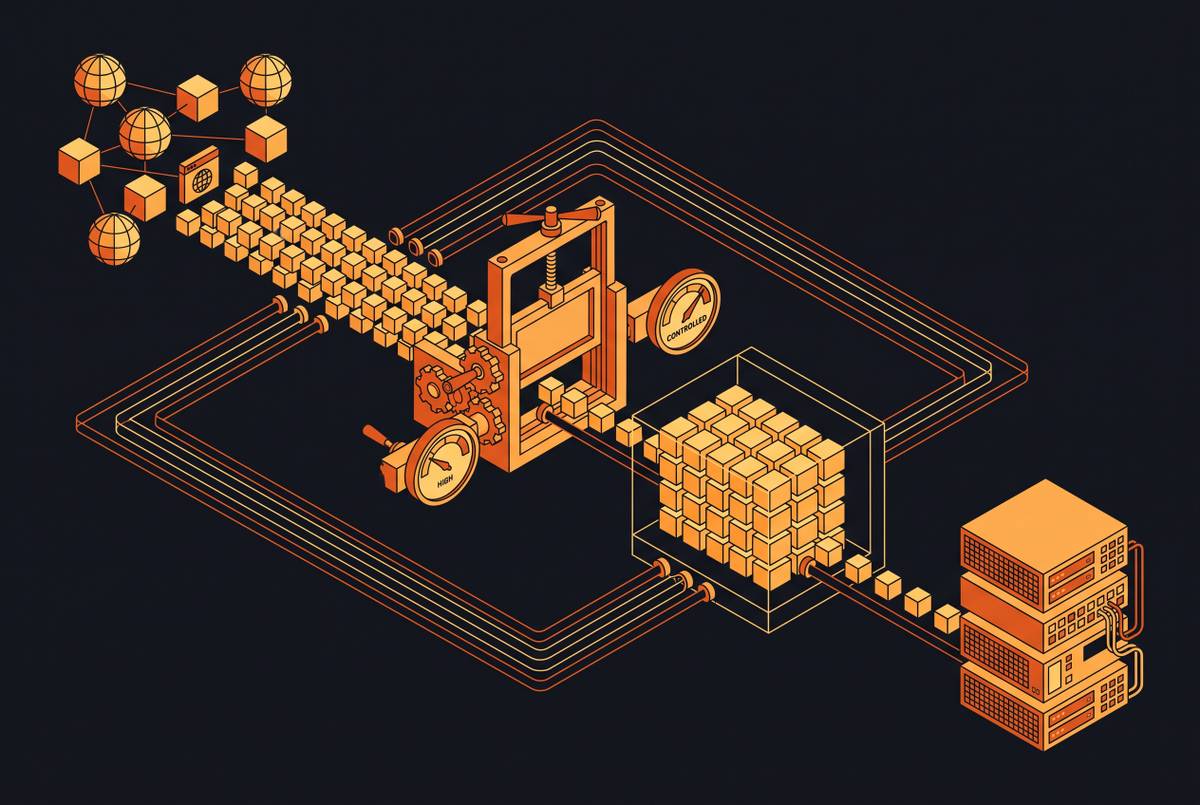
Real-time web knowledge for production LLM grounding requires an external detection and routing layer. Detecting stale knowledge boundaries means classifying freshness risk, monitoring source metadata, triggering live retrieval selectively, and measuring whether retrieved evidence influences the answer. This is a systems-engineering discipline because fluent generation cannot establish that a fact remains true.
Why an LLM cannot detect its own knowledge boundary from the inside
A language model trained on a static corpus cannot introspect on whether a fact has changed since its training cutoff. Its learned knowledge does not provide a reliable timestamp for every fact or a mechanism for recognizing every query that depends on later events. Fluency offers no dependable signal of freshness. The model can generate a confident response from obsolete information just as it can from current information.
A pipeline can continue retrieving documents and producing readable answers while its factual basis deteriorates. Trust erodes slowly before the failure becomes unmistakable. Better training alone cannot fix this because a static corpus cannot show what changed after it was built. If the model cannot diagnose that boundary from within, the surrounding system must diagnose it on the model’s behalf.
How staleness actually enters a production pipeline — three failure layers
The first failure layer is source document decay. A policy changes, a product guide is revised, or a process document is rewritten, but no event reaches the RAG pipeline. The vector index still serves the old version. Retrieval can therefore succeed technically while returning a document that no longer represents the source. The failure lies between the authoritative record and its indexed copy.
The second layer is schema and definition drift. Column names change, tables are deprecated, and the definitions of business metrics change while retrieval still works as designed. The gap between what the returned information means and what the system assumes is a data quality problem that looks like a retrieval problem, so detecting document changes alone does not cover it.
The third layer is ownership and certification lapse. Document owners leave or certification status expires without producing a missing-document signal. The entry remains available in the index. These layers can activate simultaneously and independently from the moment a knowledge base ships, leaving gaps when monitoring addresses only one.
The industrial anomaly detection paper published by Springer shows how this risk plays out in one field. An LLM’s general knowledge may not cover newly released proprietary equipment manuals and new operational standards. An unguarded pipeline may substitute parametric hallucinations for unavailable evidence. The example motivates safeguards for out-of-distribution knowledge without making industrial conditions a universal account of every stale answer.
The hidden failure mode inside RAG itself: when the model ignores retrieval
Successful retrieval does not guarantee that the model uses the retrieved evidence. A RAG system can fetch current context and still answer from memorized training data. The usual signs of activity look normal. Retrieval runs and generation finishes, but the system cannot tell that the answer rests on stale knowledge unless it measures how much context affects it.
Le Vu Anh et al.’s Retrieval-Path Contamination Scoring, or RePCS, compares a retrieval-augmented inference path with a parametric-only path. It computes KL divergence between their output distributions. Low divergence signals that retrieved context had little effect on the output. That is a signal of potential memorization rather than proof that an answer is stale, which keeps the diagnostic distinct from a factual verdict.
RePCS requires no retraining, gradients, or internal state access and adds a single additional forward pass. On PROMPT-WNQA, it achieves a ROC-AUC of 0.918, outperforming the prior strongest method while keeping latency overhead below 4.7% on an NVIDIA T4 GPU. Those results come from the reported evaluation and do not guarantee the same latency in every deployment. They nevertheless give teams a measurable alternative to assuming that completed retrieval means grounded generation.
Huang et al.’s ACL 2026 paper identifies contamination from the opposite direction. LLM-generated text in external corpora degrades retrieval quality and RAG performance through what the paper calls the “Spiral of Silence” effect. Production detection therefore needs visibility into both the generation path and the content entering it.
What an external staleness classifier actually has to do
Query-time topic classification must check whether the knowledge a query asks for changes faster than the model’s training cutoff window. This is the first routing gate. Topics with sub-day decay rates, including market data, live operational telemetry, and regulatory bulletins, should default to live retrieval regardless of other signals. Stable reference documentation and mathematical fundamentals may use parametric memory for most queries.
Temporal signal extraction must then find explicit anchors in queries and retrieved documents, including dates, version numbers, and event markers. A generally stable domain can still contain a request for a version released after the training cutoff. Extracting the anchor lets the routing system distinguish the domain’s usual pace of change from the particular fact being requested.
Inference-time divergence measurement must check whether retrieved context changes generation. A RePCS-style low-divergence signal should trigger re-retrieval or an escalation flag rather than letting apparent retrieval success settle the question. Index freshness monitoring must operate before queries arrive. It needs lineage versioning, ownership status, and certification signals so that routing can account for the condition of the knowledge base itself.
Scheduled crawls alone cannot provide that account. An indexed document may be a secondary representation of a record in the data stack, and the two can diverge without a crawl detecting the change. These functions have different diagnostic targets. Query classification cannot show whether a model ignored evidence, while healthy index metadata cannot tell whether a new question needs live knowledge.
Where the routing decision lives in an agentic pipeline
In an agentic pipeline, the staleness trigger belongs inside the planning and tool-use loop as well as before the first model call. Classic RAG supplied a pre-loaded payload, while agentic systems pull data at runtime through tools. Knowledge needs emerge as reasoning proceeds. The detection layer must therefore be able to fire when a later step exposes a freshness requirement that was not apparent at intake.
Reflection creates another point at which routing can change. An agent can re-query, rerank, or escalate to a sub-agent when it detects inconsistency, allowing freshness checks to participate in both initial retrieval and correction. Every additional search still adds latency and cost. A classifier that repeatedly triggers live retrieval for stable knowledge reduces throughput without necessarily improving accuracy.
Ontario Power Generation’s production RAG pipeline changed in stages as failures arose, with routing decisions extending beyond the start. Its progression included adaptive query reformulation, filter-guided semantic routing, chunk-to-document escalation, and capability partitioning for data residency. Each stage addressed a concrete failure mode. Routing decisions may need to change at different stages of a production workflow, though other deployments may need a different sequence.
Freshness detection needs to be co-designed with planning and tool use. A classifier added afterward can fire at the wrong granularity relative to the agent’s reasoning steps. Placement is part of the detection mechanism. Even with the right signal at intake, the agent still needs a check when it later finds evidence that conflicts.
Why retrieved content quality is not guaranteed and what that means for the trigger
Live retrieval can make an answer worse. A model may combine solid prior knowledge with partial new evidence, blending old assumptions and fresh pages into an answer less reliable than parametric memory on a well-established topic. Retrieval is not simply additive. A stale signal justifies seeking evidence, but it does not establish that the returned material deserves entry into the prompt.
Huang et al. also find that off-the-shelf detectors are insufficient for the contamination patterns encountered in RAG. The paper proposes RAG-aware data augmentation so that detector training reflects the contamination found in practice. Detecting contamination requires attention to both the retrieval setting and whether a standalone passage looks machine-generated.
For production teams, the response is selective triggering coupled with content quality checks. Retrieved material must be filtered, ranked, and shaped before generation because its raw form is not a safe fallback. Conflicting sources require attention as well as synthetic text. The industrial framework uses context-aware partitioning to segregate divergent regulatory protocols and maintain diagnostic consistency across varying conditions.
How do you give a deployed language model reliable access to live web data?
A retrieval layer must turn search results into evidence the model can use. Traditional SERP APIs return titles, URLs, and snippets, leaving developers to scrape pages, parse HTML, remove navigation and boilerplate, and format the result for the LLM. Each step adds operational work and failure exposure. In a multi-step agent chain, that assembly process competes directly with the latency and reliability requirements that made selective triggering necessary.
Scraping brittleness also creates a changing dependency. Anti-bot systems evolve, so a scraping layer that works at one point can degrade without notice. The resulting failure can resemble knowledge staleness. A trigger may fire correctly while the retrieval path fails to return current evidence the system can use, so the system cannot fix the staleness it found.
The infrastructure therefore needs predictable latency under real-world load, content that arrives reliably, and filtering that puts the quality of context ahead of how much comes back. Demo performance does not establish production suitability. Ranking and shaping content for LLMs can make evidence support reasoning or contaminate it. These capabilities belong in the retrieval layer rather than being assumed consequences of access to the web.
End-to-end ownership of the data pipeline makes it possible to control quality, latency, and data handling together, while wrapped services inherit their upstream dependencies’ failure modes. Enterprise retrieval must also enforce permissions at both the retrieval and application layers. Otherwise, a freshness trigger can open a route around access restrictions rather than provide a governed path to current evidence.
Maintaining the detection layer over time as knowledge domains shift
The detection layer itself is subject to drift. Domains that required live retrieval at deployment may not be the ones that require it six months later. Topic classifiers trained on a snapshot of queries can degrade as products evolve, users change behavior, or the underlying model is updated. Maintenance must address that moving boundary rather than preserve the original routing policy by default.
Index freshness monitoring likewise needs living metadata kept current after the build. When ownership or regulatory standards change, freshness signals should change too, without waiting for a manual audit. Divergence measurement must remain an ongoing diagnostic. RePCS-style checks can flag a new class of queries in which the model has begun ignoring retrieval, indicating that routing logic needs recalibration.
Human feedback supplies another source of correction. Domain experts can flag incorrect or outdated answers so that those failures become updated routing signals. The industrial framework validated an approach that converts expert feedback into vector representations for real-time model evolution. This connects operational knowledge to the maintained system without relying solely on the original corpus or classifier.
Teams should use model-level observability practices for the detection layer, with logs of routing decisions, measures of trigger rates by topic class, and audits of divergence scores over time. Context engineering sets the framework for this work by keeping instructions, retrieval, memory, and tools separate and making clear who owns freshness signals. Cross-layer failures need that shared view to become visible. The operational task continues after deployment because the classifier, the sources, and the model’s use of evidence can all change independently.