Web Search API Comparison for High-Throughput RAG Pipelines
Choose an API architecture that fits your pipeline's constraints, not features alone.

For high-throughput RAG, web search API selection is an infrastructure decision governed by content depth, latency under load, output shape, freshness, and data ownership. Enterprise teams seeking SOC 2-aligned web retrieval must also evaluate query retention and subprocessing, because architectural fit alone does not establish SOC 2 status. The right approach is to choose an architectural category that satisfies the pipeline’s binding constraints, then compare providers within it.
Why web search API selection is an infrastructure decision, not a feature comparison
A feature matrix and pricing sheet describe what an API offers, but not whether its architecture can support production retrieval. In 2026, autonomous agents and RAG pipelines are primary consumers of web data at runtime, while much of the infrastructure serving them was designed for another role. Under production load, a service can return relevant links quickly yet leave the caller responsible for fetching, cleaning, and preparing every page before the model can use it.
Teams need to weigh that work when choosing an API because it shapes the system they build around it. Choosing a provider also means accepting its upstream dependencies, content-processing boundaries, and control over query data. These are not tuning parameters. The market’s three architectural categories provide a more useful starting point than a feature comparison because each puts those responsibilities in a different place.
The three architectural categories and why they are not interchangeable
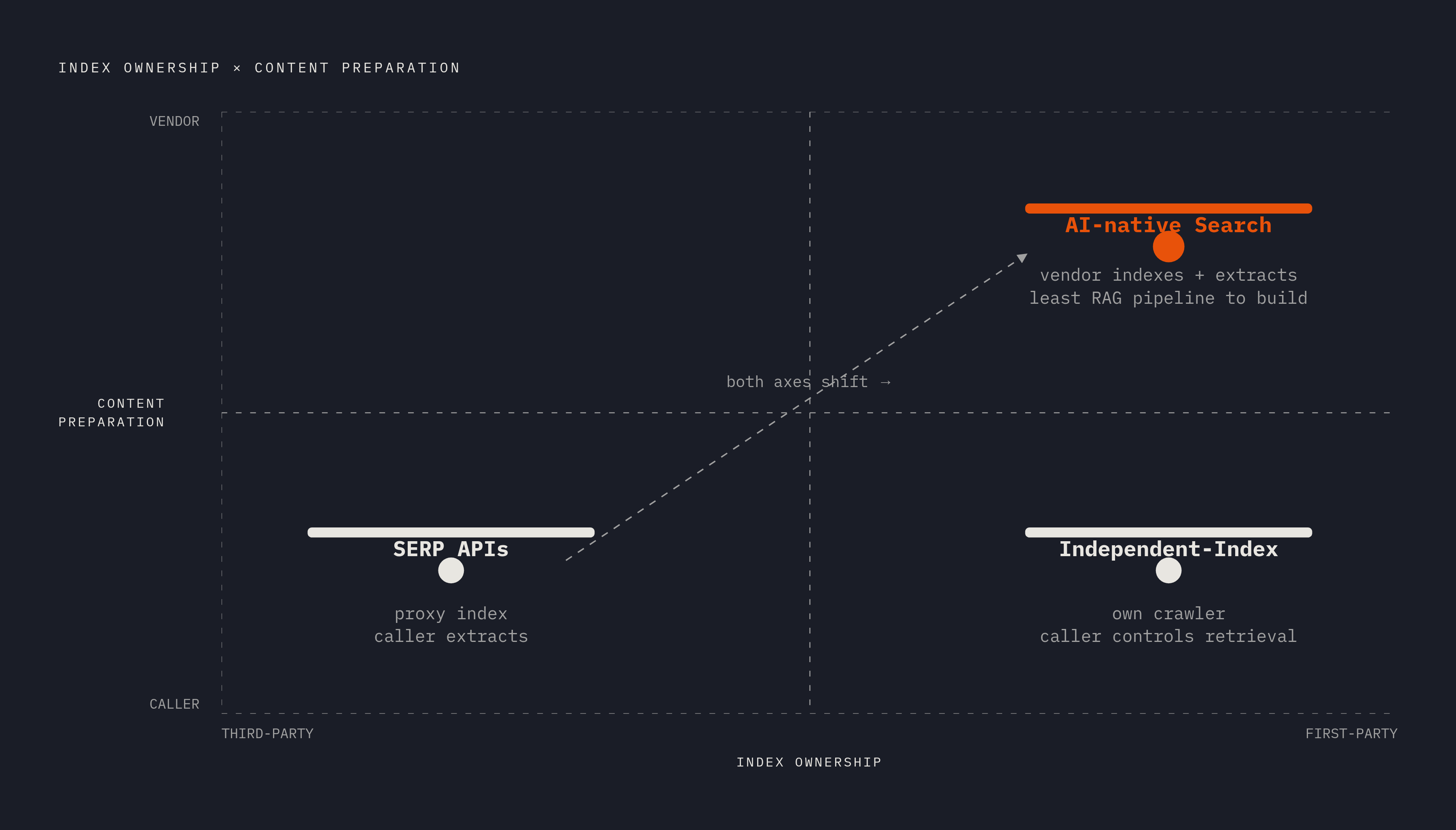
SERP APIs proxy an existing search engine, handle proxy rotation and CAPTCHA management, and return structured JSON representing human-visible organic results. They usually return titles, links, and short snippets. That is a natural fit for SEO tooling, rank tracking, and competitive analysis, where reproducing the search results a person would see is the goal. Page extraction is a separate responsibility for the caller.
AI-native search APIs combine search and content extraction in one call, returning cleaned Markdown or structured text for model consumption. Their interface is organized around downstream AI use. Features include pre-extracted content, AI-optimized relevance ranking, freshness filtering, single-call aggregation, and support for RAG and tool-calling frameworks. Ranking and summarization may happen inside the vendor’s pipeline, so the vendor makes some choices about how to prepare context behind the API boundary.
Independent-index APIs operate their own crawler and search index. Their defining property is control over the underlying retrieval infrastructure. This differs from the AI-native category, which describes how search and extraction are delivered to the caller. The distinction separates two questions that recur throughout evaluation, namely who controls the source index and who prepares the returned content.
Why SERP snippets fail as RAG context at production scale
Short keyword-matched snippets help a user decide which page to visit, but they do not provide the depth a RAG pipeline needs to reason over that page. Extracting the missing content requires another retrieval stage. A fast search response can hide a workflow that is slow from start to finish, because each chosen result needs a follow-up scraping job. Those jobs must handle JavaScript rendering, anti-bot systems, and proxy rotation, which fall outside the SERP API’s scope.
The bottleneck is round-trip latency. Fetching pages, extracting relevant text, embedding it, indexing it, and serving it to the model creates a chain whose costs compound under load. Passing raw HTML onward does not remove that work so much as displace it. Navigation, advertisements, cookie banners, and footer links use up tokens without giving the model the evidence it needs.
There is also a separate upstream dependency risk. Providers proxying Google results are exposed to changes in how the search engine treats third-party access, including scraper detection that could come with future changes in regulation. That exposure is independent of any provider’s engineering quality. SERP APIs remain suitable for reproducing human-visible search results, but production RAG must account for both their extraction gap and their dependency chain.
The five criteria that actually determine production RAG fit
Full extracted page content can go straight to the context-preparation stage, while snippets need a second scraping layer. A JSON response with search metadata differs from one with the source text needed for reasoning, even when both seem equally easy to integrate.
Latency under load measures the complete retrieval path during concurrent and bursty use. Agent research tasks can fan out into parallel sub-queries, while multi-step reasoning loops accumulate delays across successive searches. Average response time is insufficient for either pattern. Rate limits, uptime SLAs, and the choice between cached responses and live-scraped data all affect whether retrieval fits the application’s timing requirements.
Clean text or Markdown reduces the burden of separating evidence from boilerplate, while structured fields preserve the relationship between content and its source. Searlo describes output containing a title, snippet, URL, and full content for chunking, embedding, and vector store ingestion. Provenance belongs in the response. Semantic relevance ranking also serves a different purpose from ranking based on PageRank and keyword frequency for human browsing.
Live retrieval needs freshness controls to supply evidence from the right period. A current response can still contain an authoritative but outdated page, so publication-window filtering and index update speed are separate concerns. “Real-time” is not a sufficient specification on its own. SERPHouse distinguishes live retrieval from a vector store’s re-embedding cycle, but the usefulness of live results still depends on how current the underlying index is and whether the query can constrain dates.
The provider’s ability to account for queries after they leave the organization depends on data ownership. Logging, retention, GDPR alignment, and subprocessing therefore belong in the same evaluation as retrieval quality. For regulated workloads, this can be a binary procurement condition. An intermediary’s Zero Data Retention promise requires scrutiny when another engine participates in processing the query, because the intermediary does not control that entire path.
How to read an API's architecture against these criteria before committing to it
Teams should ask whether the provider owns its crawler and index, wraps a third-party engine, or combines search with live scraping. That answer identifies the main dependency boundary. It also gives the team a basis for questioning retention claims, freshness guarantees, and which parts of response time the provider actually controls.
Production-representative queries should then test what reaches the model. The useful measurements include output token count, surviving boilerplate, content completeness, and whether source URLs remain attached without additional parsing. Model context limits belong in this test. A large response offers little benefit when the intended model cannot accommodate it, and an apparently clean response may still omit the evidence needed to answer the query.
Concurrency testing should match how the pipeline sends requests in bursts, rather than rely on how many requests are allowed per second or per hour. A research task that launches many parallel searches may encounter a different constraint from a steady request stream. Searlo lists LangChain, LlamaIndex, and CrewAI support, while SERPHouse documents LangChain integration, so teams should verify native support for their chosen framework.
Query-time customization completes the architectural test for domain-specific workloads. Teams should check whether ranking and filtering happen before content is returned or only through caller-side post-processing. The distinction affects repeatability and inspection of retrieval decisions. Domain-scoped retrieval, including restrictions to selected publishers or government sites, can filter noise before it reaches the model rather than asking the model to disregard it afterward.
What security requirements must a SOC 2-aligned web retrieval API satisfy?
Security operates as a parallel procurement filter. For enterprise teams assessing SOC 2 alignment, query logging, retention, subprocessing, and GDPR alignment are relevant questions, but they do not establish a provider’s SOC 2 status. No provider-specific SOC 2 evidence is supplied here. A ranked compliance shortlist would therefore claim more than the available information supports, regardless of the providers’ retrieval capabilities.
Query privacy matters as soon as a search begins because every external search request leaves the organization’s infrastructure. For sensitive B2B workloads, whether the provider stores that request can block procurement. The content returned can also expose the pipeline to indirect prompt injection. EchoLeak, disclosed in June 2025 in Microsoft 365 Copilot, demonstrated how a specially crafted document in a retrieval pipeline could cause sensitive corporate data to be exfiltrated without employee interaction. Retrieval quality alone cannot address that failure.
A March 2026 study published in Information Fusion looked at poisoning attacks on knowledge graph-based RAG and showed how tampering with retrieval data could bring false information into the results. Source selection relied on semantic similarity without validating integrity. Duke University’s paper on “lazy grounding,” accepted to EMNLP 2026, describes a related but distinct failure in which factual evidence for a nearby question misleads an agent answering the current question. Both failures can occur in more than one search API category.
Zero Data Retention addresses query handling. The pipeline still needs broader retrieval access controls when it handles sensitive documents. At the search API boundary, the evaluation must therefore distinguish what the provider retains from what it returns, rather than treating either as a complete security assurance.
Why data pipeline ownership is the structural answer to both performance and security requirements
Performance and privacy converge on the same architectural question, namely who controls the full retrieval path. A wrapper depends on an upstream index for freshness, an upstream processor for query handling, and infrastructure outside its control for part of its latency. Those dependencies limit what the wrapper can guarantee independently. With first-party infrastructure, the provider can control these requirements together instead of relying on another provider to keep its guarantees.
Operating an index makes an end-to-end retention commitment structurally credible, but does not by itself demonstrate a retention policy or SOC 2 status. Owning an index still leaves prompt injection and source poisoning to be dealt with. Its significance is that the provider can control indexing and query processing directly, including mechanisms that address SEO spam and indexing noise, without relying on another engine’s decisions.
The strongest objection to a full-pipeline AI-native service is the loss of visibility when ranking and summarization happen internally. Regulated teams and teams building their own reasoning logic may need to inspect or reproduce why particular context was returned. Ownership does not eliminate that black box. The practical response is to evaluate query-time control over ranking, filtering, and output shape, so that first-party retrieval fits the team’s architecture without replacing the parts it needs to govern.
Matching API architecture to pipeline requirements: a decision framework
For dense multi-step reasoning and deep research, content depth and token efficiency often set the architectural requirement. An AI-native API with full extraction in a single call matches that configuration because it avoids adding separate SERP and scraping stages. Candidates within that category still need testing for output cleanliness, usable depth, and compatibility with the model’s context window.
For regulated industries and sensitive B2B pipelines, data ownership and Zero Data Retention can instead determine eligibility. Teams in that position should begin with independent-index providers operating first-party infrastructure and ask whether any subprocessing dependency qualifies the retention claim. Compliance evidence remains a separate procurement requirement. For real-time agent loops and user-facing answers, the decisive test shifts to p95 latency under bursts, considered with uptime SLAs and an explicit choice between cached speed and live freshness.
For systems combining proprietary documents with current web knowledge, a vector store and live search API serve complementary roles. SERPHouse describes using the vector store for private documents and live retrieval for current world knowledge. The usable selection rule is to start with the architectural category that satisfies the pipeline’s binding constraints, then compare candidates on the remaining requirements, rather than choosing features first and discovering the infrastructure afterward.