Polling vs Event-Driven Web Data Ingestion for Production Agents
Event-driven ingestion cuts detection latency and aligns freshness with production agent reasoning.
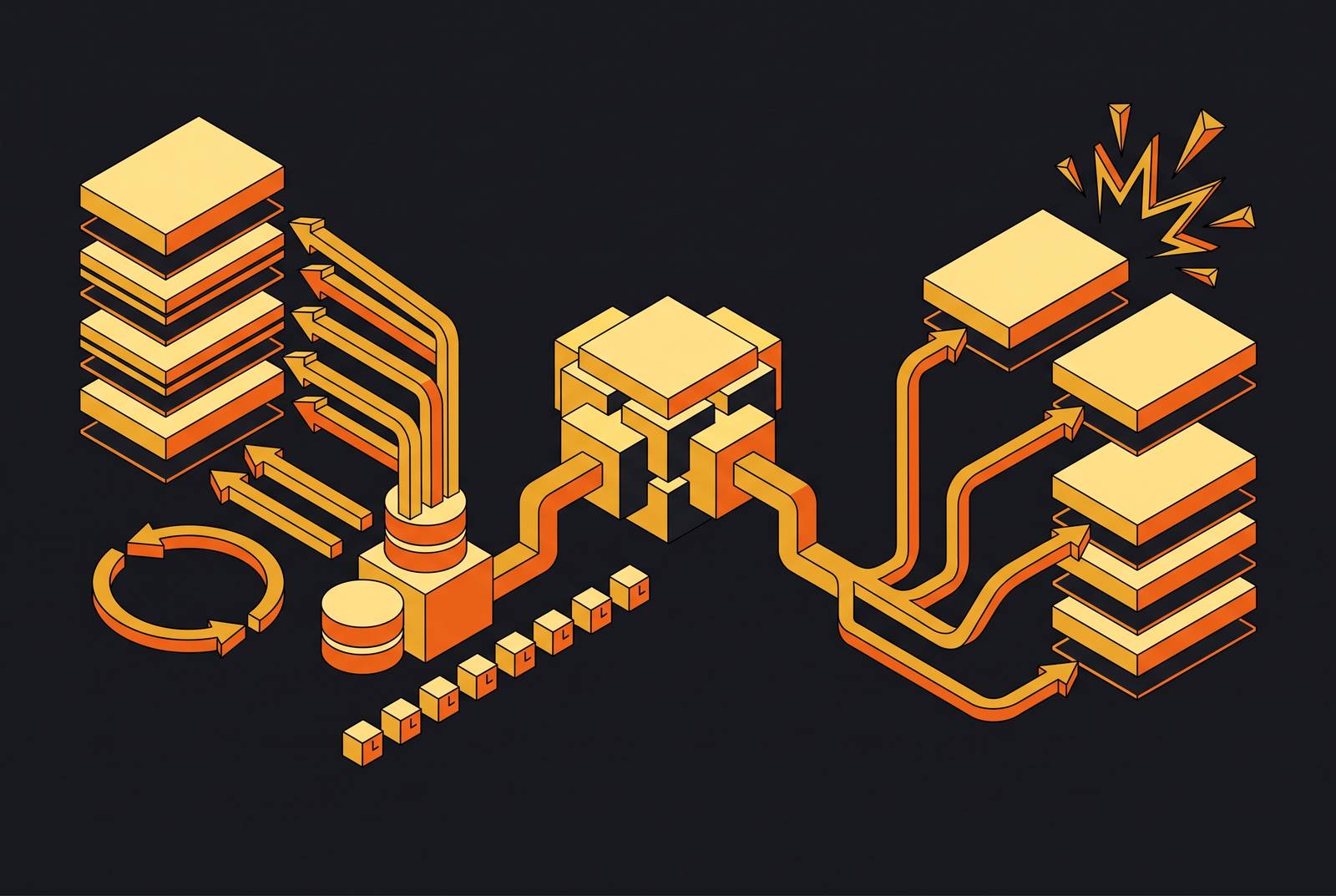
Real-time web knowledge for production LLM grounding requires both timely ingestion and retrieval that supplies current, usable evidence. Polling suits scheduled updates and sources without change signals, while event-driven ingestion suits latency-sensitive reactions. Neither pattern can ground an agent reliably if the retrieval layer supplies stale or insufficient context.
Why the ingestion pattern — not the model — determines how an agent behaves in production
Engineering teams often optimize model quality and prompts while treating ingestion as infrastructure plumbing. Yet production agents depend on external systems for the data, context, and execution their tasks require. The integration pattern sets when those inputs are ready, which limits latency, freshness, and reliability before reasoning starts. A model cannot compensate for a change that its data pipeline has not yet exposed.
A scheduled API check and an event-driven connection to a live knowledge source give the same models different evidence at different times. Web knowledge infrastructure built for this purpose, including Seltz, shows how agents depend on it by shaping the content they receive in production. The trigger governs when that context is requested, while the data pipeline governs what the agent actually sees.
How polling works and where its structural limits appear
Polling puts the agent in charge of checking for updates. On a fixed schedule, it queries an API, retrieves any new data, and processes the result without waiting for an external signal. This is straightforward to implement because it requires no event bus and leaves the update frequency under the team's control. It is appropriate when a source does not support webhooks, when real-time behavior is unnecessary, or when checks must run at a predictable frequency even if detection is delayed.
A change that occurs just after a poll remains unknown until the next cycle, even if the agent and API are otherwise fast. Shortening the interval reduces that delay, but it does not remove the dependency on a schedule. When several agents poll on their own in a sequence, each adds a wait before the next agent can start its work.
Polling also performs work when there is nothing new to process. Every cycle consumes compute, and adding agents or sources increases the volume of checks. Checking more often cuts the delay but adds more traffic before the agent has useful work to do. The resulting “checked, found nothing” records can also crowd out meaningful activity in logs, making audit reconstruction harder even though the individual polling loop is simple.
How event-driven ingestion changes the trigger model and what that enables
Event-driven ingestion reverses the direction of initiation. A source emits a signal when its state changes, and subscribed agents react to that signal as changes occur. For example, a polling agent might check every 30 seconds whether a pipeline has finished. An event-driven pipeline instead emits a pipeline.completed event at completion, which subscribed agents receive within milliseconds in the example described by the notes.
It has three roles: producers, a routing layer, and consumers. Producers include APIs, databases, file systems, and external services that cause state changes. The routing layer delivers those events to consumers, with implementations ranging from webhooks for simple workflows to Apache Kafka for high-throughput streaming. Agents subscribe only to event types relevant to their tasks, separating the source of a change from the work that follows it.
This separation lets agents process work in parallel without having to agree on when each should start. One agent can summarize a changed document while another extracts structured data from it. In a choreography pattern, their completion events trigger other agents, so the workflow has multiple steps but needs no central controller. The amount of work agents do grows with the events that matter to them rather than with scheduled checks, though the delivery infrastructure still takes work to run.
The head-to-head trade-offs across latency, cost, scalability, and reliability
Latency is the clearest distinction. Polling introduces an average detection delay of roughly half the polling interval and a worst-case delay of the full interval. Webhook delivery can be sub-one-second, removing the scheduled wait between a change and its notification. That advantage concerns the trigger, however, rather than guaranteeing that retrieval and reasoning also finish within the same window.
Idle cost follows the same structural divide. Polling consumes compute on each cycle regardless of whether work exists, whereas event-driven agents need not run between relevant events. If a polling cycle invokes a usage-based LLM merely to find that nothing has changed, it also consumes tokens. The distinction is therefore between repeated checks and event-proportional agent execution, with infrastructure costs in both cases.
Scaling extends that cost difference. Polling traffic grows with the number of agents and sources and with poll frequency, so tighter freshness targets increase load even when the underlying data is quiet. Event-driven workloads grow with the number of events that occur. Decoupled consumers can each process that work on their own, but handling bursts still takes planning for capacity and delivery.
Operational complexity favors polling at the outset. Its schedule is explicit, failures are localized, and an individual sequence of checks is relatively easy to reconstruct. Event-driven reliability depends on delivery guarantees, retries, deduplication, and burst management, while distributed flows are harder to debug.
Data access adds a separate decision. Pass-through access queries the source directly, avoiding a duplicated local copy but exposing the agent to source latency and rate limits. Sync-and-cache supports faster local queries at the cost of possible staleness and compliance risk. Either access method can work with either trigger pattern, so an event-driven notification alone cannot show whether the data returned is up to date.
How do you stop a production LLM from answering with outdated facts
Freshness affects reasoning quality because retrieval can only ground an answer in information it actually contains. A scheduled RAG pipeline pulls data, embeds it, builds an index, and serves that index until the next update. During that interval, the retrieval mechanism can function exactly as designed while returning an outdated view of the world. The failure is not necessarily a slow query or a weak model, but missing current evidence.
When the index lacks the facts needed to answer a question, the model may fall back on training-data prediction and answer with a plausible completion. This is particularly consequential for prices, regulatory updates, breaking events, and operational status. Training knowledge cannot take the place of live factual grounding in those areas because months or years can pass between training cutoff and deployment.
Ingestion architecture sets the available freshness profile. Batch ETL provides freshness measured in hours, change data capture provides seconds, and streaming materialized views provide sub-second freshness. Streaming event-driven ingestion is the pattern suited to sub-second freshness at scale. That distinction matters even more in agentic workflows, where an outdated or fabricated input can become evidence for the next agent's reasoning.
Live web retrieval services such as Seltz address the need for current external evidence rather than treating model training as a substitute for it. The relevant criterion is whether the retrieval layer supplies factual content appropriate to the question at the time of use. Continuous refresh supports that requirement, but the presence of an event bus does not prove that the index or returned content meets it.
The production failure modes that emerge when the ingestion pattern mismatches the agent's operational demands
A polling mismatch appears when the acceptable response window is shorter than the update interval. Fraud detection, supply chain alerts, and real-time customer support can lose operational value when an agent acts on state that is tens of seconds old. The failure can remain silent because the response still sounds confident and gives the caller no indication that its context was stale.
Chained polling creates a related failure in multi-agent workflows. When each agent waits independently for its next check, the worst-case polling delay is the sum of those intervals. Three agents polling at 30-second intervals can stretch a task that takes seconds toward minutes. Even if each agent processes its work faster, it still has to wait for the scheduled handoffs.
Webhook providers retry failed deliveries, so an agent without deduplication can process the same event repeatedly. The webhook endpoint should keep its work minimal by accepting the payload, verifying the signature, returning 200 OK, and pushing the event onto a queue. Heavy processing should run as asynchronous work, with idempotency ensuring that an event delivered more than once is executed only once.
A missing retry handler, a misconfigured dead letter queue, or an unhandled burst can silently drop events. Event-driven logs can map more directly to meaningful state changes than empty polling records, but that advantage does not make distributed debugging simple. Both patterns need careful engineering to be reliable, but they differ in where failures can spread and what evidence is available to find the cause.
How production architectures combine both patterns rather than choosing one
Production architecture is better understood as a set of layers than as a single choice between polling and events. Event-driven triggers detect changes, pass-through APIs obtain real-time data, RAG retrieves knowledge, tool calling supports execution, and orchestration manages multi-step workflows. Each solves a different problem. Treating them as substitutes obscures where freshness, latency, or reliability is actually being lost.
The trigger layer is the natural place for event-driven ingestion when a change should initiate reasoning promptly. Polling still works well for sources without webhooks, data that changes slowly, or retrieval schedules where teams need to control how often checks run and how much they cost. A system can therefore react to events from one source while periodically refreshing another.
A streaming trigger can update a cached retrieval index for fast lookup, while pass-through access can serve data that is sensitive or changes often. Clear event schemas let producers and consumers change on their own without having to change the whole workflow at the same time. MCP-based unified APIs address another boundary by giving agents one interface instead of separate integrations for every data source.
Tool selection follows those roles. Apache Kafka suits high-throughput streaming, while RabbitMQ suits complex routing at lower throughput. Redis Streams supports low-latency inter-service communication and event-driven workloads, and webhooks provide the lowest-complexity entry point for simpler triggers. These illustrate different delivery needs within agent architectures. The combined system succeeds when each layer has an appropriate mechanism and a clear responsibility.
What the ingestion layer decision means for web knowledge specifically — and what it requires of the retrieval infrastructure beneath it
Prices, regulatory changes, breaking events, and competitive intelligence can change faster than a scheduled index reflects them. A real-time signal that a relevant page changed tells the agent only that the change occurred. The retrieval layer must still return fresh, structured content from that page when the agent needs to reason about it.
Traditional SERP APIs return shallow snippets designed for human scanning rather than the depth, verified citations, and structured output that LLM reasoning requires. Scraping tools have their own risks of failure when used in the real world. Neither limitation disappears because an event initiated the request.
Context engineering connects these layers by deciding what enters the model's context window. Its controls include metadata filters, hybrid search, re-ranking, source authority rules, and freshness windows. These determine which evidence is selected, how recent it is, and whether it is suitable for the task. Seltz meets this need with a web search API built for the purpose, which owns its data pipeline end-to-end and supplies content that it has selected, filtered, ranked, and shaped for AI reasoning. Its role is at the retrieval and context layer, distinct from the event bus or webhook that starts the work.
Polling can be appropriate where scheduled freshness meets the task, and event-driven ingestion can be necessary where agents must react to current state. In both cases, the retrieval infrastructure must supply evidence with enough freshness, depth, and structure to support the answer. Trigger and retrieval must be co-designed around the agent's operational demands.