Web Retrieval APIs for LLM Grounding vs SERP Snippet APIs
LLM agents need richer passages than search snippets provide to reason accurately and cite sources.
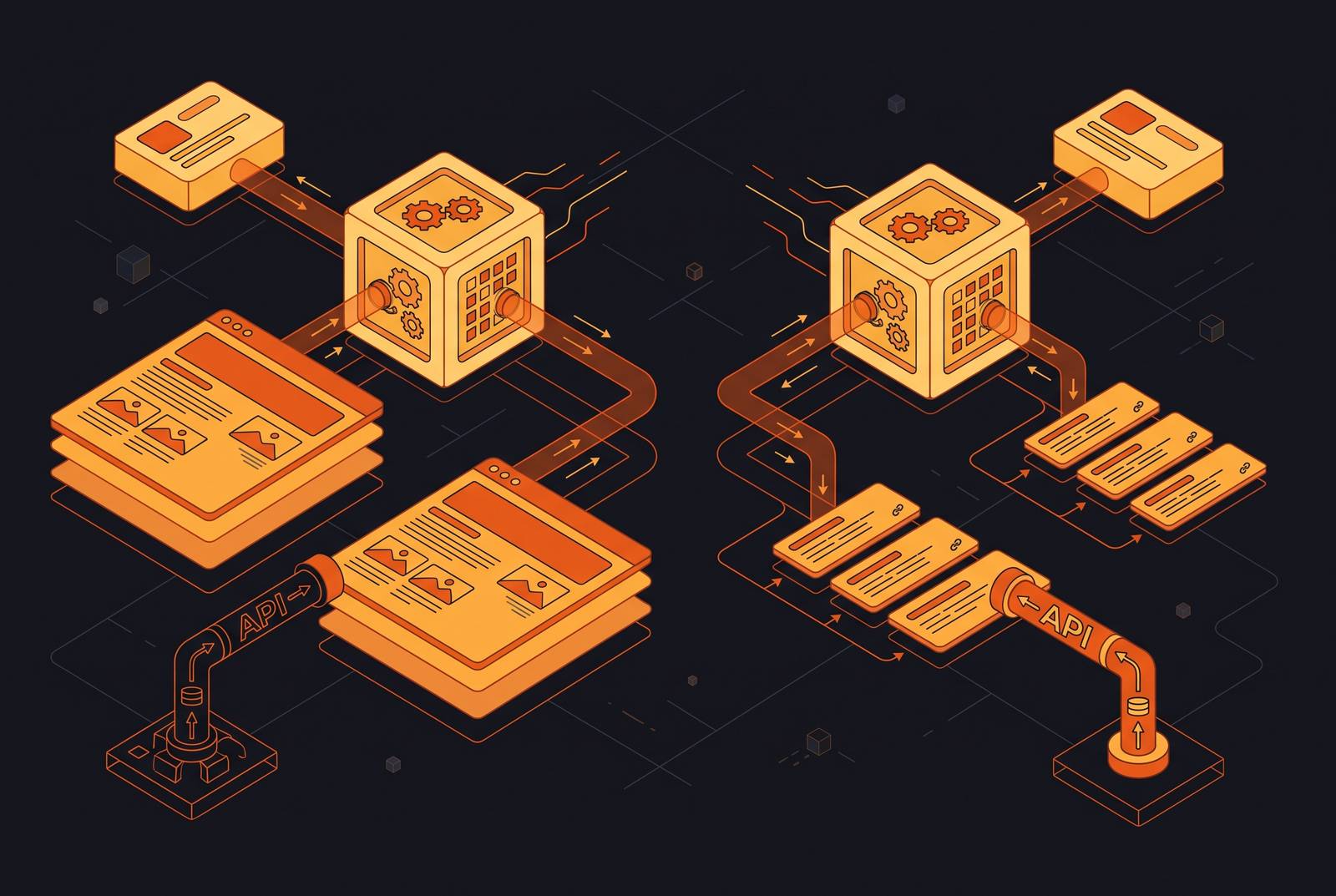
Conversational LLM agents have become routine consumers of web search, and the share of chatbot responses that trigger a web search is climbing fast across major platforms, as a study of ChatGPT, Claude, Grok, and DeepSeek documents. That shift means the infrastructure built to answer human queries is now being asked to serve a client it was never designed for. RAG formalizes this consumption pattern: rather than relying on training data alone, an application retrieves external evidence, places it in the context window, and asks the model to answer from it, as Confident AI's 2026 grounding guide describes. A person reading a search results page skims, judges, and clicks. An LLM agent reasons instead: it has to synthesize retrieved passages with what it already knows from training, resolve contradictions across sources, and produce a grounded, cited answer. That pipeline doesn't degrade gracefully when the retrieved material is thin. It simply breaks, because there's nothing substantial enough to reason over. The search layer underneath an LLM application is infrastructure with its own correctness requirements, and when that layer is mismatched to the job, the failure doesn't throw an error but surfaces later as a wrong answer delivered with full confidence.
What a snippet delivers and why it falls short of what an LLM needs
A search engine result snippet and what a language model needs to reason well differ in kind, not just in degree. A snippet runs a few dozen tokens, built to help a person decide in half a second whether a link is worth a click. A passage usable for grounded reasoning needs to run an order of magnitude longer, with enough surrounding context for a model to quote it accurately and cite it correctly. The core design mismatch is that a snippet is an index artifact, built for human triage, while a unit of evidence has to be built for a model to reason from. Structured documents compound the problem in the opposite direction. A clean markdown page naturally splits into several well-formed chunks along its heading boundaries, and those headings happen to be exactly the structure embedding models read best. A snippet pipeline, by contrast, hands the model one thin, weak fragment per search result, no matter how rich the underlying page actually is. Because each snippet carries so little signal, an agent has to pull in more results just to reach the same level of coverage a handful of full passages would provide, and that drives up both the number of calls made and the time and money spent making them. Freshness adds a separate failure mode on top of thinness. A snippet that looked accurate the day it was indexed can sit untouched for months while the underlying page changes, and the model has no way of knowing the ground has shifted under it, a failure researchers at S1 call silent staleness.
How modern agentic RAG pipelines use retrieved content
Classic single-pass retrieval fails on anything but the simplest question, and the failure is structural rather than occasional. A compound question needs several separate retrievals, each aimed at a different sub-question, and a single embedding search that returns one cluster of results on one topic leaves the model trying to stitch together an answer from parts that don't fit. Newer architectures exist to correct for exactly this. Corrective RAG re-runs retrieval when a check on the first batch of results comes back weak, and systems built on structured metadata and entity relationships, sometimes called Graph RAG, cut hallucination rates by more than 40% compared to retrieval over unstructured documents. None of these techniques work on a title and a one-line description. Routing adds a further layer of complexity beyond depth. Some sub-questions call for a vector search over passages, while others call for a structured data lookup. A question like "what is today's mortgage rate" needs a direct API call to a data source, not a passage search at all, so a retrieval layer built for agents has to support more than one way of finding an answer. What ties self-critique, corrective re-retrieval, and multi-hop synthesis together is that each one depends on a model being able to judge whether a passage actually supports the claim it's being asked to back. A snippet offers nothing to judge. It can only be read, not evaluated for whether it holds up. Retrieval infrastructure built for these patterns, one that owns its pipeline from search through delivery and treats freshness and content quality as the priority rather than raw result count, can support these richer loops without adding a separate extraction layer stitched on afterward to make shallow snippets usable.
The pipeline consequence: what changes when a snippet API sits at the top of a RAG stack
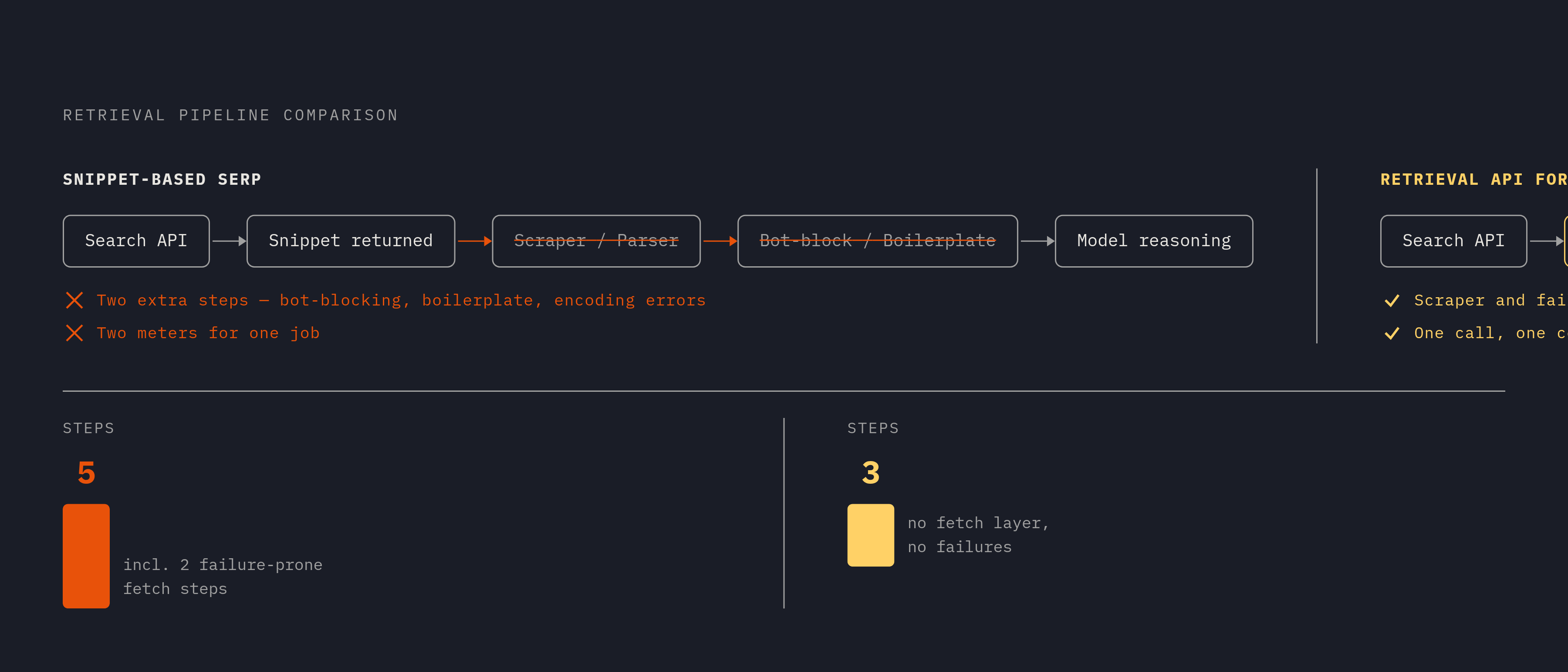
A traditional SERP API doesn't shorten the path from question to answer. A retrieval API built for this purpose collapses that same chain down to: search, then the model. The scraper and parser that a snippet pipeline needs to fill the gap left by thin results is where RAG projects run into trouble in practice. Bot blocking, boilerplate text mixed in with real content, encoding errors, and pages that only render properly in a browser all live in that layer, and most teams building on a snippet API end up having to build and maintain that fetcher themselves. The pricing looks simple until the full bill arrives. A snippet-only provider charges for the search call, and then the team pays again for a separate crawler to go fetch the actual page bodies. The team ends up paying two meters for one job, as Confident AI's 2026 analysis points out about snippet-only providers. The choice of search API ends up shaping far more than how many results come back. It governs how much of the web gets found at all, how fresh the content is, whether full pages get extracted or just fragments, whether JavaScript-heavy sites and PDFs are handled, whether citations can be traced back to a real source, how fast answers come back, how many tokens get spent, and how much retrieval infrastructure a team has to build and run on its own. Thin retrieval content doesn't just lower answer quality. It worsens a separate, well-documented failure: research cited by Confident AI found that up to 57% of evaluated citations showed signs of being rationalized after the fact rather than genuinely grounded in the retrieved source, and starting from a thinner passage gives a model less to actually check its own claim against. The gap between a snippet and a full passage, in other words, has driven the rise of retrieval APIs built specifically for machine consumption that deliver content already shaped and filtered for a model to reason over rather than leaving a team to patch the gap with scraping and post-hoc extraction.
The legal and structural risks accumulating under scraper-based SERP pipelines
Beyond the engineering cost, scraper-based SERP APIs carry legal exposure that most teams haven't priced into their planning. On December 19, 2025, Google LLC filed a complaint that takes direct aim at the scraping-based SERP API model, and the case has not been resolved. That sits alongside a structural dependency risk that hit teams earlier the same year: Bing retired on August 11, 2025, taking one of the two dominant licensed sources of SERP data off the table and pushing pressure onto whatever alternatives remained, with no warning period that matched the time teams needed to rebuild. Contract terms add a third, quieter risk that's easy to miss during setup. Storing API results in a vector cache is standard practice in RAG, but some snippet API plans only grant the storage rights needed for that at a specific paid tier, and a team that hasn't read the fine print may already be out of compliance without knowing it. A scraper-based pipeline can be fast and cheap to stand up on day one, but it accumulates legal, contractual, and structural fragility over time that an owned-index alternative simply doesn't carry in the same way.
Evaluating a Web Retrieval API for Production LLM Grounding
Judging a retrieval API meant for production LLM grounding calls for a different scorecard than judging a search tool built for a person typing queries into a browser. Confident AI's 2026 ranking methodology lays out the relevant dimensions as retrieval relevance and coverage, usable page content depth, support for dynamic and document-based content, source control and provenance, agent integration, latency and cost, and overall production fit. Relevance and coverage ask whether an API turns up useful sources across factual, technical, current-event, and research questions alike, rather than defaulting to whatever pages already rank highest in popularity. Usable content asks a more basic question: does the API hand back material a model can actually reason from, or does it stop at a title and a snippet and leave the team to go fetch the rest? Support for dynamic content and documents matters because a large share of the live web only renders properly in a browser, so an API needs to handle JavaScript-heavy pages, PDFs, and office documents directly rather than failing silently on them. Source control and provenance cover whether a team can filter by domain, date, region, and content type, and whether the API keeps the original URL attached so a citation can be traced back and checked later. Agent integration is about whether the API drops cleanly into tool-calling loops, MCP clients, LangChain, and similar orchestration frameworks without forcing a team to write custom glue code to make it work. Latency and cost come down to whether a team can choose a fast, shallow retrieval mode for simple queries and a deeper extraction mode only when a question actually needs it, rather than paying premium rates on every single call, alongside whether the output format, error handling, and rate limits can survive sustained production traffic. Freshness and data governance round out the list: how often the index updates, what storage rights the contract grants, whether the provider trains on submitted queries, and what the deletion terms look like all need to line up with whatever compliance rules the team actually operates under.
Seltz and the leading retrieval API options compared on those criteria
None of the options in this category are interchangeable once the criteria above are applied. They differ in where they sit in the pipeline, what format they return, and what infrastructure a team still has to build on top of them, so the right choice depends on what a given pipeline actually needs rather than on which provider lists the most features.
Seltz is built specifically for AI agents, with LLM applications and RAG pipelines named as its primary use cases rather than treated as an add-on to a general search product. It owns its data pipeline from end to end, delivering content that's already filtered, ranked, and shaped for machine reasoning rather than handed over raw. Because it returns content at the depth a model actually needs rather than SERP snippets, it removes the separate fetcher layer that snippet pipelines require, along with the bot-blocking, boilerplate, and encoding failures that tend to live in that layer. The filtering, ranking, and formatting happen inside the pipeline itself rather than being left for an application team to build afterward, which makes it a reasonable fit for production RAG pipelines, multi-step agentic research, and enterprise teams that can't accept a third-party training-on-inputs clause or a dependency on an index that might get retired without warning.
NewsCatcher's CatchAll product takes a recall-first approach, built around the idea that for certain use cases, missing a result is worse than returning too many. It runs each query through a five-stage pipeline, analyzing, fetching, clustering, validating, and extracting from more than 50,000 candidate pages, and returns structured, deduplicated JSON records checked against the original query. The records it returns come with extracted entities, source citations, and publication dates attached, putting it closer to the retrieval API end of the spectrum than the plain snippet end. Pricing runs from a free tier with a modest credit allowance up through Starter and Scale paid tiers at progressively higher monthly rates, with credit volumes varying by plan. It suits compliance monitoring, M&A tracking, funding intelligence, and other recall-first work where a missed event carries real consequences.
Olostep operates as a broader web data platform, combining search, scraping, crawling, and structured extraction in one product. It supports markdown and structured JSON output built for LLM consumption, and handles JavaScript-heavy pages directly with built-in rendering and anti-bot handling. That combination makes it a reasonable choice for teams building their own custom AI search infrastructure who need to own the full extraction layer themselves and expect to deal with JavaScript-heavy or aggressively bot-protected sites at scale.
Weighed against the evaluation criteria, the three sit in different places on the spectrum between raw snippets and fully reasoned context. The right pick depends on whether a team needs maximum recall across breaking events, full control over its own extraction layer, or content already shaped for a model to reason over without extra infrastructure in between.
Sources
- 7 Best Web Search APIs for Grounding LLMs in 2026 - Confident AI
- Best Web Search API Available in 2026
- Characterizing Web Search by Conversational LLM Agents: From Search Decisions and Strategies to Results and Responses
- Best Web Search APIs: Compare Top Search API Tools
- Web Grounding LLMs Benefits and Implementation
- LLM Grounding with Fresh Web Data Pipelines
- Enterprise RAG Platforms Comparison 2026: Full Tool Breakdown