Why Full Crawl-to-Serve Ownership Changes Agent Reliability at Runtime
Unified pipeline ownership makes retrieval failures visible and correctable before generation fails.
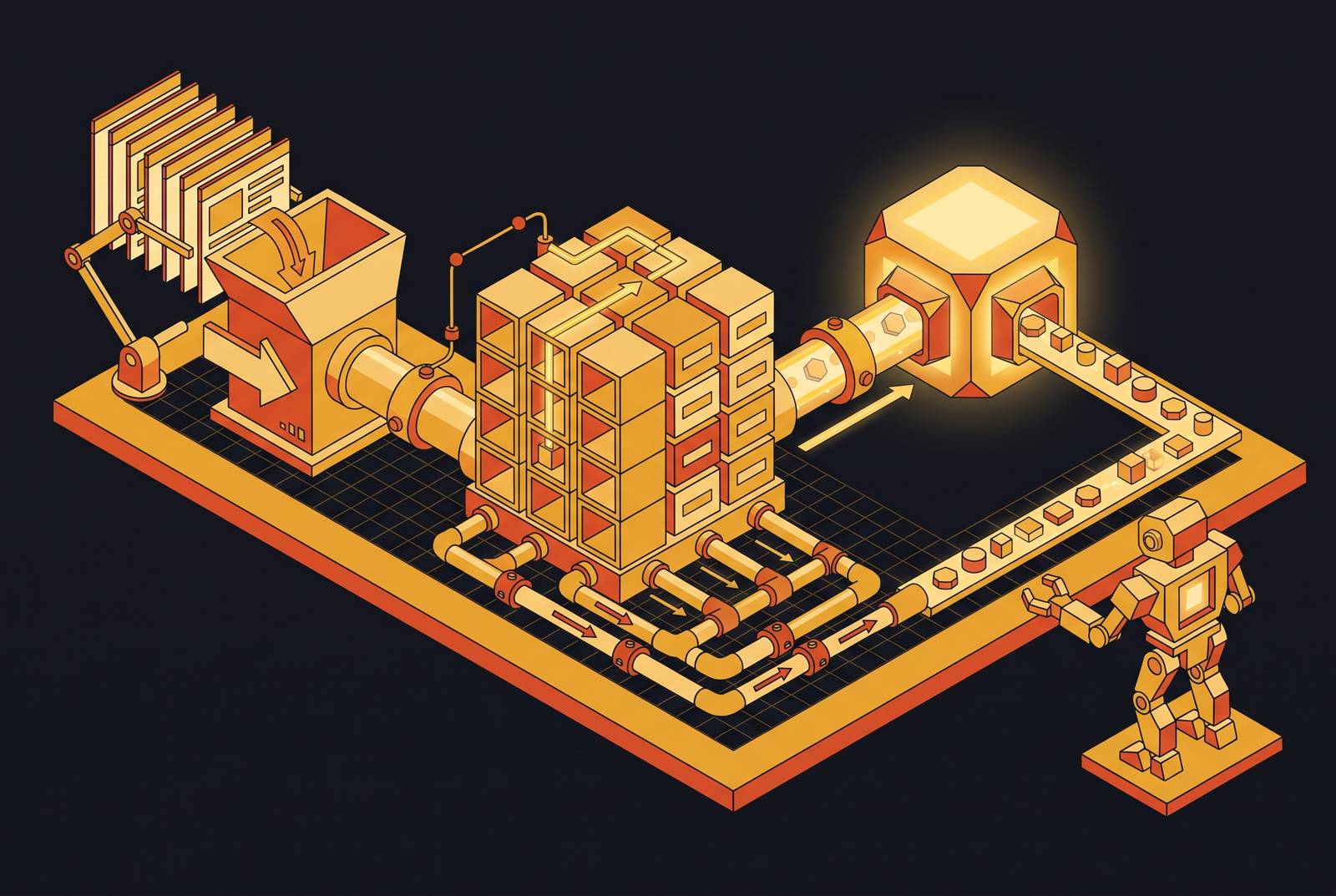
Full end-to-end pipeline ownership for web retrieval means one accountable party controls crawling, extraction, filtering, indexing, ranking, and context serving. It changes agent reliability at runtime because failures can be traced and corrected across the whole path. Orchestration cannot recover missing content or reconstruct accountability that disappeared between providers.
How agents actually consume web knowledge at runtime
A web-grounded retrieval-augmented generation pipeline begins when an agent issues a live search. A crawler fetches the target pages, their content is extracted and filtered, and that context goes into the prompt before generation starts. Each step depends on the preceding one. Search identifies what might be useful, while fetching and extraction determine what the agent can actually read.
Elnaffar & Rashidi (2026) describe agents through a perception-reasoning-action cycle in which each action modifies the environment and constrains subsequent decisions. Their framework distinguishes observational, grounding, execution, and decision failures. A retrieval error can cross those boundaries. Degraded input affects reasoning, which then shapes the action taken and the conditions for the next decision. Cruz (2026) places this activity at runtime, after planning has begun and beyond what static orchestration or offline analysis can settle in advance.
Why fragmenting custody across that chain is a structural reliability problem, not a tooling gap
When different parties control each stage in turn, a party’s responsibility can end before anyone can see the effects of its stage. The receiving component processes what it receives, while the supplying component has no responsibility for the eventual answer. No owner connects the two outcomes. A failure can then pass through the chain as context that looks usable, so generation quality may be the first sign that something went wrong.
Atolio (2026) identifies knowledge fragmentation as one of nine structural failure modes that stall an agent program’s scaling. Disconnected silos with poor native search require fan-out retrieval that is slow, expensive, and grounded on stale data. More monitoring does not remove those separations. The proposed remedy is a single, permission-aware retrieval layer, updated in real time and ranking across sources in one query. The distinction is architectural, because observability added afterward cannot reconstruct accountability that was absent when the handoff occurred.
Three failure modes that only become visible once fragmentation has already done its damage
Retrieval drift misattributed to generation drift occurs when a single accuracy score combines failures that began in different stages. Without groundedness scores gating retrieval quality separately from faithfulness scores gating generation quality, teams debug a composite signal. Atolio specifies per-agent quality and latency telemetry and retrieval grounded in a single high-quality index as reliability requirements. Those requirements support diagnosis, although they are not explicitly presented as a method for separating the two drift signals.
Garbage-in, garbage-out confidence describes an answer that sounds reliable because the model has put unreliable context into fluent words. In a RAG system, hallucination can originate upstream. Poor document chunking or weak vector similarity can feed low-quality context unchanged into generation, so how confident an answer sounds says little about whether it is correct. Elnaffar & Rashidi show that structural clarity and temporal validity indicators in the content layer make agents much more reliable and help them make fewer errors.
Wetzk (2026) introduces schema mismatch as an agent operating within an interpretive frame that no longer applies to the current context. Its output may remain internally consistent and linguistically plausible while being structurally invalid. Output-quality metrics alone cannot catch that distinction. Wetzk describes experiments that separate temporal knowledge drift from correctness and uncertainty in representation space, but spotting it requires an owner who monitors the retrieval layer that supplies the grounding facts. Across all three failure modes, locating the upstream cause requires visibility across the full crawl-to-serve path.
Why shallow SERP responses and scraping pipelines cannot close these gaps even with orchestration on top
Traditional search engine results page APIs return short metadata snippets, typically 120 to 160 characters. A pipeline still has to fetch each URL, run JavaScript, strip out boilerplate HTML, and extract structured text. Each added step is one more thing that must work before a search can yield usable evidence. Orchestration can put those steps in order, but that gives it no control over what happened inside each one.
Access can fail before extraction even begins. Anti-bot systems examine network behavior, browser fingerprinting, session patterns, and traffic consistency, producing blocked requests, partial crawls, degraded coverage, and region-specific denials. An extraction stage cannot repair content it never received. Passing raw HTML to a language model does not make this chain deterministic either. MLflow (2026) lists non-deterministic outputs as a production failure class, in which the same prompt can give different outputs across calls, though it does not tie that class specifically to HTML extraction.
The same limit applies to governance layered above retrieval. MLflow calls for deterministic policy enforcement beneath the model layer so that undesired actions are stopped before they reach the wire. Cruz describes AI Runtime Infrastructure as operating above the model and below the application, actively observing and intervening in agent behavior. Intervention depends on what the layer can see. An orchestrator cannot compensate for missing visibility into a retrieval component simply by issuing another call to it.
What end-to-end pipeline ownership actually provides that component assembly cannot
Under a single accountable owner, crawl, extraction, filtering, ranking, and context delivery remain distinct engineering stages without becoming separate islands of responsibility. Every failure has an owner and an audit trail. That makes the conditions for separating retrieval drift from generation drift available within the architecture, rather than dependent on cooperation after an incident. Cruz identifies execution-time intervention, long-horizon state awareness, and integrated recovery as requirements of the runtime layer. Full-path visibility gives that layer the basis for acting on a failure before its consequences propagate further.
Control also determines what reaches the prompt. Content that is selected, filtered, ranked, and shaped for AI reasoning reduces the risk of generating confident answers from unreliable context before generation starts. Elnaffar & Rashidi identify structural clarity, action cues, and temporal validity indicators as content-layer features that improve task reliability. An owner responsible for the whole path can make those features part of delivery. Atolio adds the operational requirements of real-time updates rather than nightly batches, cross-system ranking in one query, and per-agent retrieval scoping. Ownership is therefore the enabling condition for runtime guarantees.
Security and data control as runtime reliability requirements, not compliance additions
The retrieval boundary determines both what an agent knows and what data it can access. Security belongs at that boundary. Atolio describes agents connecting to external sources with the credentials of whoever built them, exposing systems to prompt injection, tool poisoning, indirect injection, and exfiltration. These risks follow the path through which information and authority enter the agent. A coherent security perimeter therefore depends on control over that path.
MLflow locates security at the skill boundary in the plugin and skill execution layer. It identifies the OWASP Agentic Skills Top 10 as a production checklist covering skill authorization, supply-chain integrity, and runtime isolation. These controls operate where actions and access occur. But content that goes through external retrieval or scraping infrastructure has already crossed a data-flow boundary before downstream policy can act. Later filtering cannot retroactively contain that exposure.
Atolio specifies query-time policy enforcement, scoped access per agent, and an architecture in which data does not leave the perimeter to be governed. Those properties require control where retrieval happens. MLflow also references EU AI Act Article 14 and its requirement for human oversight mechanisms in high-risk AI systems. Full-path auditability supports demonstrating that oversight, while disconnected audit trails leave gaps in the account of what the agent received and did.
What does end-to-end ownership cost versus fragment-and-orchestrate?
Building and operating an end-to-end pipeline in-house is genuinely difficult. Proxy management, anti-bot infrastructure, extraction, and context shaping all require sustained work, and enterprise teams can spend a large share of data engineering time keeping scrapers running. However, assembling external components does not eliminate that work so much as change where it appears. Every added source can increase the maintenance burden of a fragmented pipeline rather than represent a fixed, one-time integration cost.
Retrieval volume also changes the economic comparison. Atolio states that token spend rises with retrieval volume and identifies missing per-agent cost telemetry and usage caps as sources of compounding expense. Redundant tool calls and the absence of cross-system ranking amplify that exposure. The relevant comparison is therefore not construction cost against component subscription cost. It is the ongoing cost of operating a pipeline designed for the load against the less predictable cost of keeping disconnected components working together.
One accountable party can operate the chain internally or supply infrastructure purpose-built for the function. MLflow describes modular, microservices-inspired agent architecture with a defined routing layer as a way to keep failures apart, upgrade parts on their own, and reduce blast radius. Applied to retrieval, that principle supports an owned component with defined interfaces. The critical asymmetry remains that fragmented pipelines can fail silently, while an owned, observable pipeline makes failure audible enough to repair.
What pipeline ownership requires in practice for teams moving agents into production
The first requirement is control over the crawl layer, including access infrastructure, anti-bot handling, and coverage guarantees. Content failures need someone to take responsibility for them and a path to recovery. Extraction and filtering should also be deterministic rather than delegate structural decisions to a language model. MLflow’s broader warning about non-deterministic outputs supports that design requirement without establishing a separate, extraction-specific finding.
Context shaping must then have its own planned stage before information goes into the prompt. Ranking and filtering for AI reasoning give structural clarity and temporal validity a place in the pipeline. Freshness needs an explicit runtime guarantee as well. Atolio specifies real-time updates rather than nightly batches, addressing the stale grounding facts that can invalidate an agent’s working schema. Per-agent retrieval scoping and query-time policy enforcement belong at the same data boundary, where access can be controlled before content is delivered.
Structured audit logging must span the crawl-to-serve path so that runtime governance has a usable account of both retrieval and generation. For buyers, the decisive criterion is control over crawling, indexing, and serving infrastructure under one accountable party, together with extraction, filtering, and context shaping. A search response alone does not establish that control. Purpose-built infrastructure must deliver machine-ready context through an owned, observable pipeline, rather than leave the remaining stages to an unaccountable chain of integrations. Cruz supplies the organizing principle for that requirement, because execution-time intervention can work reliably only when the retrieval layer beneath it is designed to support intervention.
Sources
- Building Production-Ready AI Agents in 2026
- Epi-Logic: A Conceptual Framework for Epistemic Runtime Control, Schema Validity Checking, and Controlled Accommodation in Autonomous AI Agents
- Designing Agent-Ready Websites for AI Web Agents: A Framework for Machine Readability, Actionability, and Decision Reliability
- AI Runtime Infrastructure