Real-Time Web Grounding for Financial LLM Applications
Financial LLMs need live data to answer real-time questions accurately.

An analyst who asks a large language model for a stock's current price, or for the market's reaction to a filing made this morning, is asking a question that the model's frozen weights cannot answer correctly. The parameters were set during a training run that ended on some fixed date, and nothing about the architecture changes after that point unless a separate system intervenes. Research on the FinBloom project states the underlying problem without much hedging: many financial tasks require access to real-time data from several sources to work with high accuracy and efficiency, and this sits beyond the capability of frozen LLMs that have no grounding in real-time knowledge and operate as static systems. A model that cannot see today's price or this morning's SEC filing is reasoning from memory, not from the market.
In finance, that gap carries a cost measured in decisions, not just in correctness. A valuation built on a three-month-old earnings figure is not a rough estimate; it is a wrong answer dressed as a current one.
Some teams have tried to close this gap through frequent fine-tuning, retraining the model on fresh data at short intervals. Two problems compound against that approach. The second, harder problem to engineer around: users of a fine-tuned model have no reliable way to verify what the model actually absorbed from the new data, so the model cannot be trusted in any context where a decision depends on the accuracy of newly introduced information.
The alternative keeps the model's weights frozen and stable, and adds external grounding modules that inject fresh context at inference time. This sidesteps both problems at once: the weights remain fixed and auditable, while the facts the model reasons over arrive live, pulled in at the moment the question is asked.
What financial data demands from a grounding system
Grounding a language model in finance asks more of the system than grounding one in most other enterprise domains, because three things have to be true simultaneously: the data has to be fast, it has to come in more than one format, and every answer has to be traceable back to a document someone can point to.
A production financial system has to handle three distinct data streams at once, and each behaves differently. Each stream carries its own update frequency and its own structural format, and a grounding system has to reconcile all three without flattening them into a single, generic retrieval problem.
Velocity is not a secondary concern here; it is close to the whole challenge. A retrieval system that refreshes its index on a schedule, rather than querying live, builds delay into its own foundation.
Matching freshness windows to data type takes real engineering discipline. Price data and breaking news demand access that is close to instantaneous. Treating all three streams as though they share one freshness requirement wastes compute on data that doesn't need second-by-second refresh, or produces errors in the stream that does.
Regulatory traceability introduces a constraint that barely exists in most other AI applications. When an answer rests on a specific SEC filing or a specific policy document, that answer has to trace back to the exact source it came from, because a financial services analyst may need to produce that citation for a compliance review. An answer that happens to be correct but cannot be traced to its source document does not satisfy that requirement.
Domain language compounds the difficulty further. A retrieval system has to resolve what a term means in financial context before it can decide which document actually answers the question, and that traceability requirement, more than any accuracy metric alone, is what a financial institution relies on to trust a retrieval system's output.
The FinBloom grounding loop as a reference architecture
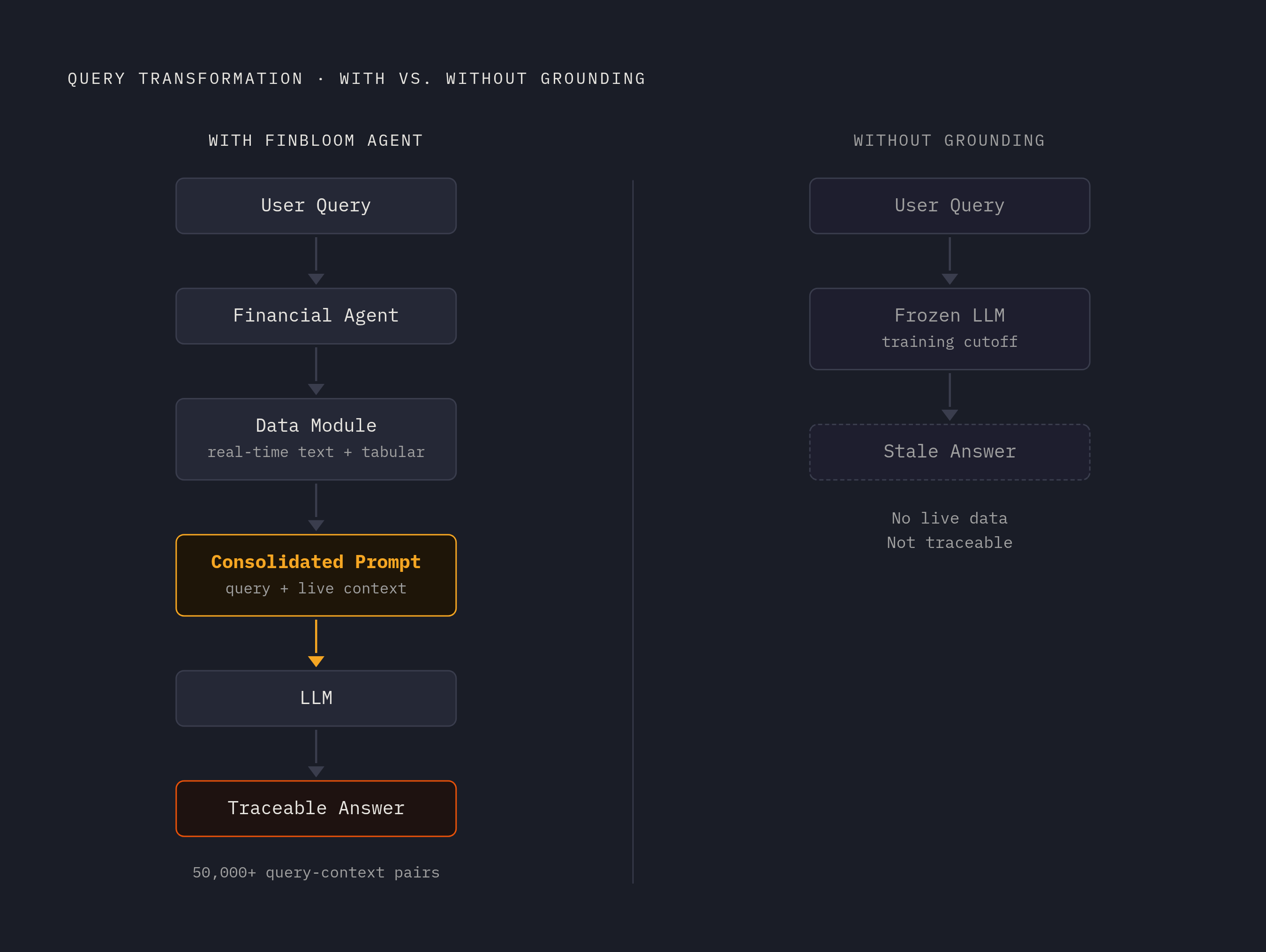
The FinBloom research gives a concrete, working picture of what grounding looks like once it moves past the concept stage. The paper introduces the Financial Agent, a knowledge-grounding approach built so an LLM can handle financial queries using real-time text and tabular data together.
FinBloom's designers chose an agent-based procedure specifically because financial data arrives in high volume and at high velocity, conditions under which high-latency approaches are poorly suited. The pipeline is built from three integrated components. The LLM itself sits downstream of both, and it never receives a raw query; it receives a consolidated prompt that already contains the retrieved context.
The sequence runs like this: when a user submits a query, the Financial Agent reaches into the Data Module's real-time repositories, converts the retrieved numeric and textual data into a textual representation the model can read, and appends that representation to the original query to form one consolidated input. Before this loop exists, an LLM answering a financial question draws only on whatever it memorized during training, frozen at a fixed point in the past. After this loop runs, the same model answers from context assembled at the moment of the query, built from data the model never saw during training.
A news event and the price movement it triggered are two halves of one question, and a system that retrieves only one of the two gives an analyst half an answer.
FinBloom's Financial Context Dataset, built specifically for this task, was constructed from over 50,000 financial queries, each paired with the context required to answer it; that purpose-built dataset is why this architecture performs the way it does. That scale of purpose-built training signal indicates something about the difficulty of the underlying task: grounding financial queries correctly is not a matter of wrapping an existing retrieval tool around a model, but a task that benefits from training data built specifically to teach a system what context a financial question requires.
Where financial grounding succeeds or fails: retrieval architecture
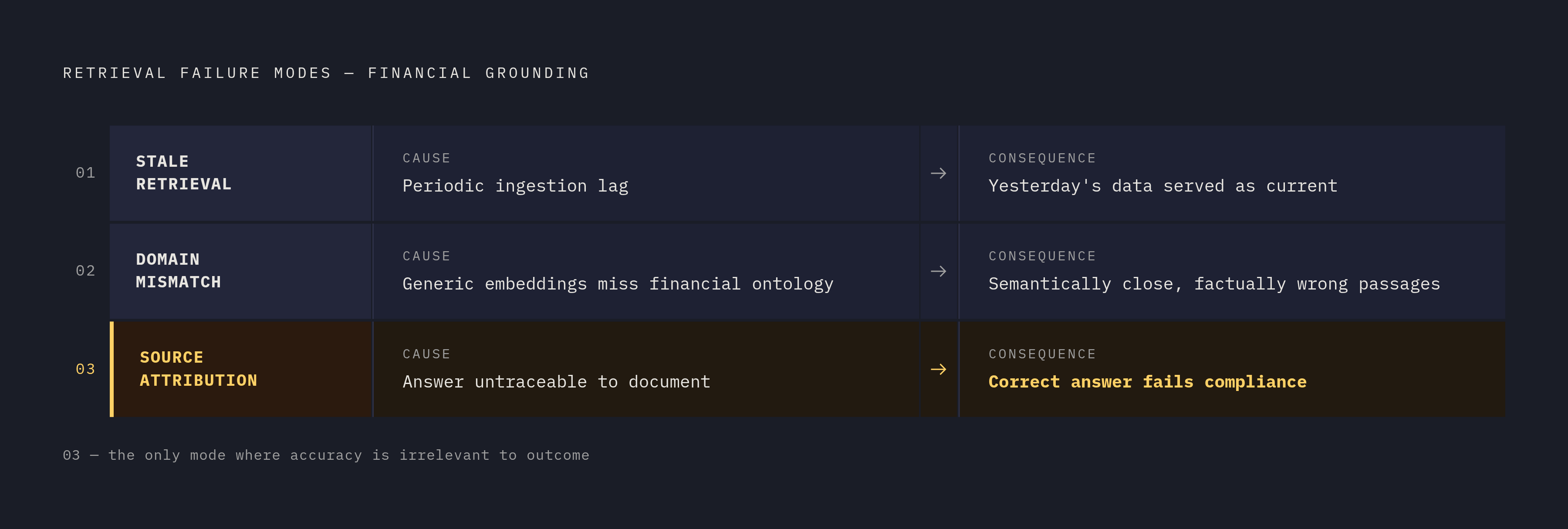
Once grounding is accepted as necessary, the harder question is where grounding systems actually break. Most grounding failures in financial AI trace back to the retrieval layer rather than to the language model itself, which makes retrieval architecture, not model selection, the central engineering decision for any team building this kind of system.
Three distinct failure modes live in that layer. Stale retrieval occurs when periodic ingestion schedules introduce latency, risking a system that serves yesterday's data as though it were today's. Domain mismatch occurs when a generic retrieval system fails to resolve financial acronyms or handle instrument-specific ontologies, producing retrieved passages that read as semantically related but are factually wrong for the question asked.
Fintech-specific agentic retrieval-augmented generation (RAG) addresses domain mismatch directly through a modular pipeline: query reformulation, sub-query decomposition through keyphrase extraction, acronym resolution handled by a dedicated acronym helper agent, and cross-encoder reranking of the retrieved results. The acronym resolution step carries particular weight, because financial abbreviations left undefined or contextually ungrounded cause the retrieval system to surface entirely the wrong set of documents.
This modular approach comes with a cost that production teams need to weigh deliberately. In most domains, that trade might not justify the added time. In finance, it does, because an answer built on the wrong document does not just produce an inconvenience; it creates regulatory and financial risk that a few hundred milliseconds of latency does not come close to matching.
Web search as a retrieval source needs its own infrastructure layer
Internal corpora, however well built, cannot cover everything a financial AI system needs to answer. Breaking news, analyst commentary, and macro announcements originate on the open web, and the system that retrieves them from the web must be designed as carefully as the internal RAG pipeline discussed above.
A grounding system that only looks inward misses the most time-sensitive signals in the market.
A Vellum analysis draws a structural distinction that matters here: a web search tool can give an agent a pointer to content, a URL and a snippet, while a different kind of tool retrieves and structures the full content of the page itself. For a model trying to reason about a financial question, that difference is substantial, because reasoning over a pointer and reasoning over the actual document are not the same task.
The accuracy gap between snippet-only retrieval and full-page retrieval is not a minor rounding error. Much of the answer quality that matters lives in the body of the page, not in the snippet shown above it. For financial reasoning tasks, where the answer might be a specific figure buried deep in a filing or a qualified statement inside an analyst's note, snippet-based retrieval fails routinely at exactly the kind of question a financial analyst asks most often.
Query drift compounds the problem in agentic financial loops. As an agent reformulates its own queries across several iterations, it can drift away from the user's original question without anyone noticing until the final answer is wrong. A query normalization step applied before the query reaches the search API anchors it semantically to the original intent; reranking the results after the fact cannot repair drift that already happened upstream of the search call.
A further complication sits in the retrieval market itself: many web search tools marketed toward AI agents are wrappers built on top of the same underlying index, so two differently branded tools can return identical results under the hood.
A purpose-built web search API designed for AI agents, one that returns cleaned, chunked, and semantically structured text, complete with source URLs and publication dates already formatted for prompt injection, collapses the fetch-parse-clean-chunk pipeline that a snippet-based API forces onto every single request. For financial grounding, that architectural choice affects both how fast an answer arrives and how fresh the information behind it actually is.
Citation integrity and source traceability as non-negotiable requirements in regulated finance
An AI-generated answer that cannot be traced to a verifiable source creates regulatory exposure in a regulated financial context, regardless of whether the answer turns out to be correct. Correctness alone does not satisfy a compliance requirement; traceability does.
RAG-based grounding builds citation into the system by design. Because each answer gets assembled from specific, identifiable documents retrieved at query time, the system can attach the exact source, whether that is a filing, a news article, or a policy document, directly to the claim it supports. A financial services analyst can then trace that AI-generated answer back to its underlying document, satisfying audit and compliance requirements; a frozen model has no document to point back to for the answer it produced.
This turns the choice of retrieval source into a compliance decision, not merely a quality decision. If a source cannot be identified, versioned, and handed to an auditor on request, the answer carries regulatory risk even when the underlying fact is accurate. A team that evaluates retrieval tools purely on speed or topical coverage, while treating provenance as an afterthought, builds a compliance gap it will eventually have to retrofit at greater cost than building it correctly the first time.
Publication dates on retrieved sources carry weight in finance that they rarely carry elsewhere. A piece of regulatory guidance published two years ago may since have been superseded by newer rules. A news article timestamped before a market event tells an entirely different story than the same article timestamped after that event. The retrieval layer has to surface and preserve these timestamps, both so the language model can reason about them correctly and so the audit trail behind the answer holds up under review.
Security and data ownership requirements that financial AI teams cannot defer
Security and data ownership belong at the retrieval layer itself, not as a perimeter control bolted on after a grounding architecture is already built. A financial AI team that treats access control as a later addition is building the system in the wrong order.
Access controls have to be enforced at the point where data is retrieved, before the application's front end is ever reached. If a retrieval system surfaces a document that the requesting agent was never authorized to access, the grounding answer built from that document inherits the same exposure. Inside a financial institution, unauthorized data access carried out through an AI intermediary carries the same regulatory weight as unauthorized access carried out directly by a person.
The risk this creates is concrete.
Multi-agent financial systems add another layer of difficulty: data lineage has to stay traceable across every agent boundary in the system. The causal chain connecting a data source to an agent's eventual decision has to be reconstructable, and that requirement applies not just to the final output an analyst sees, but to every intermediate retrieval step and every reasoning step that led there.
Prompt injection detection, PII scanning, and output validation now function as production requirements in regulated finance. These checks need to be built into the retrieval and grounding pipeline itself, not applied only once a response has already been generated and is on its way out.
Regulatory-grade deployments require that the entire grounding stack, retrieval, processing, and inference together, operate inside the institution's own infrastructure boundary. A grounding system that requires data to leave the institution's virtual private cloud disqualifies itself from many financial use cases no matter how strong its retrieval quality otherwise is. Enterprise teams should not have to trade retrieval quality for data control. An infrastructure layer that owns its full pipeline, end to end, can treat data residency, access permissions, and audit logging as first-class parts of the system's design.