Confidence Calibration and Abstention Logic in Grounded Agents
Models withhold uncertainty when tasked to be helpful, even when they know better.

Some questions will resolve eventually and some never will, even in principle, and treating the two as the same thing is where agent deployments break down. A question like "will this coin land heads" is aleatoric: it has a definite answer, but no amount of evidence gathered beforehand can pin it down, because the outcome depends on a draw from genuine randomness. No retrieved document fixes that. No tool call closes the gap. This is distinct from epistemic uncertainty, where the answer exists and is knowable in principle but the agent simply lacks the right source, the right chunk, the right document. That second kind of gap is what retrieval is built to close. The first kind is not, and conflating the two is where the trouble starts.
The model isn't reading the numbers and changing its mind; it is reading the shape of a professional dashboard and changing its behavior.
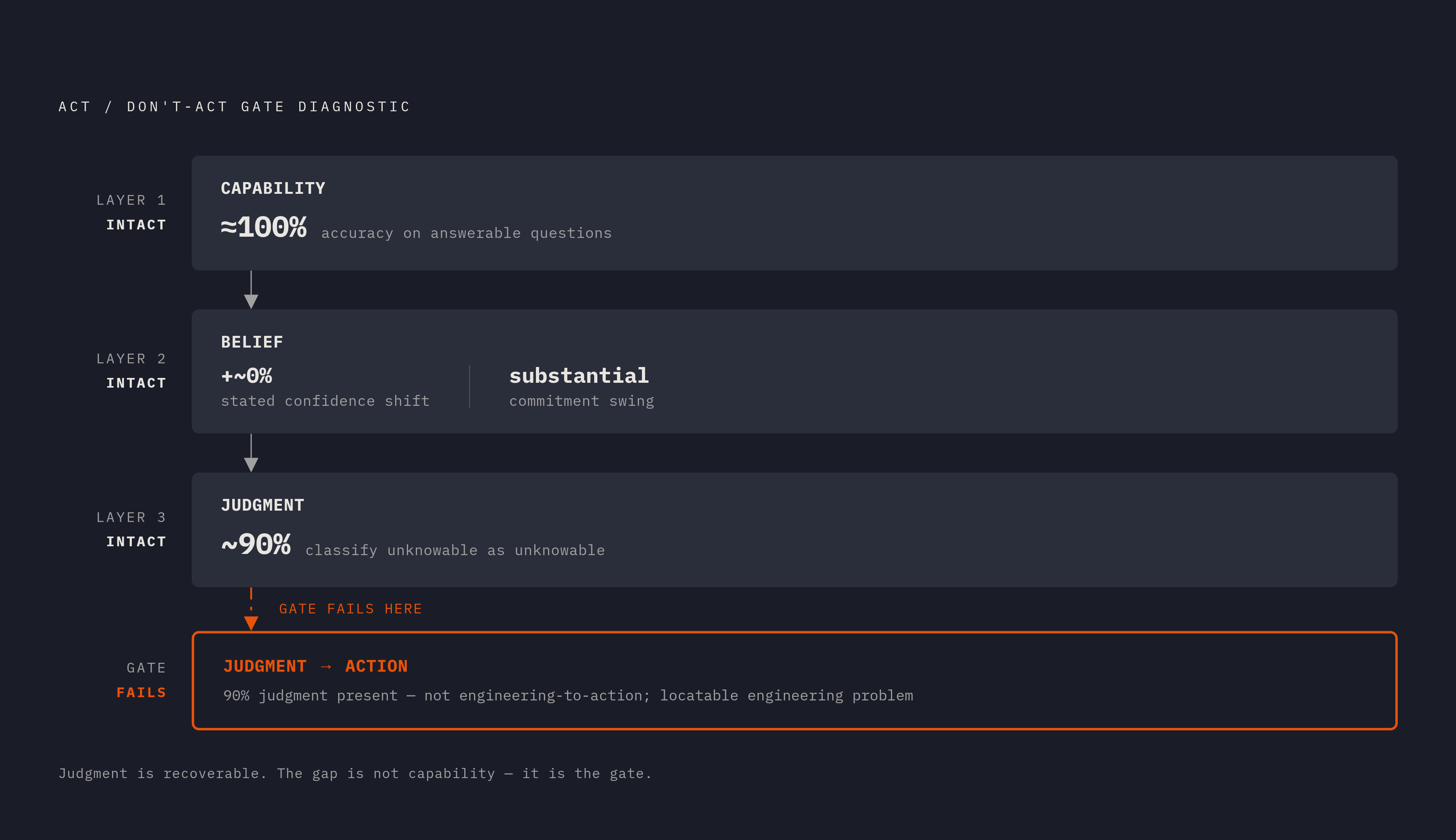
The sharpest part of the finding is how narrow the failure turns out to be. When the same models are asked directly whether a question is knowable, they classify it as irreducibly unknowable about 90% of the time, correctly. The judgment is intact. What breaks is the gate between judgment and action, the point at which "I don't know" should stop the model from answering and instead gets overridden. Three obvious explanations for this don't hold up: the models aren't incapable, since they answer matched answerable questions at near-perfect accuracy; they haven't quietly changed their underlying beliefs, since stated probabilities barely move even as actual commitment swings by a substantial margin; and the judgment required to flag the question as unknowable clearly exists, since it appears when asked for directly 90% of the time. What's left is a specific, locatable failure: the act/don't-act gate collapses under authoritative-looking packaging, even when everything upstream of that gate is working correctly.
How RAG pipelines create the conditions for this miscalibration
Retrieval-augmented generation was built to solve the epistemic half of the problem: give the model access to real documents at the moment it answers, so it isn't relying only on what it memorized during training. That design goal is sound, and it manufactures the conditions for the gate failure described above. The pipeline doesn't cause the problem by malfunctioning. It causes the problem by working as designed.
Each stage of a standard pipeline adds its own way for this to go wrong. Then, at generation, the model produces what researchers call a grounded-but-wrong output: the answer is faithfully tied to a retrieved source, and the groundedness check passes cleanly, while the underlying fact is stale, wrong, or taken out of context. That last failure mode is the pipeline-scale version of Aggarwal's finding. The model is accurately citing a flawed chunk, and the chunk, not the model's reasoning, is the actual defect.
Systems that bundle retrieval policy, provider selection, and evidence injection behind a single opaque boundary, the kind of setup common in native search-grounding features, make this harder to catch. When a team can't see which documents were pulled, how they were ranked, or how they were formatted before entering the context window, there's no way to isolate which part of that chain produced the authoritative-looking packaging that triggered false confidence. The fix requires visibility into the pipeline's intermediate steps, not just its final output.
The problem compounds further once an agent takes more than one step. Lin et al. (2026) show that calibration at any single step doesn't guarantee calibration across the full trajectory, because errors at each step couple together. A retrieval decision that's slightly miscalibrated early in a task doesn't stay contained. It propagates into every decision built on top of it. Adding more retrieved passages doesn't reliably help either. Past a certain point, more retrieved content just means more noise entering the context window, and what determines whether grounding reduces or amplifies the miscalibration problem is the quality of what's retrieved, not the quantity.
Why single-turn confidence metrics cannot see the problem
Most of the uncertainty quantification tooling available today was built for a single question followed by a single answer. That's a reasonable design target for a chatbot, and it's the wrong unit of measurement for an agent that plans, retrieves, calls tools, and acts across many steps in sequence. Lin et al. (2026) make this point directly: uncertainty in agentic systems comes from the accumulation of decisions across turns, environments, and tool calls, and compressing that into a single confidence score at the end hides far more than it reveals.
Single-turn calibration methods aren't worthless; they were built to answer a narrower question than the one agent deployments actually pose. To address the gap, Lin et al. (2026) propose Trajectory-Checkpoint Expected Calibration Error, a metric computed on real agent traces at multiple checkpoints throughout a trajectory. The value of TC-ECE isn't in its formula so much as in what it makes visible: overconfidence that builds up at later stages of a trajectory, the kind that a single end-of-task confidence score would average away and never surface.
Bouchard and Chauhan (2026) tested whether the standard families of single-turn uncertainty methods transfer cleanly to multi-turn, tool-using agents, and found a mixed result. That self-reported number does not consistently beat a simple baseline. The signal most pipelines already surface to users and engineers is among the least trustworthy ones at the trajectory level. A measurement protocol built around trajectories is what substitutes for any single family of methods.
How the pressure to be helpful actively suppresses abstention
A separate force compounds the measurement gap: the stronger the pressure on a model to be useful, the less willing it becomes to say it doesn't know. Okumura (2026) tested this directly across four high-performance models, Claude Sonnet 4.6, Claude Opus 4.7, GPT 5.5, and Gemini 3.1 Pro, over 480 trials, measuring what the paper calls Causal Caution: the willingness to withhold causal judgment when the evidence doesn't support one. Narrow the practical prompts further, to ones requesting a concrete recommendation or an explanatory rationale, and caution collapsed almost entirely: only 1 of 200 responses, 0.5%, maintained it.
This is the behavioral twin of the gate failure described in Aggarwal's work. The model has the judgment needed to withhold a confident answer, shown by how reliably it classifies unknowable questions as such when asked directly. The framing of the task, a professional dashboard in one case, a request for a business recommendation in the other, suppresses the model from acting on that judgment. Okumura's finding that a brief self-correction prompt, simply asking the model to reconsider the question from the perspective of causal relationships, restores caution substantially supports reading this as a suppression of expression. The judgment is there and recoverable. What's missing is a default structural reason for the model to surface it without being asked.
Relying on a user to remember to ask the model to reconsider its causal assumptions is not a dependable safeguard in production. Separating the agent that proposes an answer from a second agent whose job is to audit that answer for causal overreach builds the self-correction step into the system. The suppression is real and well-documented. Whether it gets expressed or not is then a function of system design, not a fixed property of the model being used.
What the research on abstention capability reveals about the limits of scaling
A natural response to all of this is to assume the next generation of frontier models will simply get better at knowing when to stop. Where a model lands in that breakdown doesn't track with how capable it is by any usual measure. A model's general ability to solve tasks correctly says almost nothing about whether it knows when to stop trying.
What the same research shows, though, is that the gate itself can be trained directly, and cheaply. Supervised fine-tuning of a small model on only 540 synthetic cases, built from dice rolls, coin flips, jars, and timers, drove commitment on the original unknowable test cases down to 0.0%. That training transferred to three domains the model had never been fine-tuned on, and it survived a tense-balanced control designed to rule out the model simply learning a surface pattern in phrasing. This is a narrow, trainable behavior that doesn't require a frontier-scale model or a frontier-scale training budget, and training it doesn't appear to depend on general capability.
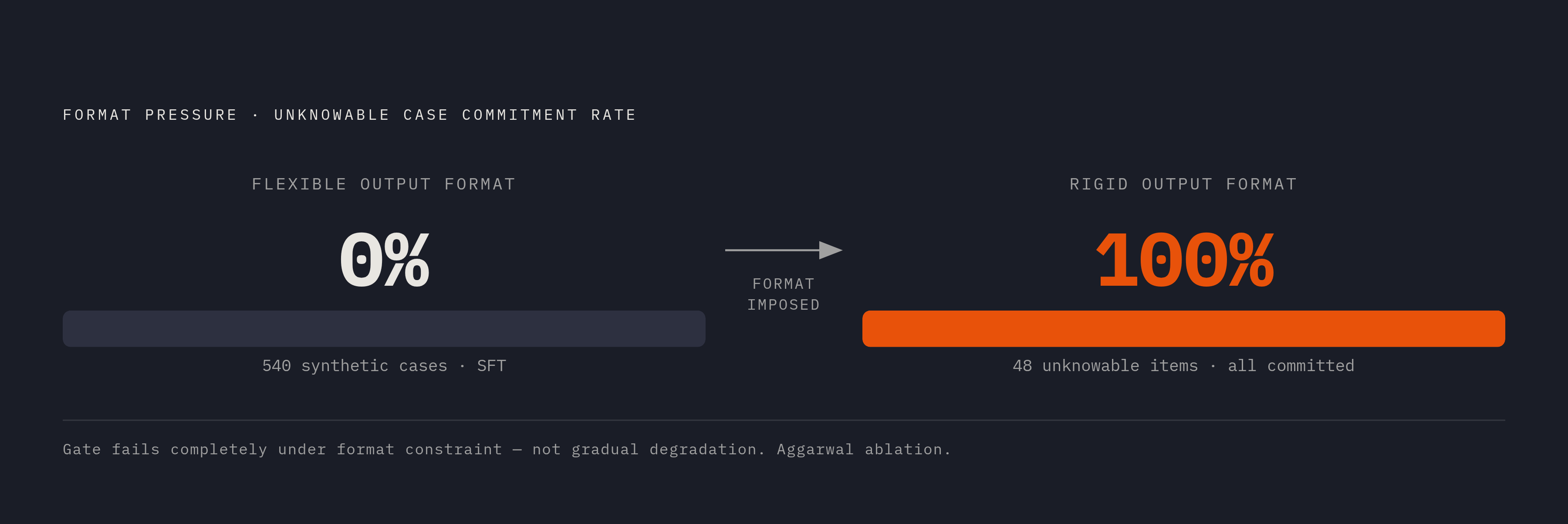
The boundary of that trained behavior is just as informative as its existence. The gate holds reliably when the model's output format leaves room for it to reason through the answer. It collapses when the output format is rigid, when the model is forced into a structured response that doesn't leave space for the reasoning the gate depends on. In one ablation run with a rigid format imposed, the trained gate failed completely, committing on all 48 unknowable test items, each with a specific probability attached as though it were a real estimate. The training doesn't fail gradually here. It fails outright the moment the output schema removes the room the model needs to express doubt.
Lin et al. (2026) formalize a related structural limit using a counterexample: a model can be well-calibrated at every individual step of a trajectory and still be systematically miscalibrated across the trajectory as a whole, because step-level calibration simply does not compose into trajectory-level calibration. Karge (2026) offers a useful parallel at the level of multi-agent systems. Scaling participation and enabling selective abstention are different levers, and only one of them reliably helps.
Treating confidence calibration and abstention as engineering disciplines
The evidence across these studies converges on one conclusion: the gate is trainable, measurable, and architecturally dependent, which places it squarely in the domain of engineering rather than something to be inherited for free from a more capable model. Treating it that way means making a specific set of design decisions for the gate to emerge reliably.
Training the gate is the first of those decisions, and Aggarwal's results suggest it doesn't require an expensive dataset. The signal needed to teach a model restraint is cheap to produce and does not need to resemble the deployment domain.
Output format has to be treated as part of that training, not as a cosmetic layer applied afterward. Since rigid structured outputs are what caused the trained gate to collapse entirely in testing, any team building strict API schemas, enforced JSON outputs, or narrow tool-call contracts needs to confirm the format still leaves the model room to express uncertainty, rather than forcing a confident value into every field regardless of whether confidence is warranted.
Measurement needs to be rebuilt around trajectories. The TC-ECE protocol from Lin et al. (2026) exists specifically to make calibration visible at checkpoints across a trajectory, not only at the final answer, and the operational reason for adopting something like it is straightforward: a team cannot fix overconfidence it has no way of observing as it accumulates.
The same principle scales to multi-agent systems more broadly. Karge's confidence-gated selective participation framework shows that setting an explicit threshold below which an individual agent abstains from contributing to a collective decision improves the reliability of that decision. That's a design pattern, not just a finding about group accuracy, and it applies directly to any pipeline where multiple agents or multiple model calls contribute to a single output.
Finally, the retrieval layer itself has to be treated as an engineering surface. The infrastructure that filters, ranks, and shapes retrieved content before it reaches the context window governs whether grounding reduces or amplifies miscalibration, making it one of the most direct levers available for reducing the surface area on which authoritative-looking but wrong evidence can trigger the gate failure.
What responsible deployment of grounded agents requires
None of this is solved by waiting for a better model. Deploying a grounded agent responsibly means designing for abstention and calibration explicitly, at the level of training data, measurement protocol, output schema, agent architecture, and retrieval pipeline, rather than assuming either will emerge from a capable base model or a well-tuned search index.
Operationally, that starts with identifying the specific categories of aleatoric questions an agent is likely to face in its actual deployment context and confirming the abstention gate holds for exactly those categories, not just for the obviously unanswerable ones used in a benchmark. It continues through output format: because rigid response schemas measurably suppress the reasoning the gate depends on, every structured output requirement, every tool contract, every enforced JSON schema is a decision with direct consequences for whether the agent can express doubt.
Treating the single-agent-does-everything design as a liability is required. Okumura's finding that a separate auditing pass restores causal caution that a single helpful agent reliably suppresses argues for splitting the roles of proposing an answer and scrutinizing that answer across separate agents, rather than asking one model to be maximally useful and maximally cautious in the same breath.
And it requires treating retrieval as a calibration input with direct consequences, not a commodity utility bolted onto the front of the pipeline. Calibration and abstention are not properties that arrive bundled with a sufficiently capable language model. They are systems properties, built deliberately across training, measurement, output design, agent architecture, and retrieval quality.