Lost-in-the-Middle Problem and Re-Ranking for LLM Context Windows
Re-ranking retrieval results puts high-confidence chunks where models actually attend to them.

A retrieval-augmented pipeline does its job correctly: the right chunk of text comes back from the vector database, lands in the context window, and sits there available to the model. The model still gets the answer wrong. This is the pattern that gives lost-in-the-middle its name, and it is worth being precise about what it is not before describing what it is. It is not a failure of search, embedding quality, or chunking strategy. It is a structural property of how large language models attend to long sequences of text: it appears as a U-shaped performance curve, where accuracy is highest when the needed information is at the very start of the context, nearly as high when it is at the very end, and drops specifically for information placed near the center. Liu et al. identified this empirically in 2023, and the result has since been reproduced across multiple model families and task types.
The U-shape has an echo in human cognition. Three factors compound to produce it. At the same time, attention sinks, a well-documented pattern where early tokens in a sequence retain disproportionate attention weight, reinforce the primacy side of the curve and make early-positioned content even stickier.
Rutgers researchers Nikolaus Salvatore, Hao Wang, and Qiong Zhang offer a sharper account of why this shape exists. Their paper argues that lost-in-the-middle is an emergent adaptation to the mixed demands placed on a model during pre-training. The recency effect in the U-curve aligns with that short-term pressure. Salvatore, Wang, and Zhang trained GPT-2 and Llama variants from scratch on two simple memory paradigms built to simulate those two demands, and the same U-shaped curve emerged, and the result generalizes from those simple memory paradigms to sequence completion tasks that closely resemble the next-token prediction objective models are actually trained on. The bias is baked into the training dynamics that produce capable language models in the first place, not a bug introduced by careless engineering downstream.
Why bigger context windows do not fix positional bias
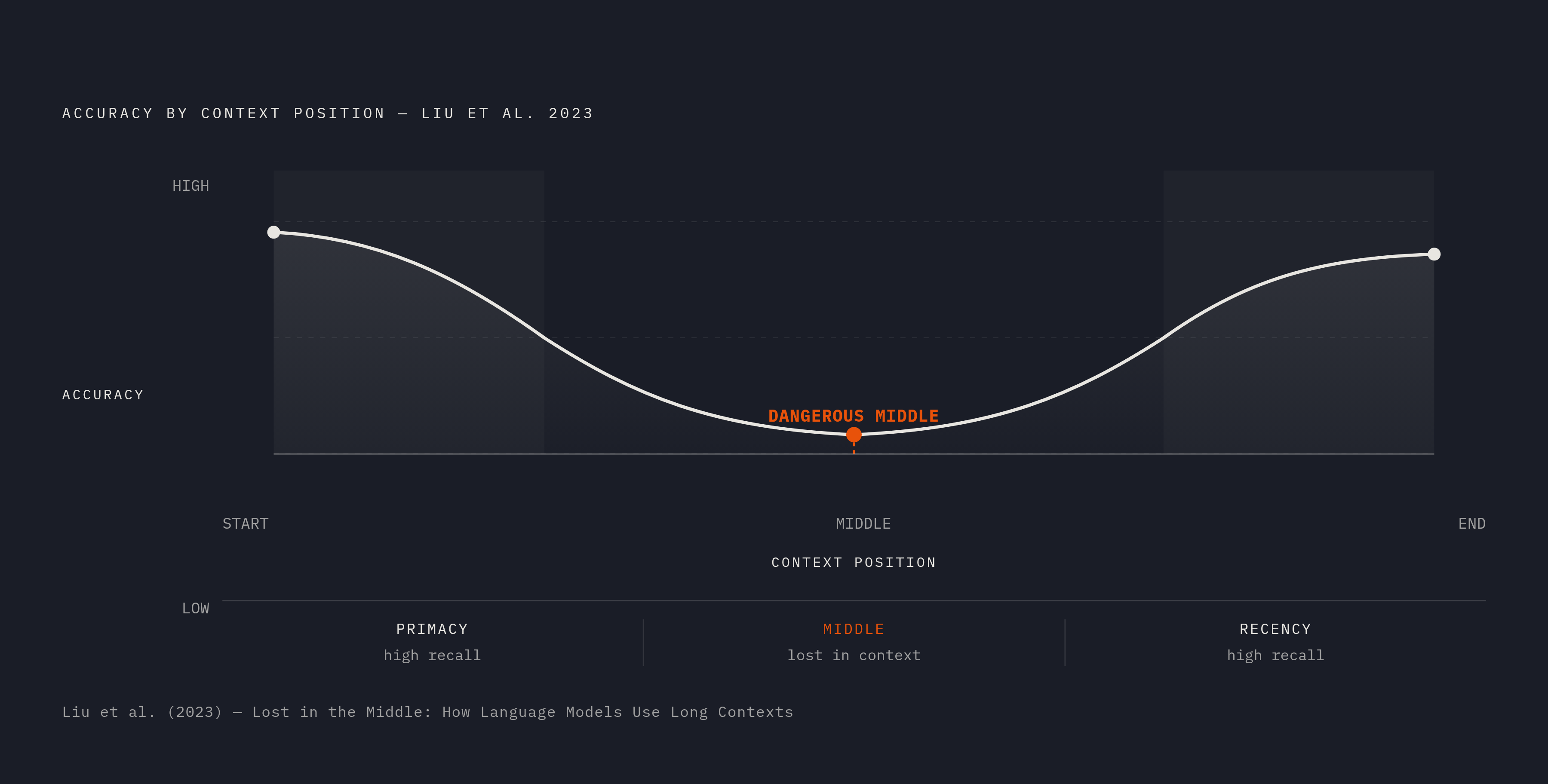
The obvious response to a U-shaped accuracy curve is to make the window bigger, on the theory that more room reduces the pressure on any single chunk's position. That instinct does not hold up. Expanding the context window increases how much text a model can accept, but it does not redistribute attention across that text. The U-shape persists at larger scales, and the middle zone, the region where accuracy drops, grows in absolute size as the window grows. A very large token window does not shrink the dangerous middle; it enlarges it.
Blerta Veseli, Julian Chibane, Mariya Toneva, and Alexander Koller, in a paper presented at COLM 2025, measured how positional bias behaves as inputs approach the limits of a model's context window, and the result complicates the naive picture further. The lost-in-the-middle effect is strongest when inputs occupy up to 50% of a model's context window. Signal density drops as irrelevant material accumulates alongside the few facts that matter. Stale instructions and deprecated definitions can sit beside current, correct content with no positional marker to tell the model which one to trust.
Future architectures with better attention mechanisms will not make this problem disappear on their own. Salvatore, Wang, and Zhang's account traces the bias to pre-training dynamics themselves, not to a specific, isolated attention implementation that a redesign could patch out. Even a model with meaningfully improved long-range attention still inherits whatever retrieval and ordering decisions the systems feeding it have already made. The problem relocates rather than resolves. If scaling the window cannot scale past the bias, the lever that remains is controlling what enters the window and where it sits once it does.
Concrete failures in RAG and agent pipelines from positional bias
Architecture becomes consequence the moment a retrieval system puts a correct answer into production use. In RAG and agent workflows, positional bias takes a retrieval success and turns it into an answer failure: the right evidence is retrieved, it is present in the context window, and it lands in a position the model systematically under-attends to. The retrieval log shows nothing wrong, because nothing about retrieval was wrong.
Three patterns recur across production systems. The sharpest version of this failure appears in agent workflows: a tool-use rule, an access policy, or an approval threshold gets set mid-session, and the agent, needing to act on exactly that rule later, misses it precisely because it now occupies the least-attended part of the context.
The mechanism behind all three is the same. A chunk can score highest on relevance and still be assembled into the worst possible spot. Veseli et al., cited in Salvatore, Wang, and Zhang's paper, make the underlying point directly: a model's ability to perform real-world tasks using its context window depends on retrieving the correct contextual information in the first place, and position governs whether that retrieved content gets used. This is a placement and ordering problem. Fixing it means intervening on placement and ordering, which is exactly the job re-ranking exists to do.
Why re-ranking is the right lever for placement
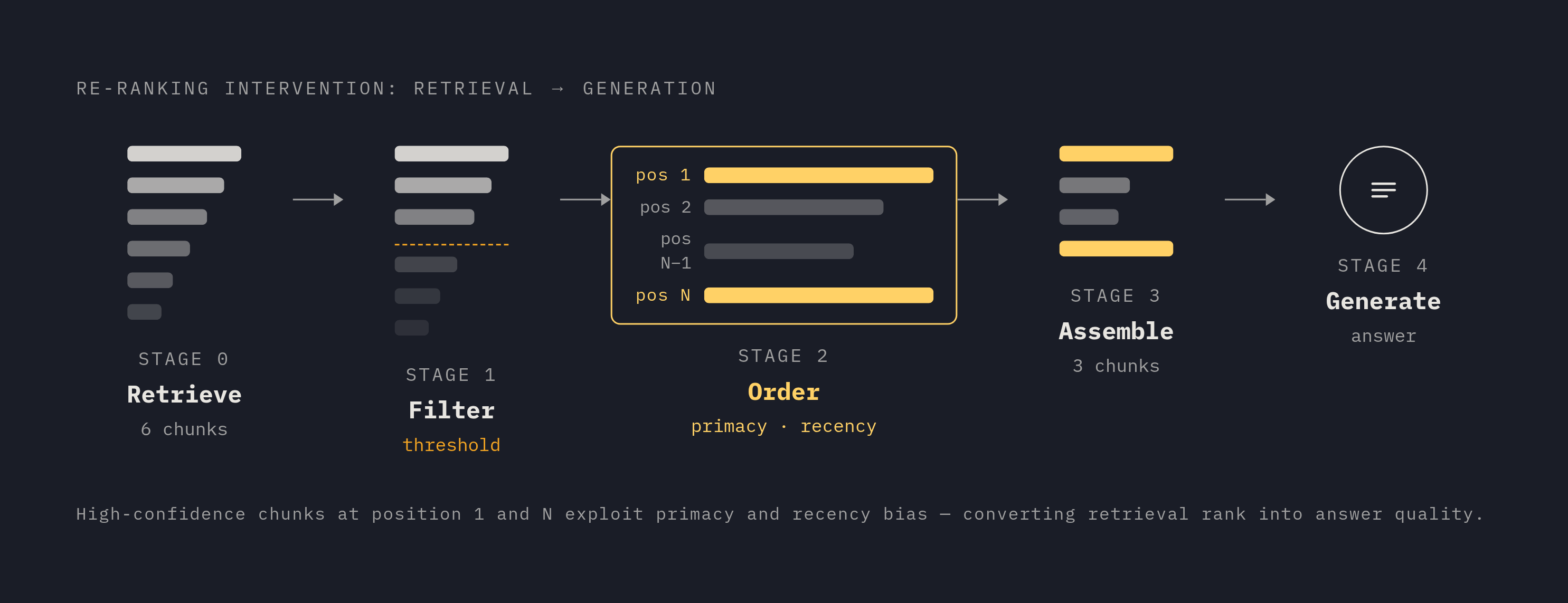
Re-ranking addresses placement directly, by inserting a second-pass scoring stage between retrieval and generation that decides two things: which chunks are good enough to enter the context window at all, and in what order they should appear once they do. First-pass retrieval, whether vector search, BM25, or a hybrid of the two, is built to optimize for recall. Its job is to return a reasonably good candidate set quickly. It is not built to reason about where a chunk will land in the final assembled prompt or how the model's attention will treat that position, and that is not a deficiency in first-pass retrieval so much as a mismatch between what it is designed to do and what the placement problem actually requires.
A re-ranker closes that gap by applying a more expensive, more precise scoring model over the retrieved candidate set and reordering it according to a relevance signal independent of the original retrieval rank. The first is ordering: the highest-confidence chunks can be placed deliberately at the beginning and end of the assembled context, working with the model's primacy and recency tendencies instead of leaving placement to chance. The second is filtering: chunks that score below a relevance threshold can be dropped from the context entirely, which reduces the volume of noise the model has to sift through and shrinks the size of the dangerous middle zone in absolute terms. Placing the strongest chunks at the start and end of the window is a low-cost intervention precisely because it exploits the U-shaped bias rather than trying to fight it. As a secondary effect, filtering out weak chunks also reduces total token consumption, which compresses the context window overall and further shrinks the surface area where the positional blind spot operates.
The Rutgers reframing of the bias as an emergent property of pre-training, rather than a correctable flaw, is what makes re-ranking the right response rather than a stopgap. If the bias cannot be waited out until some future model architecture resolves it, the only available lever in the near term is controlling what goes into the context and where it sits. Re-ranking controls placement and admission. It does not touch the model's internal attention mechanism, and it does not need to, because the problem it solves lives upstream of attention, in the construction of the prompt the model receives.
How prompt engineering interacts with re-ranking
The order and format of content within the context window, independent of which chunks were selected, shifts how well a model attends to different parts of that content. Prompt engineering and re-ranking are complementary interventions on the same underlying issue rather than competing ones.
James McCammon's paper ran a controlled evaluation across six models on a long-transcript retrieval task and found that placing the query before the transcript, rather than after it, improved accuracy by a substantial margin depending on the model, while also reducing total token count. The principle the result demonstrates, however, holds more broadly: where the query sits relative to the surrounding content is itself a placement decision, with measurable consequences for accuracy, separate from which content got selected in the first place.
That has a direct implication for how a RAG system assembles its final prompt. The system prompt and task framing belong first. Retrieved chunks should be ordered by re-ranking score, with the strongest chunks placed at the beginning and end of that block. The user's actual query should come immediately before generation begins, not buried somewhere in the middle of the retrieved material. Handled this way, the two interventions compound rather than merely add. Re-ranking decides which chunks are admitted and in what sequence; prompt structure decides where the query itself sits relative to that sequence. Together, they minimize the share of the context window given over to the positions a model is least likely to use well.
RankRAG: re-ranking and generation unified in a single model
A two-stage pipeline, retrieval followed by a separate re-ranking model followed by a separate generation call, is the standard architecture for addressing placement today, and it works, but it also introduces a service call, added latency, and a seam at which ranking errors can compound before generation ever begins. A recent approach from the research literature represents a different direction: a single instruction-tuned LLM trained to perform both context ranking and answer generation, collapsing the seam rather than optimizing around it.
In practice, this approach instruction-tunes one model to evaluate candidate chunks for relevance as a filtering step, retaining the top-scoring contexts, and then uses a separate generation pass over that retained set to produce the answer. The pipeline is still two steps functionally, but both steps live inside a single model rather than being split across a dedicated cross-encoder and a separate generative system. That consolidation raises an open question rather than settling one: if the same model that ranks the chunks also generates from them, it may be able to learn, during training, to compensate for its own positional tendencies at the ranking stage. Whether that compensation actually happens, and how reliably, remains a research question rather than an established result.
The trade-off is straightforward to state. A unified model costs more per call and demands more from the underlying model's capability, but it removes one network hop and one independent point of failure from the pipeline. Which side of that trade-off wins depends on the size of the retrieval candidate set and the throughput a given system needs to sustain. RankRAG is one clear signal of where the field is heading: toward tighter integration between the model that decides what matters and the model that writes the answer, rather than two separate systems handed off in sequence.
Re-ranking in production: hybrid retrieval, permissions, and freshness
Re-ranking only works as well as the material it is given to rank, and a well-ordered context window full of stale or improperly permissioned content still produces a failure, regardless of how carefully it was assembled. Re-ranking is one stage in a longer pipeline, and the stages before and alongside it can undermine everything it is built to accomplish.
Hybrid search, combining vector similarity with BM25-style lexical matching, has become the standard first-pass retrieval approach in production enterprise systems precisely because it captures both semantic and lexical relevance, giving the re-ranker a stronger and more diverse candidate set to work from. Permissions enforcement has to happen before re-ranking, not after it. A re-ranker that surfaces the single most relevant chunk available is actively harmful if that chunk is something the requesting user should never see, so permission inheritance needs to be a hard constraint applied at retrieval time, upstream of any relevance scoring. Freshness interacts with the placement problem in a similarly dangerous way: a stale chunk that scores high on relevance, but reflects an outdated policy or a fact that has since changed, can land in one of the high-attention positions at the start of the context window and override newer, correct evidence that got retrieved but happened to land in the middle. The staleness problem and the placement problem do not operate independently; they compound each other.
For agents that depend on real-time web knowledge, there is a further upstream issue that re-ranking cannot solve on its own. Search APIs built for human-readable, keyword-driven ranking were not designed with LLM reasoning in mind, and a raw search result page carries navigation menus, footers, ads, and other boilerplate that consumes space in the context window without contributing anything to the answer. That is a pre-retrieval quality problem. No amount of re-ranking sophistication recovers the signal that gets lost when the candidate set is mostly noise to begin with. Infrastructure built specifically to select, filter, and shape web content for AI consumption, rather than adapted from tools built for search-engine optimization, addresses that problem before retrieval happens, so the re-ranker is working over signal rather than digging through noise. The quality of what enters the re-ranking stage sets the ceiling on what placement optimization can achieve afterward.
Sources
- Lost in the Middle: An Emergent Property from Information Retrieval Demands in LLMs
- TimeStampEval: A Simple LLM Eval and a Little Fuzzy Matching Trick to Improve Search Accuracy
- Lost in the Middle: An Emergent Property from Information Retrieval Demands in LLMs
- Positional Biases Shift as Inputs Approach Context Window Limits
- RankRAG: Unifying Context Ranking with Retrieval-Augmented Generation in LLMs