Multi-Agent Orchestration With Supervisor and Subagent Roles
Supervisor agents solve tool overload, context limits, and reasoning collapse in production systems.
The three problems supervisor architecture solves
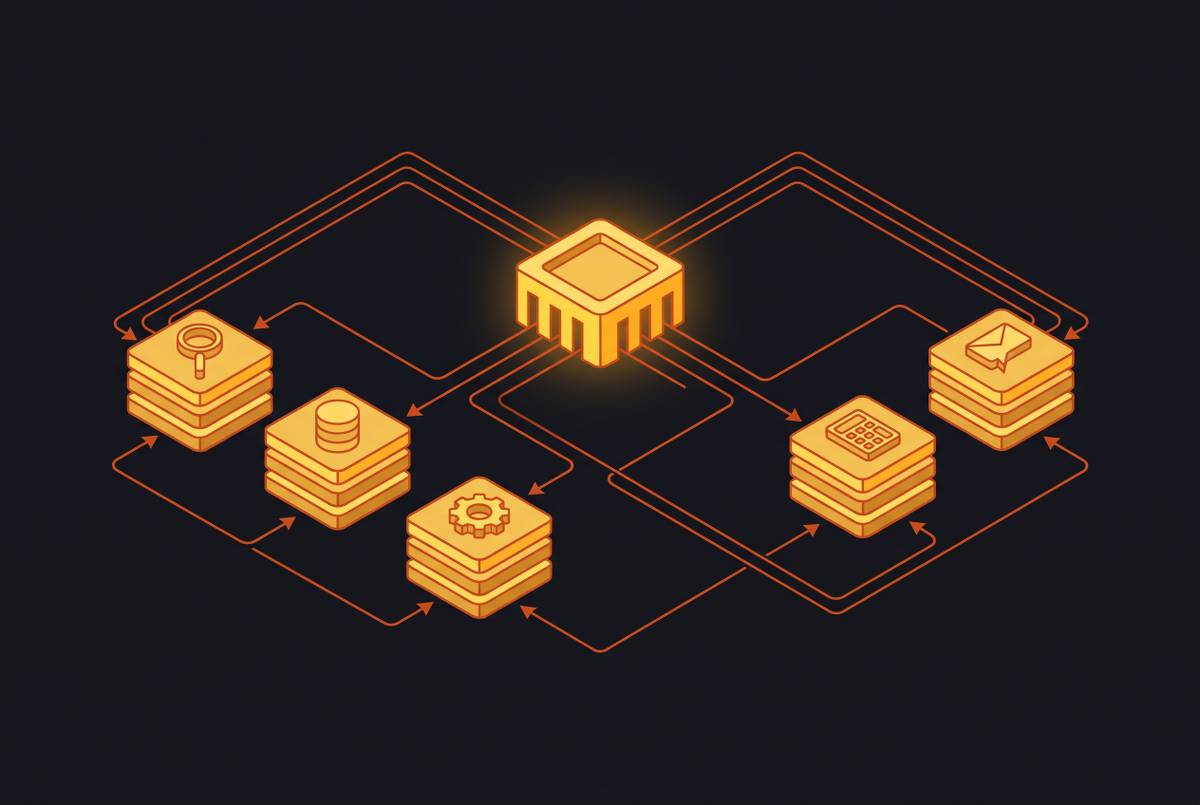
The supervisor pattern earns its complexity only when it's answering a real forcing function. Three of them appear repeatedly in production systems, and if none of the three apply, adding a supervisor is just adding a failure point for no reason.
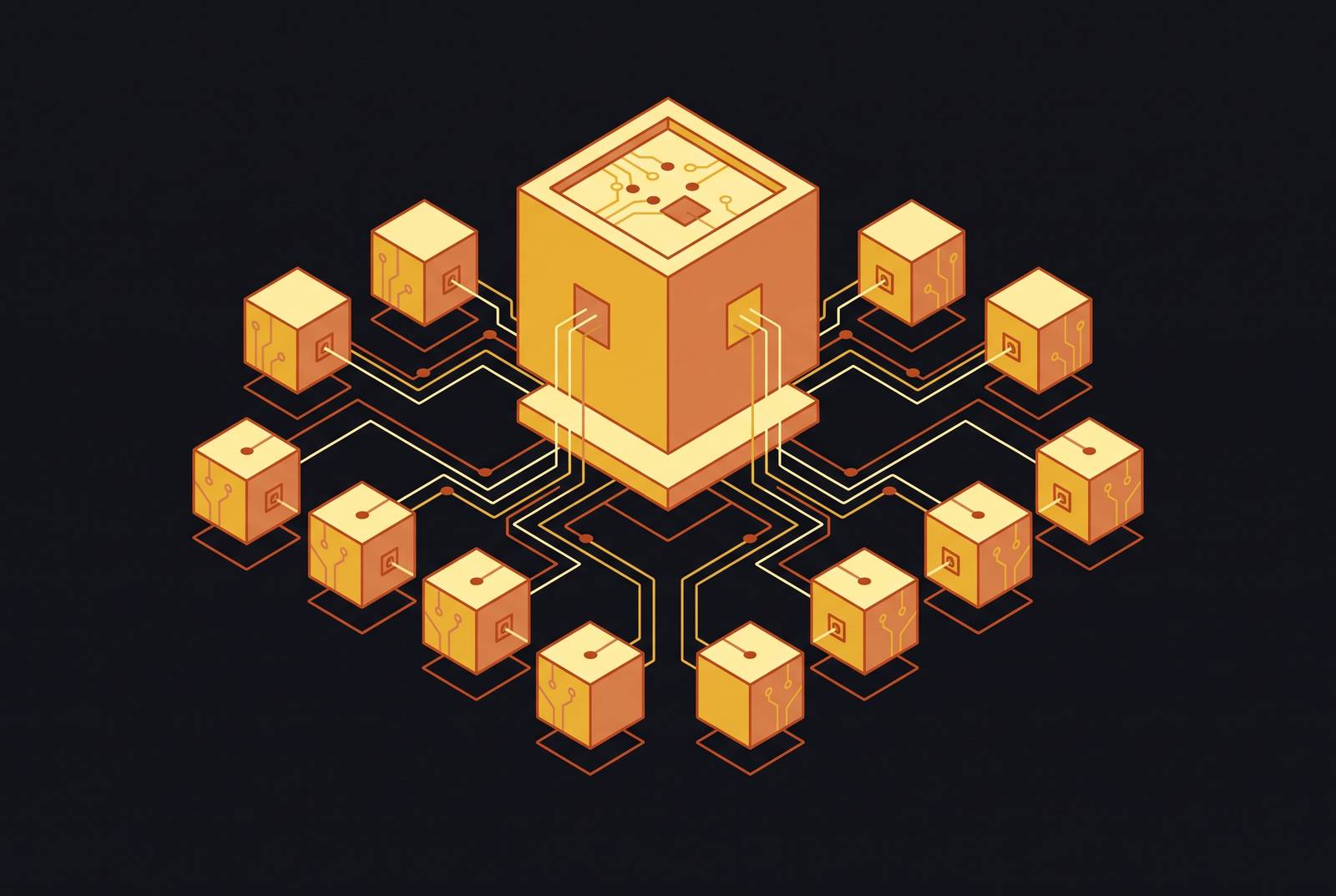
The first is tool overload. A single agent's performance drops sharply once it's juggling more than 10 to 15 tools, yet enterprise workflows routinely need hundreds of functions spread across databases, internal APIs, and third-party systems. Distributing those tools across scoped subagents, each responsible for a narrow slice, recovers the performance that a single overloaded agent loses.
The second is context exhaustion. Even generous context windows fill up fast once you account for tool documentation, conversation history, and the output accumulating as a task runs. A task that requires research, drafting, and citation all in the same pass can blow past a single context window before it's even finished. Subagents solve this by staying stateless and bounded, each one working inside its own manageable context rather than inheriting the growing pile from every previous step.
The third is reasoning collapse. Asking one model to plan a task, execute it, and then critique its own output in the same pass produces shallower results than splitting those functions across agents with distinct roles and success criteria. A planner that only plans, an executor that only executes, and a critic that only critiques each do their one job better than a generalist doing all three back to back.
Most teams reach for a supervisor because tool overload is the visible symptom, but reasoning collapse is the one that gets ignored the longest, because it doesn't throw an error. It just quietly produces worse answers, and nobody notices until the outputs are audited against a baseline.
The supervisor layer in production: state, routing, and subagent statelessness
The supervisor's job goes well past picking which subagent handles which request. It has to hold the global conversational state, manage the handovers between agents as work moves through the pipeline, and revise its own plan as intermediate results come back, sometimes contradicting what it expected when it made the original routing call.
Good supervisor design means the routing decision isn't arbitrary. Before delegating, a well-built supervisor inspects the internal structure of whatever's been retrieved, a table versus a document versus a code snippet, and picks the specialist suited to that data type. That's data-type-aware routing: a deliberate judgment about which agent is equipped to handle the shape of the material in front of it.
Subagent statelessness gets described as a limitation somewhere along the way, something teams work around instead of design for. That's backwards, because subagent statelessness is a design feature, not a limitation to work around. A subagent that receives input, returns output, and forgets the interaction the moment it's done keeps context isolated between tasks. Nothing bleeds from one job into the next, so a subagent can't get confused by leftover state from a request it was never asked to think about. Statelessness is the feature, not the compromise.
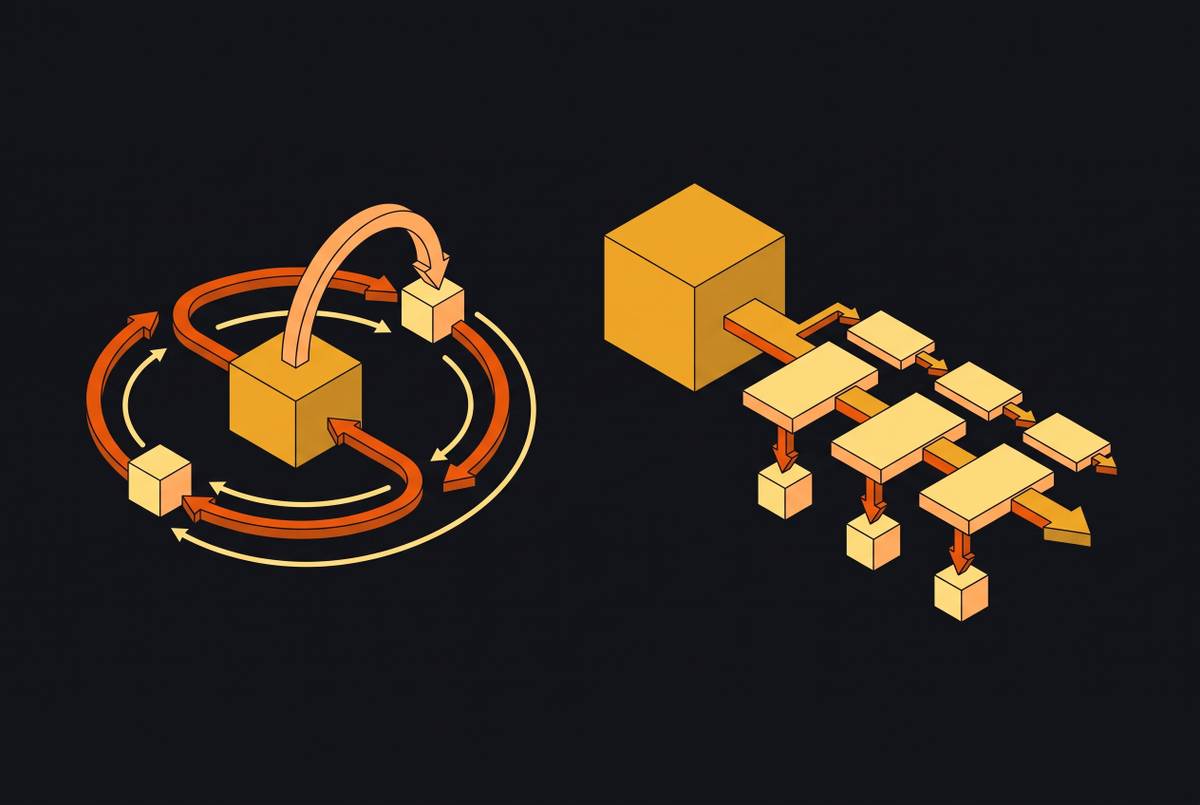
Supervisors also choose their own coordination shape. Multiple subagents can run in parallel when the work is independent, or the supervisor can dispatch sequentially when the order of operations matters for correctness, say, a code review that has to happen after the code is written and not before.
The failure modes that supervisor topology introduces
These are structural properties of centralizing control in one coordinator, not bugs a better prompt will fix. Knowing them ahead of time is what separates a system that holds under load from one that collapses the first time it hits real traffic.
The first is the supervisor bottleneck itself. One coordinator processing decisions in sequence creates queuing delays as volume climbs, and because every routing decision passes through that single point, a hallucinated routing call stalls the entire workflow behind it. Coordination overhead here scales linearly with the number of workers, which beats the quadratic scaling of a fully peer-to-peer mesh, but it accumulates all the same. Linear is better than quadratic. Coordination overhead accumulates even though it scales linearly rather than quadratically.
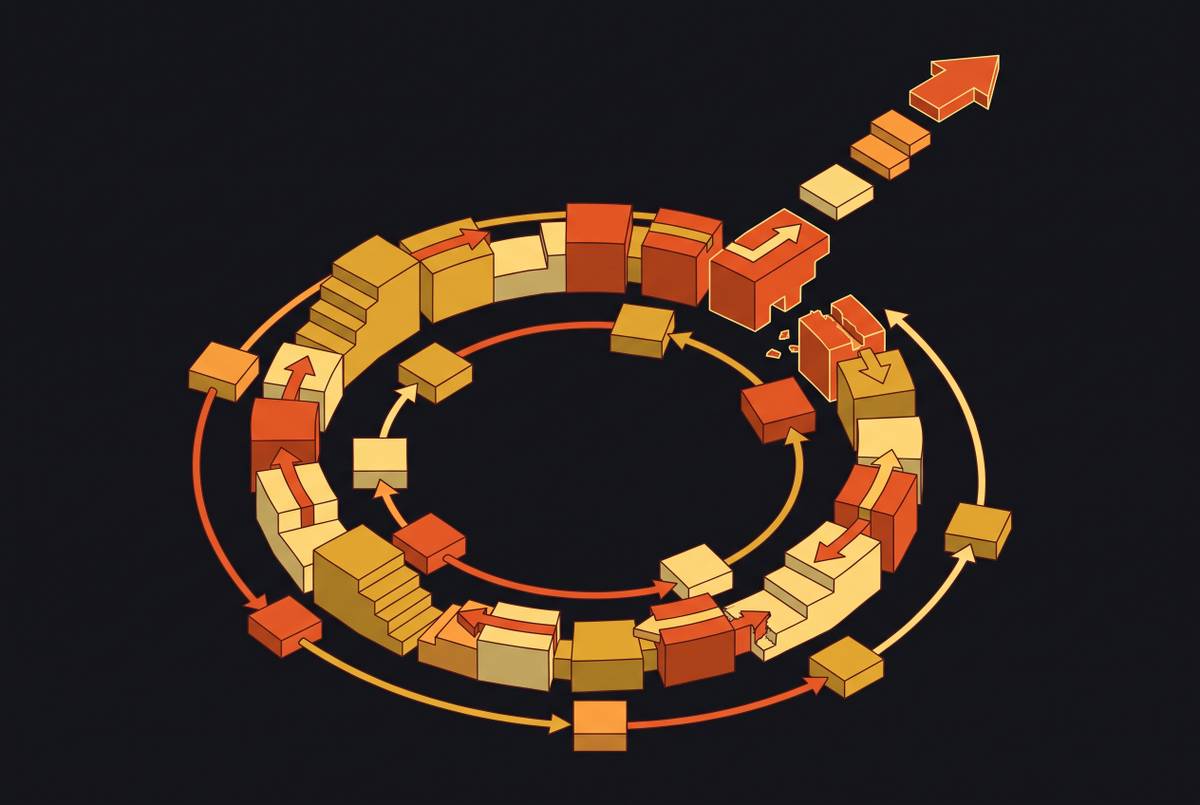
The second is hallucination cascade. Agent A produces a wrong answer, the supervisor passes it downstream unchecked, Agent B builds on the mistake, and Agent C inherits an error that's now been compounded twice. The failure sits in the design, not in any one model's reasoning: nothing was built to catch the error before it propagated. The fix is a validation gate. It's a validation gate, a reviewer agent or verification step sitting between hops, checking output before it moves forward. Treating that gate as optional lets small errors turn into wrong final answers nobody can trace back to their source.
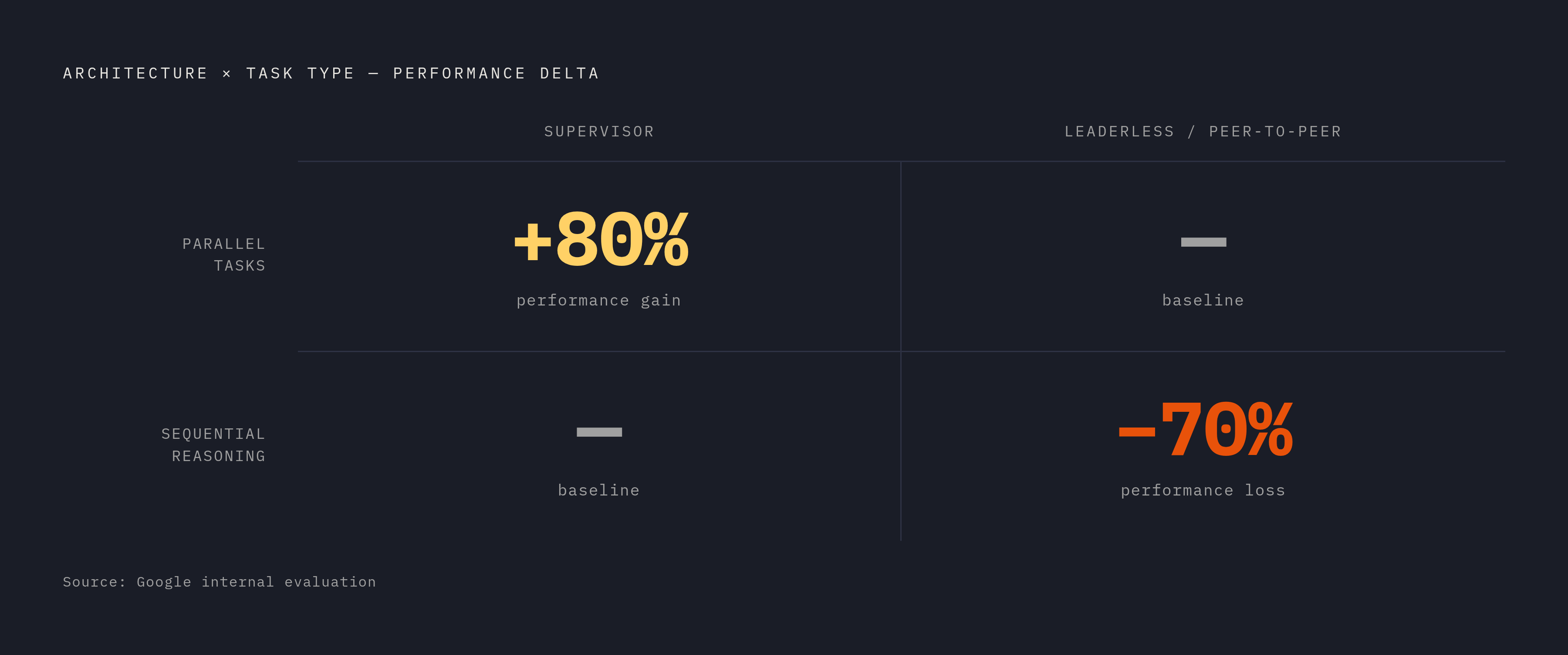
The third failure mode most clearly shows why topology choice should be picked based on the task's requirements rather than on enthusiasm for a given architecture. Multi-agent systems generally beat single agents on tasks that parallelize cleanly, but they degrade performance on sequential reasoning tasks, with reported drops in the range of 39 to 70%. Google's internal evaluation found independent, leaderless patterns degraded sequential reasoning by roughly 70%, the same evaluation that found the supervisor pattern boosted parallel task performance by 80%. The identical architecture that helps in one regime actively hurts in another. That's not a footnote. Whether a task gets a supervisor should depend on that fact.
How to decide whether your task warrants a supervisor topology
Three signals justify the jump to multi-agent, and none of them are vibes: tool overload past the 10 to 15 tool ceiling, context exhaustion on tasks that need accumulated state across many steps, and reasoning collapse where planning, execution, and critique need separating to get quality output.
If none of those walls has actually been hit, stay single-agent. That's the correct call. A lot of teams reach for orchestration because it sounds more serious, and end up debugging a routing layer they never needed. Complexity is not a credential.
Supervisor topology specifically, as opposed to multi-agent generally, is the right pattern under a few conditions. Workflows with clear task boundaries and explicit handoffs suit it well. So does any process where deterministic execution order matters for correctness, like a write-test-security-review pipeline where skipping the order produces broken output. Centralized visibility also affects debugging and compliance auditing, since it lets someone trace exactly which agent did what and when. And when subagent outputs need real synthesis rather than concatenation, a supervisor earns its place by doing the work of combining them.
Other patterns fit other shapes of problem, and reaching for a supervisor by default when one of these fits better is its own mistake. Fan-out or parallel topology suits tasks that partition cleanly, don't share intermediate state, and benefit from running concurrently: parallel research streams, parallel document summarization. Swarm topology is reserved for genuinely massive parallelism, Kimi K2.6's 300-agent swarms being a cited example of that category, and it's overkill for most enterprise workflows that will never need anywhere near that scale. Peer-to-peer or blackboard architectures fit situations where agents need to negotiate directly, or where no single coordinator can realistically hold all the routing logic. The supervisor pattern is common because it's legible, not because it's always correct.
Self-correction and validation gates: making the architecture resilient by design
The validation gate is the structural answer to hallucination cascade, and it has to be built into the architecture, not patched in through prompt wording. A dedicated reviewer agent checks the output of each agent before that output moves downstream.
What this looks like varies by domain. A reviewer agent might check generated code for security flaws before it reaches deployment. A fact-checker agent might verify research output before it's synthesized into a final report. A compliance agent might inspect outputs against policy before the supervisor hands the result to the next worker in the chain. Each is a distinct role with its own success criteria.
The PANGAEA-GPT architecture pushes this further with self-correction through execution feedback: agents diagnose and resolve runtime errors inside the same pipeline, rather than surfacing every failure back up to the supervisor or out to the user. That's error recovery handled where the fault occurs, instead of routing every hiccup through the coordinator and adding another round trip.
Authorization-aware filtering is a related but separate concern. In retrieval-augmented multi-agent systems, the filter for what a given user or agent is allowed to see has to apply inside the retrieval query itself, before similarity scoring runs, not after. Filtering after the fact produces two failure modes in the system: a result set exhausted by restricted items before anything usable surfaces, and every new code path becoming one more place someone forgets to apply the filter.
Web knowledge retrieval as a first-class concern in multi-agent systems
Retrieve-then-generate pipelines are not the dominant pattern going into 2026. Agentic RAG, where specialized agents handle retrieval and validation in parallel, has emerged as a leading pattern in production systems, because retrieval itself is a multi-step decision process now, not a lookup. An LLM plans the retrieval, orchestrates it, manages memory across steps, inspects the intermediate evidence it pulls back, and decides if it needs to retrieve more before answering safely.
Five recurring failure modes in RAG systems map directly onto supervisor concerns. Documents change and the index doesn't, so a subagent that confidently cites last quarter's policy has failed architecturally because the system fed it stale ground truth, regardless of how well the model reasoned. Most weak RAG answers are retrieval problems wearing a generation costume. A single user question is often ambiguous on its face, and strong pipelines handle that by expanding the query space, generating multiple paraphrases and retrieving against each one before anything reaches the model. Authorization filtering and the absence of an evaluation loop round out the list, both already covered above as architectural fixes, not cosmetic ones. The fifth failure mode is treating retrieval as a plain function call instead of what it actually is: a reasoning layer with its own judgment calls baked in.
Graph-augmented retrieval adds another layer. Context-graph-grounded RAG has shown gains up to 5x in AI analyst response accuracy over raw schema lookups, which matters directly for subagents reasoning over structured knowledge. What they need from the retrieval layer isn't just similarity between text chunks, it's a reflection of how the underlying entities actually relate to each other.
None of this fixes the deeper issue that model weights freeze at a training cutoff. A supervisor coordinating subagents that need to reason about current regulatory status, live market pricing, or events from the past week can't lean on static embeddings baked in at training time. Those subagents have to ground in live web content. That's a correctness requirement.
The web search layer underneath an agent system
Traditional search APIs were built for a different consumer entirely: a human scanning a results page, deciding what to click. They return short teaser snippets designed to earn that click, plus raw HTML and metadata bloat that a browser renders into something readable, but a language model just has to wade through. Getting that content into shape for an agent to reason over means building a second pipeline on top of the first: search, scrape, parse, clean, re-rank, and only then hand it to the model.
That pipeline isn't free, and it doesn't stay quiet once it's running. Every step adds latency, adds a new place for something to fail, adds ongoing engineering upkeep. Scraping breaks under the conditions real websites throw at it: rate limits, pages that rely on dynamic content and never finish loading in a headless browser, anti-bot measures that block the request. None of the infrastructure built for human search traffic was designed for the depth, speed, and reliability that autonomous agents need running in production, around the clock, with nobody there to notice when a page came back empty.
What an agent system actually needs is different on nearly every dimension that matters. Clean, structured content shaped for machine consumption instead of human eyes. Full-text extraction that answers the question directly, instead of a two-line snippet built to earn a click. Response formats that map efficiently into an LLM's context window rather than forcing the agent to parse raw markup. Freshness guarantees, so a subagent isn't citing a cached page from months back. Predictable latency, so five workers running in parallel don't all end up waiting on the slowest, flakiest request in the batch.
That last point matters more at scale than it looks at first glance. A supervisor coordinating five subagents that each fire off their own web queries doesn't just add up the quality problems sitting in the underlying search layer, it multiplies them. Stale content, noisy HTML, and truncated snippets each appear once per branch of the fan-out, and by the time the supervisor synthesizes five sets of results into one answer, the search layer's weakness is baked into every branch of the reasoning it's trying to combine. Fix the search layer once, and every downstream agent benefits. If it is left broken, every new subagent you add repeats the same failure in a new place.