Retrieval-Augmented Generation Pipeline Architecture for Factual Agents
Proper architecture matters more than better models for building reliable AI agents.
Where the naive pipeline breaks down
A factual agent that hallucinates a filing date or invents a price is badly built. It's badly built. Retrieval-Augmented Generation exists to fix a structural fact about large language models: they freeze at a training cutoff and have no way of knowing last week's policy update, this morning's stock price, or anything sitting in a private database they never saw. RAG solves that by pulling in outside text at query time. But it's a stack of seven decisions, and each layer either compounds the mistakes of the layer beneath it or corrects them. Most teams get the stack wrong in the same place, and the model is rarely to blame.
Consider what a language model does when it's asked something past its cutoff date. It has exactly two options. It can refuse, which is honest and useless in a production setting, or it can generate a fluent, confident, entirely fabricated answer, which is worse, because a user can't tell grounded output from invention unless they already know the answer. Confident hallucination is the failure mode that kills trust in a factual agent, and it's the one RAG exists to prevent.
The appeal of RAG rests on four concrete benefits. Update a knowledge base and the model's effective knowledge updates with it, no retraining required. Proprietary contracts, internal wikis, and support tickets the model never trained on become answerable. The model reasons over retrieved source text instead of extrapolating from statistical patterns baked into its weights, which cuts hallucination. And because the sources are retrieved, they can be cited, so a user can check them independently. That combination of benefits is why RAG has grown into a multi-billion dollar segment of AI infrastructure.
Adoption isn't the same as impact, and that gap is the reason this piece exists. Industry research on generative AI has found that a large majority of organizations report regular use of the technology, yet only a small fraction can point to a meaningful contribution to earnings. MIT's 2025 GenAI Divide report found that most enterprise GenAI pilots never reach measurable financial impact, a pipeline problem rather than a model problem. That's a pipeline problem. Frontier models are already good enough for most factual tasks, and the gap appears first in the simplest version of RAG anyone builds.
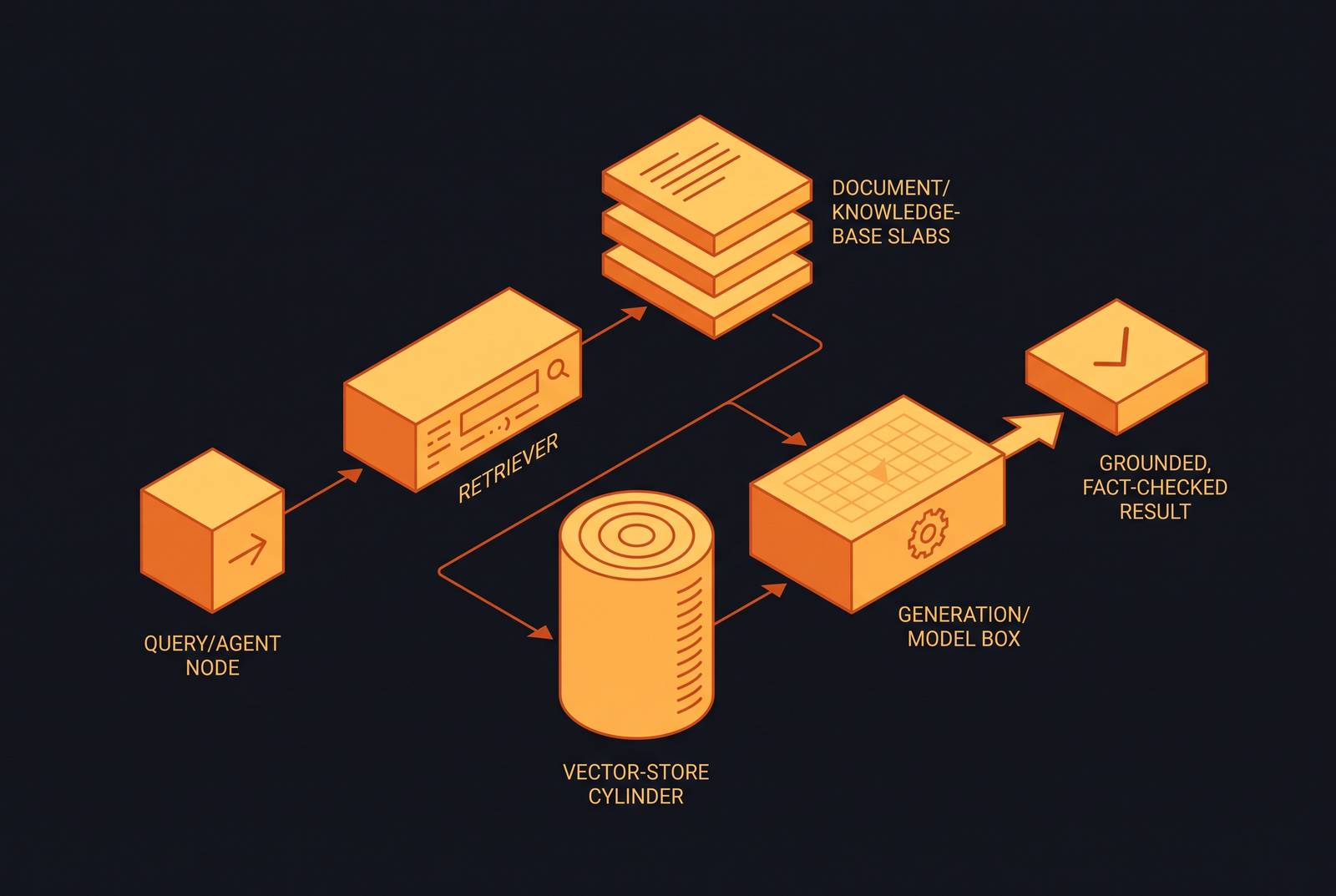
The standard pipeline runs in seven steps: load, chunk, embed, store, retrieve, augment, generate. Loading ingests raw material such as PDFs, web pages, database exports, and support tickets. Chunking splits that material into searchable units, and the size and method chosen affect retrieval quality and downstream answer accuracy enough to earn its own section later. Embedding turns each chunk into a vector encoding meaning rather than exact words. Storage persists those vectors in a database built for similarity search. Retrieval pulls the top-k chunks closest to the query vector. Augmentation stuffs those chunks into the prompt. Generation lets the model answer, conditioned on the query and whatever evidence got retrieved.
The retrieval engine is built to find a needle in a large haystack. The language model is built to read and synthesize text once that needle is in hand. Pairing them is sound design, and because the dataset, the retriever, and the model are all swappable independently, teams can iterate on one layer without tearing down the rest. That modularity is a genuine strength of the architecture.
It's also where the naive version runs out of road fast. Single top-k retrieval cannot answer a question that requires synthesizing facts scattered across three or four separate documents, because it was never built to reason across sources, only to fetch chunks that resemble the query. Ambiguous queries return chunks that look plausible and are wrong. And even when the retriever does its job and surfaces the right passage, that passage can get buried in a noisy context window, and the model still answers incorrectly, because finding the right chunk and using it correctly are two separate problems a naive pipeline treats as one.
Garbage in, garbage out applies here without exception. Final answer quality is capped by retrieval quality, full stop. Everything that follows is really about closing that gap, one layer at a time.
How agents change the retrieval problem
Retrieval gets harder, not easier, once a model stops answering single questions and starts acting as an agent. Most production agent architectures in 2026 run on four layers working together. A reasoning layer, the model itself, interprets input, plans a sequence of actions, and decides what to do next, but that's the thinking piece, not the whole agent. A tool layer is what actually turns a language model into an agent in the first place: without tools it can only produce text, but with tools it can search the web, read and write files, query a database, call an API, or run code. A memory layer holds short-term conversational context alongside longer-term vector retrieval and episodic memory, the kind that captures specific past events with a timestamp attached. An orchestration layer manages planning and coordination across steps.
RAG sits inside the tool and memory layers, connecting the reasoning engine to a live knowledge base. That connection is what makes proprietary data, recent events, and specialized domain knowledge usable at all, since none of it exists in the model's training data.
Production systems generally follow one of four patterns: reactive, deliberative, hybrid, or multi-agent. Each suits a different level of task complexity, and the pattern chosen shapes exactly when and how retrieval gets invoked. The multi-agent side has matured fast. Frameworks like Microsoft's Agent Framework (the successor to AutoGen), CrewAI, and LangGraph are now widely used in multi-agent deployments. The Model Context Protocol has become a widely adopted standard for giving models a unified interface into external tools and data sources, and Google's open Agent-to-Agent specification lets agents built by different vendors hand sub-tasks off to each other.
None of that autonomy runs unsupervised, and it shouldn't. Irreversible, costly, or regulated actions still need a human in the loop, usually through staged autonomy: the agent reads and retrieves on its own, but proposes anything high-stakes for review before it executes.
Azure AI Search draws a useful line between classic RAG and agentic retrieval. Classic RAG runs a single query, with the application handling the handoff to the model separately. It's simpler, faster, and it keeps the model out of query planning. Agentic retrieval lets the model help plan the query itself, pull from multiple sources, and return structured responses built for another agent to consume rather than a human reader. It's more capable, and it costs more to run. That tradeoff is not close to symmetrical once an agent starts working a multi-step task, and teams that skip past it end up paying for it later in latency they can't explain.
Agents don't retrieve once. They retrieve repeatedly across a multi-step task, and every inefficiency in the pipeline, extra latency, noisy chunks, wasted tokens, gets invoked again on the next step and the one after that. A weak pipeline doesn't cost a fixed penalty in an agentic system. It costs that penalty on a loop.
Retrieval source selection and the web knowledge gap
Everything downstream depends on where the retriever looks first. Picking the wrong source means no amount of reranking or clever prompting saves the answer, because the right information was never in reach to begin with.
Three broad categories cover most systems, and each trades something away. Private vector stores give high precision on proprietary material but are static: ask them about something that happened after ingestion and they simply don't know. Structured databases are exact for whatever facts they actually contain and brittle for everything outside their schema. Live web search offers freshness and breadth neither of the other two can match, but retrieval quality on the open web swings wildly depending on how it's implemented. Noise is the default there, not the exception.
That last point is where most agent pipelines quietly lose their token budget and their latency. Traditional search APIs, the kind built to show a results page to a human, return search metadata: titles, URLs, a snippet running somewhere around 150 to 300 characters. An agent can't answer a factual question off a snippet that short, so it has to crawl each URL itself, render whatever JavaScript the page needs, and strip out the markup. That's a multi-step process with real hidden cost in time and compute. And even once that's done, a naively scraped page still drags in navigation bars, ad copy, cookie banners, and boilerplate alongside the actual content, diluting the signal the model needs and burning tokens on text nobody wanted retrieved.
That two-step search-then-scrape pattern is not a minor inconvenience tacked onto an otherwise clean pipeline. It stacks search cost, scraping cost, token bloat, and added latency on top of each other, and answer quality degrades as all that overhead piles up. Infrastructure built specifically for AI agents handles this differently: it returns clean Markdown or structured JSON instead of raw HTML, filters and pre-processes content before it reaches the model, and optimizes for the depth, speed, and reliability an autonomous system needs rather than the layout a human browser expects. That's the specific gap a search API built for AI, rather than for search-engine results pages, is meant to close. Teams that keep bolting agent logic onto a human-facing search API are solving yesterday's problem with yesterday's tool.
Why splitting is not a minor detail
Chunking decides what the retriever is even capable of finding, full stop. Two systems can run the identical embedding model and the identical vector database and still produce different quality retrieval, purely because one split its source documents better than the other. Teams that treat chunking as a preprocessing afterthought are the same teams debugging retrieval failures three layers downstream that were actually decided here.
The tradeoff sits at the center of the decision. Chunks that are too large bury the one relevant sentence inside three paragraphs of surrounding noise. Chunks that are too small strip away the context the model needs to make sense of that sentence. No setting avoids this tension. There are only ways of managing it depending on the document type.
Fixed-size chunking with overlap is the simplest approach and works fine on uniform documents; the overlap keeps meaning from getting severed right at a chunk boundary. Splitting along sentence or paragraph boundaries preserves sense better and suits prose-heavy material where meaning runs across sentences longer than a fixed token window. Sliding-window chunking, the method Ragnarök uses on its MS MARCO V2.1 segment collection, balances coverage against boundary integrity. Hierarchical or recursive chunking splits by the document's own structure first, sections and headings, before splitting further by size, and it tends to work better on long technical or legal documents that already carry a clear internal shape.
Chunk size also interacts directly with top-k. Smaller chunks mean the system needs a higher k to cover a topic fully. Larger chunks mean a lower k works, but each one carries more noise along with the signal. There's no universal right answer here, only a decision that has to match the document type and the query pattern.
Metadata is the cheap win most teams underuse, and it should be the default. Attaching a source URL, a publication date, a document type, and a section header to each chunk lets the system filter before it even runs an embedding comparison, and that filtering step costs almost nothing to add. The University of Waterloo's Ragnarök framework, built for the TREC 2024 RAG Track, uses sliding-window chunking on MS MARCO V2.1 as a standardized baseline, and it's a useful reference point for judging whether a team's own chunking choices are reasonable.
Get this wrong at ingestion and it's expensive to fix later, since correcting chunking strategy after the fact usually means re-indexing the entire vector store from scratch. The cost of getting it wrong compounds silently until someone finally traces a bad answer back to a decision made months earlier.
Why neither vectors nor keywords alone are sufficient
Dense vector search finds meaning. It can match a query about "reducing employee attrition" to a document that only ever says "retention," because it encodes concepts rather than exact words. What it struggles with is precision: rare product codes, exact technical terms, specific proper nouns, strings where exactness outweighs semantic closeness.
Sparse keyword search, the BM25 family, is the mirror image. It's reliable on named entities and exact terminology, and it misses paraphrases entirely, because it has no concept of meaning beyond the literal string. Running either one alone is a mistake dressed up as a design choice. It's a mistake dressed up as a design choice.
Public benchmark work from 2024 and 2025 shows that combining BM25 with dense embeddings, then fusing the two ranked lists with Reciprocal Rank Fusion, consistently beats either method running alone. It's the production baseline most serious retrieval systems build on now. Reciprocal Rank Fusion is what makes the combination practical: it merges two ranked lists without needing to normalize scores across fundamentally different scoring systems, a detail that sounds minor but matters a great deal in practice.
Retrieval-augmented models generate from what they retrieve in two distinct ways. RAG-Sequence uses one retrieved document to generate an entire output, summing probability across the top-k retrieved documents. It's simpler and faster. A finer-grained variant retrieves per token instead, which grounds the output more tightly but adds a lot of complexity for the gain, and most teams don't need that complexity unless the domain genuinely demands token-level precision.
Even with hybrid retrieval running well, the result set coming out the other end is still messy. It carries real signal and confident-looking noise side by side, and untangling the two is a job hybrid retrieval was never built to do on its own.
Reranking as the step that determines whether the right answer reaches the model
Embedding similarity is a proxy for relevance. It is not relevance, and treating the two as interchangeable is where most production pipelines quietly lose accuracy. The top-k chunks a hybrid retriever hands back include some that genuinely answer the question and others that merely resemble it, and without a step to tell the two apart, both land in the context window carrying equal weight.
That's what reranking does, and skipping it is the single most common gap between a demo and a production system. It produces a failure mode every team recognizes eventually: the right answer was sitting in the retrieved set the whole time, and the model still got the question wrong, because it was drowned out by noise sitting right next to it.
Bi-encoders, the kind used for the initial retrieval pass, encode the query and each document separately and compare the resulting vectors. That's fast enough to run against an entire corpus, but it can't model any interaction between the query and the document itself. Cross-encoders take the query and a candidate chunk together, as a single input, and model how they interact directly. That makes them far more accurate, and far too slow to run against millions of documents. They only ever touch the shortlist a bi-encoder has already narrowed down.
A representative production pipeline follows this pattern closely: hybrid retrieval pulls a broad shortlist, a cross-encoder reranker, scores that shortlist, and only the top candidates move on to generation. Broad retrieval funneling into precise reranking is the standard two-stage shape now, not an optional add-on. Skipping it is a known regression. It's a known regression.
Benchmark results back that up. Adding a cross-encoder reranker on top of hybrid retrieval is widely regarded as producing meaningful gains on harder retrieval sets, consistent enough that skipping the step counts as a known architectural mistake rather than a defensible shortcut. Reranking also fights a separate failure entirely: research on long-context models shows they carry position-dependent bias, often underusing information sitting in the middle of a long input. Putting the most relevant chunk first, not just somewhere in the context, changes how likely the model is to actually use it.
Whatever the reranker passes forward sets the ceiling for the answer. Nothing downstream can add back information that got cut here.
Context engineering: shaping what the model reasons over
The bottleneck in 2026 isn't context window size. Modern models hold enormous amounts of text at once, and the temptation that comes with that space is exactly the wrong move to make. The real limit is discipline over what goes into that space, and that's a different problem entirely from capacity.
The failure pattern is familiar by now: treat the context window like a junk drawer, dump in everything retrieval returned, and hope the model sorts it out. It won't, reliably, and production systems do the opposite on purpose. Context engineering treats what enters the prompt as a deliberate decision rather than a byproduct of whatever the retriever and reranker happened to return. It covers filtering, ranking, pruning, summarizing, and isolating information as core engineering work, not cleanup performed after the fact.
Selection and filtering sit at the center of that discipline: deciding, chunk by chunk, what earns a place in the prompt and what gets left out. That decision is where every layer built up through retrieval, chunking, hybrid search, and reranking either pays off or goes to waste. A pipeline can get every earlier step right and still hand the model a context window stuffed with redundant or tangential material, and the answer suffers regardless of how good the retrieval was upstream.
Precision at this last step is what turns a technically correct pipeline into an agent that actually gets the fact right, cites it, and earns the trust a factual system depends on. None of the six layers before it matter much if this one is careless.