Stateful vs Stateless Agent Design Trade-Offs
Building durable state solves agent amnesia but introduces new production failures.
Every major LLM API, whether it's GPT, Claude, or Llama, is stateless at the model level. The model retains nothing from the last request it processed, and that single architectural fact shapes nearly every hard problem in agent design. Understanding where statelessness ends and durable state has to begin separates a demo that impresses in a meeting from a system that survives real production traffic.
Why every LLM is stateless by default
The model doesn't remember you. The model doesn't remember you, and it never did. What feels like "chat memory" in a consumer AI assistant is client-side bookkeeping: the application re-sends the entire conversation transcript with every new call, and the model reconstructs its sense of context from scratch each time. At least one provider now offers opt-in memory tooling layered on top of that stateless core, but the underlying inference call stays a one-shot event with no persistent thread running underneath it.
Two things get conflated constantly here, and the conflation causes most of the confusion downstream: the context window and state. A context window is temporary and token-bounded. It exists for the duration of a single call and vanishes once that call resolves. State is durable. It survives restarts, crashes, deployments, and the days between a user's first session and their fifth. Mixing the two up is a common design error, and it is the root of a lot of production incidents that look like "the agent forgot everything," when what actually happened is that nobody built a state layer to begin with.
A conversation is what got said. A case file is what's still true once the conversation is over. A support chat where a customer explains a billing dispute is a conversation. The decision that the customer is owed a refund, the ticket number, and the fact that the refund already went out together make up a case file. Stateless systems handle conversations fine. They are structurally bad at maintaining case files, because nothing about a stateless transaction implies persistence unless something outside the model deliberately writes it down.
What stateless agents are good for
Stateless agents treat every request as a sealed transaction. Input comes in, a prompt gets built, the model responds, and nothing gets saved. That simplicity earns its keep. Horizontal scaling becomes trivial, since any server can handle any request when no request depends on what a specific server remembers. There's no database schema to design for session data, no consistency model to enforce across replicas, and no risk of one instance holding state another instance needs but can't see. For single-turn classification, text extraction, or one-shot summarization, this is close to the ideal architecture. Nothing extra to build, nothing extra to break.
The trouble starts the moment a task stretches across more than one turn, and two failure patterns appear almost immediately, compounding each other. The first is a token-cost snowball: since the model carries no memory of its own, the client has to resend the full conversation history on every call. Turn ten means resending everything said in turns one through nine, every single time, so token cost climbs steadily as the conversation grows, even once most of that history has stopped mattering to the current step.
The second is amnesia between calls, and it does more damage. No context survives between calls unless something outside the model captures it, so an agent at step ten can't reliably reference a decision made at step three unless that decision got faithfully carried forward in the resent transcript. Any break in that chain, a dropped field, a truncated history, a summarization step that threw out the wrong detail, and the agent starts making decisions as though step three never happened. A one-shot classifier never feels this. Anything resembling a multi-step task feels it constantly, and the effect gets worse the longer the task runs.
What stateful agents must persist
Agent state gets discussed as if it's one thing to solve, usually flattened into "memory." That framing undersells the problem badly. State breaks into several distinct layers, each doing a different job, and each with its own failure mode when it goes missing.
Conversation memory covers message history, user preferences, and prior decisions. Without it, the agent asks the same onboarding questions every session and never accumulates anything close to personalization. Task checkpoints track the current step, the remaining steps, and any branch decisions made along the way. Without checkpoints, a crash doesn't mean a pause, it means a full restart, and a multi-step workflow, a document generation pipeline, a multi-call research task, has to begin over from zero. Tool outputs are the results of API calls, searches, and computations already performed. Skipping persisting them means an agent re-runs expensive or rate-limited calls it already made, burning money and, with rate-limited APIs, sometimes stalling the task. Files and artifacts, generated documents, intermediate outputs, large payloads, need their own durable storage too, or the work product disappears the moment a session ends or gets handed to another process.
Memory is one piece of this picture, not the whole picture, and treating it as the whole picture is the mistake most teams make early. Task checkpoints, tool outputs, and transaction history matter critically once something actually breaks mid-task. That connects to a larger point about what "agentic" is supposed to mean: state is the substrate an agent stands on, but orchestration turns that substrate into action. A durable store full of checkpoints and tool results doesn't produce autonomy on its own. It needs a structured planning loop sitting on top, deciding what to do with what's been persisted. Without that loop, state amounts to a very well-organized filing cabinet, nothing more.
The five failure modes that kill stateful systems in production
Building a state layer solves the amnesia and opens up a new set of failure modes that stateless systems never had to face, because stateless systems never had anything worth corrupting.
Stale state from parallel overwrites occurs when two agents, or two processes belonging to the same agent, write to the same record at the same time. Last write wins, and whatever context the earlier write carried gets silently discarded. Nobody sees an error. The system just quietly forgets something true. Partial updates happen when a write sequence gets interrupted midway, leaving a record that's neither the old version nor the new one, just an inconsistent hybrid that downstream logic was never built to handle. Race conditions are the multi-agent version of the same underlying issue: two agents touching the same record with no isolation guarantee turns what should be collaboration into conflict, and the conflict often stays invisible until output starts looking wrong for reasons nobody can trace quickly.
Prompt drift moves slower. Across many turns, accumulated state grows noisy, and older entries, some irrelevant, some flatly contradicting more recent ones, start polluting the context the model actually sees. The agent is remembering too much of the wrong thing. It's remembering too much of the wrong thing. Lost state across retries rounds out the list: a step fails, gets retried, but the state store never got updated before the failure hit, so the retry redoes work that already happened, sometimes with side effects, a duplicate charge, a duplicate email, that can't be cleanly undone.
Each of these traces back to a specific architectural decision. Stale overwrites point to an isolation strategy. Partial updates point to write atomicity. Prompt drift points to retention policy and schema design. Lost retries point to idempotency handling. Most teams that hit these walls didn't get there because the model was wrong. They got there because they stitched together a database for operational data, a separate vector store for retrieval, a cache for session state, and a warehouse for analytics, glued together with custom code that nobody fully owns. That seam is where reliability actually breaks down, and in multi-agent setups the stakes only rise: two agents touching the same record need one agreed source of truth and a way to avoid stepping on each other. That's an architecture problem. No bigger model fixes it quietly on its own.
How benchmark results quantify the gap between stateless and stateful on the tasks that matter
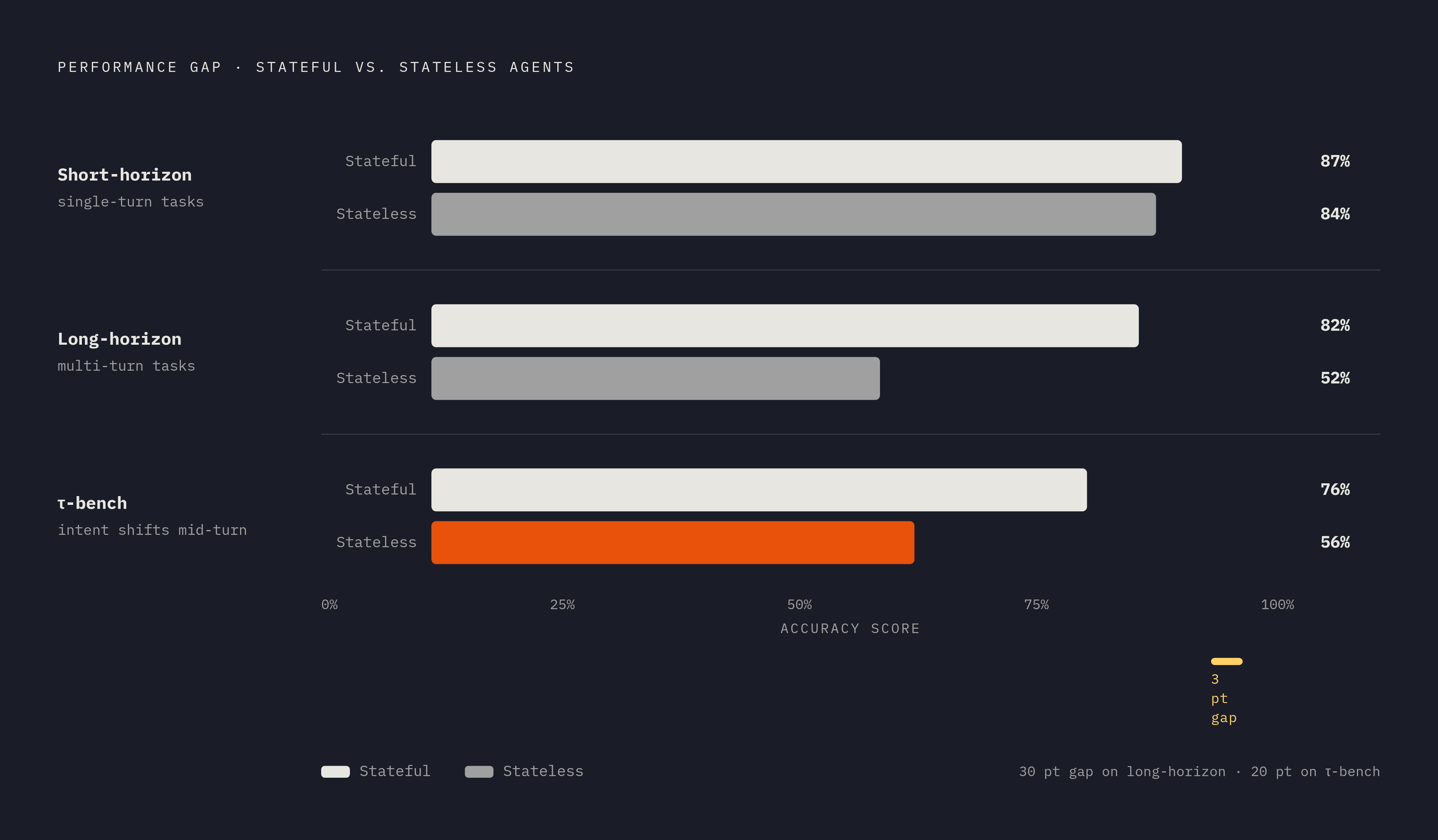
On short tool-use tasks, stateless designs hold up fine. Single call, single output, nothing to lose track of. The gap opens once tasks stretch across long horizons or many conversational turns, and once it opens, it isn't subtle.
On long-horizon software engineering tasks and multi-turn dialogue, the strongest stateful systems outperform the strongest stateless ones by roughly 20 to 40 percentage points on benchmarks built specifically to stress memory. The gap has to be pieced together from task-specific benchmarks rather than a single stateful-versus-stateless summary figure. One of the more telling is τ-bench, which simulates customer-service conversations where the user changes their mind partway through, the way real customers actually do. A stateless system that re-derives everything from the raw transcript on each turn loses somewhere between 15 and 25 points against a system that maintains an explicit belief state, updating a structured record of what's currently true rather than re-inferring it from scratch every turn.
None of this makes stateless design inferior in some general sense. For one-shot classification it's entirely sufficient, and bolting on state there is pure overhead with nothing to show for it. But once a task involves a change of intent, a correction, or context that has to span more than a couple of exchanges, the penalty for staying stateless is large, measurable, and grows with the length of the interaction.
Where the industry is, and the gap between deployed "agents" and production-grade stateful systems
Fifty-seven percent of organizations report agents running in production, up from 51% the year before, marking a genuine rise in adoption. That's real adoption, not hype cycle noise. Separately, 40% of enterprise applications are projected to feature task-specific AI agents by the end of 2026, up from less than 5% in 2025.
What's inside that 5% baseline is that most of the agents already counted as "deployed" are stateless. They handle single-turn tasks well, get logged as agent deployments, and never face the harder test of surviving a multi-step workflow with a failure somewhere in the middle. The jump from 5% to a projected 40% by 2026 is, at bottom, a state management story. The tasks enterprises actually want automated, case handling, multi-step approvals, anything spanning a day or a week, require durability that stateless architectures were never built to provide.
An agent that loses context halfway through a task, or can't recover cleanly after a crash, isn't something anyone lets run unsupervised. Trust, not raw model accuracy, is the actual threshold for whether something graduates from pilot to production.
The hybrid pattern, stateless frontends with stateful orchestrators
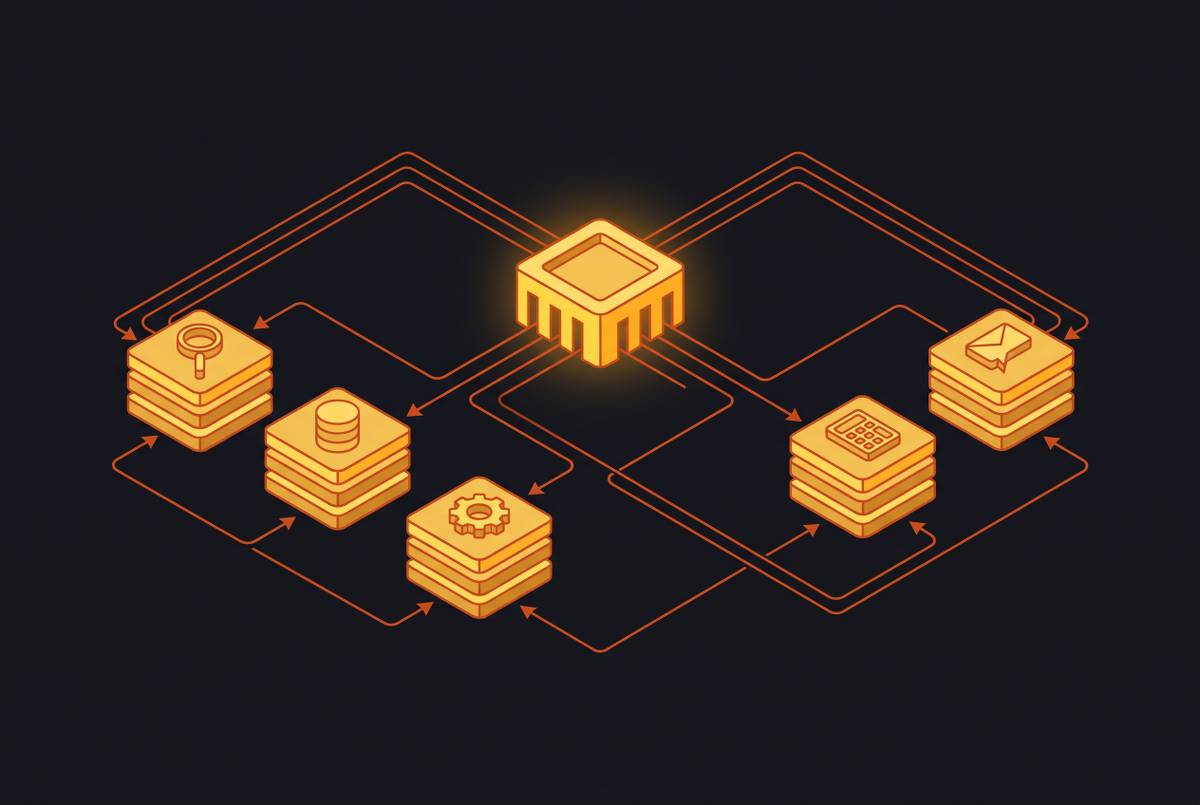
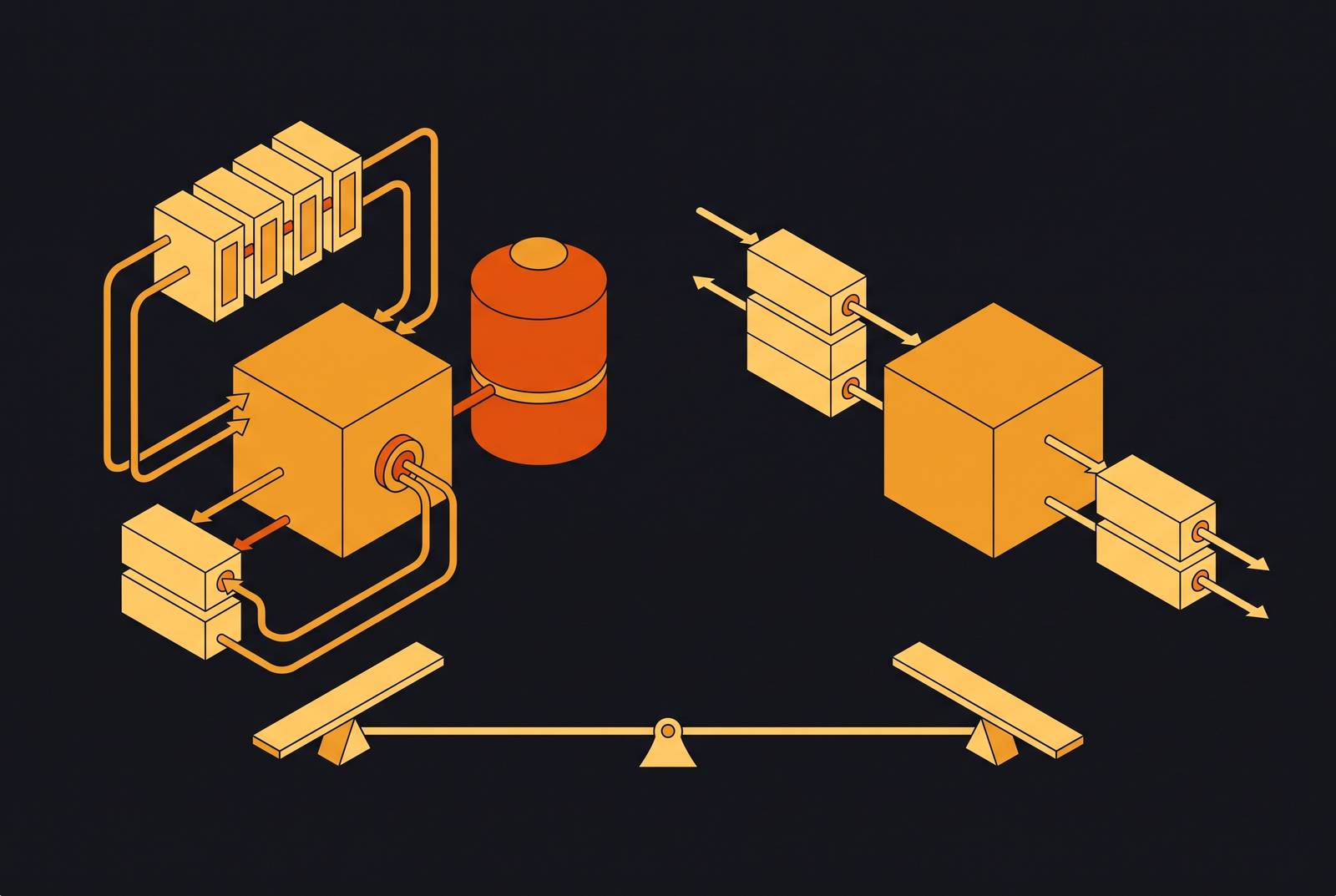
The pattern most production systems converge on splits the problem in two. A stateless frontend handles request routing and horizontal scaling, which is what stateless systems are good at. Behind it, a stateful orchestrator holds the task checkpoints, the belief state, and the tool outputs, which is what stateful systems are good at. Neither layer has to compromise on the thing it does well, and that's the whole point of splitting them.
The frontend keeps the simple load-balancer story: any node handles any incoming request, no session stickiness required. The orchestrator owns durability guarantees without worrying about scaling horizontally the same naive way, because it's solving a different problem. Modern AI platforms have largely settled into this shape, stateless services for scale, stateful agents for reasoning and continuity, and the major agent frameworks now build around that split rather than around one model or the other.
LangGraph structures state as a directed graph with built-in checkpointing, so agents resume from where they left off after a failure instead of restarting the whole graph. CrewAI offers higher-level state abstractions aimed at multi-agent collaboration, letting teams of agents coordinate with less low-level plumbing. AutoGen is oriented toward multi-agent conversational workflows, coordinating exchanges across several agents. Microsoft's Semantic Kernel provides agent orchestration capabilities for teams already inside that ecosystem. Four frameworks, four different abstractions, share one bet: state and orchestration need designing together, not bolted on after the fact.
Context engineering as the layer above state, how what the agent sees shapes what the agent does
Durable state solves the problem of having information available somewhere. It does not solve the separate problem of what actually gets pulled into the model's context window on a given call. Those are different problems, and confusing them is another common source of production failure.
Gartner flagged this shift directly, naming context engineering a defining change in AI application development for 2025 in a research note titled "Context Engineering Is In, Prompt Engineering Is Out." The discipline is about deciding, systematically, what a model gets shown at all, not about crafting a cleverer instruction. An agent at step 47 of a task carries the residue of steps 1 through 46, and the attention budget available to process all of it is finite. Most context failures at this stage of an agent's life don't trace back to a poorly worded initial prompt. They trace back to spending that finite budget on the wrong things.
Four building blocks do the actual work. Selection and filtering decide what makes the cut, using relevance scoring, recency weighting, and salience thresholds to keep low-value entries out of the window. Compression and distillation shrink what remains without losing its meaning, through extractive summaries, abstractive summaries, or key-value distillation that keeps the facts and drops the phrasing. Temporal management governs how context shifts across turns, drawing a line between short-term and long-term memory, session versus cross-session retention, and explicit forgetting or decay policies so stale entries don't linger indefinitely. Context assembly and ordering determine how everything composes inside the actual prompt: instruction hierarchy, where tool results land, and whether recent memory or foundational memory wins when the two compete for space. Get any one of these wrong, and durable state stops helping, because the model never sees the parts of it that actually matter for the decision in front of it.
What the agent's state needs from web knowledge
Stateful agents accumulate decisions, checkpoints, and task history, but the factual claims those decisions rest on have to stay current. A model's training data is fixed at a point in time, and no amount of internal state management substitutes for knowledge that's actually live.
Retrieval-augmented generation handles this with a retriever that finds relevant material, a reranker that orders it by relevance, and a generator that produces an answer grounded in what got retrieved. All three stages sit downstream of the knowledge source feeding them, so if that source is ungoverned, stale, or thin on real substance, no amount of tuning further down the pipeline fixes what comes out the other end. Retrieval quality is a ceiling, not a variable model improvements can raise by themselves.
The field is heading toward treating retrieval and state as converging systems rather than separate ones. Instead of a fixed retrieval pipeline sitting apart from an agent's memory, the emerging approach is agentic memory: a store the agent itself learns to consolidate and write to over time, rather than a static index queried the same way on every call. RAG itself is shifting from a narrow retrieval pattern into something closer to a broader context engine, one where intelligent retrieval is the core capability and structured knowledge, databases, graphs, gets handled alongside unstructured text rather than as an afterthought. State and retrieval used to get discussed as separate architectural concerns. Treating them that way now is a mistake.
Choosing the right pattern, a decision framework mapped to workload characteristics
This isn't a matter of taste. The right architecture follows directly from the shape of the workload, and four questions settle most of the ambiguity.
Task horizon comes first: is the work single-turn, or does it stretch across multiple steps? Stateless architecture is sufficient, and preferable, for isolated calls. It stops being sufficient the moment step ten needs to reference a decision made at step three. Failure recovery requirements come next: can a failure simply mean starting over, or does the system need to resume from where it stopped? Any workload requiring resumption needs durable checkpoints, full stop, because there's no way to fake resumption without them.
Concurrency model is the third dimension. A single agent working alone has very different requirements than a fleet of agents touching shared records at the same time. Multi-agent systems need isolation guarantees, a source of truth, and a way to stop one agent's write from silently erasing another's, and stateless architectures have no mechanism to provide any of it. Knowledge freshness closes the framework: does the agent act on facts that shift over time, pricing, inventory, current events, account status? If so, state has to pair with live retrieval, because state built on stale knowledge doesn't stay useful for long. It just decays quietly until someone notices the outputs have gone wrong.
Running a workload through those four questions honestly makes the stateless-versus-stateful decision mostly make itself. What's actually hard is building the state layer, the recovery logic, and the retrieval pipeline well enough that the choice holds up once real traffic, real failures, and real concurrent load hit the system all at once. Picking a side was never the difficult part.